
Finally, brethren, whatever is true, whatever is honorable, whatever is just, whatever is pure, whatever is lovely, whatever is gracious, if there is any excellence, if there is anything worthy of praise, think about these things. [Philippians 4:8 (RSV)]
My son, sweeten thy tongue and make savory the opening of thy mouth; for the tail of a dog gives him bread, and his mouth gets him blows. [Story of Ahikar]
 Last month, my husband and I attended a “Sweetheart” dinner at church. The men were in charge of the entire event and there were a few rough spots in the night. Then again, at the risk of being accused of political incorrectness or gender bias, most of the men probably were novices at that kind of event planning. Unlike the men, we women have had decades of organizing (and attending) school parties, PTA fund raisers, charity galas, birthday parties, showers, weddings, anniversary bashes, and other assorted celebrations. In spite of the glitches, there was much that went right and the evening was enjoyable and entertaining. Unfortunately, the woman sitting beside me kept criticizing how things were done—from name tags and table assignments to flowers and dessert. Her nit-picking comments became as annoying as the yapping of a bad-tempered dog and I thought of a bumper sticker I’d recently seen: “Wag More, Bark Less!”
Bad tempered dogs (and people) are nothing new; a similar proverb dates back to 500 B.C. in an Aramaic papyrus found in Egypt called the Story of Ahikar. “Wag More, Bark Less!” may be bumper sticker philosophy, but I wish more people (including me) did just that. After reading the qualifications and concerns of the candidates for our property association board, I was struck by how many were unpleasantly barking and nipping at each other rather than wagging their tails and showing me how well they’d work with one another and our management company. An on-line community newsletter was so filled with bark (and bite) that we stopped subscribing. Rarely are the letters to the editor in the newspaper anything but bark in the way of anger and criticism. While waiting at the bakery counter yesterday, an impatient woman yelled at the harried clerk and stormed away in a huff. Sometimes, it feels like we’re in a kennel full of angry upset dogs—yapping, baying, growling and snarling! Worse, once one dog (or person) starts barking, other dogs (and people) tend to join in the unpleasant clamor.
Like the woman beside me at that dinner, there are times I bark or snarl in disparagement, annoyance or anger rather than wag in happiness, appreciation, or compassion. In his letter to the Philippians, the Apostle Paul reminds us that we are responsible for what we put in our minds. Even in the bleakest of circumstances or worst of conditions, there is some small thing worthy of praise. Our job, as Christians, is to find it and think about it! Fortunately, we have the Holy Spirit to help us in that task. Moreover, as my mother used to say, “If you can’t say something nice, say nothing at all!” Thankfully, the Spirit gives us the self-control to do just that! If we can’t wag, at least we can muzzle ourselves so we don’t bark!
 For thousands of years, during their weekday morning prayers, observant Jews have worn tefillin. Sometimes called phylacteries, they are small black leather boxes attached to leather straps. Inside the boxes are four sections of the Torah from Exodus and Deuteronomy. The verses pronounce the unity of one God in what’s called the Shema, the promise of blessings for obedience and warning of retribution for disobedience, the obligation to remember the Jews’ bondage in Egypt, and the responsibility to transmit their faith to their children. One box is strapped on the left arm so to be near the heart and the other is strapped on the forehead. The placement symbolizes that God’s word is to be impressed upon both the heart and soul.
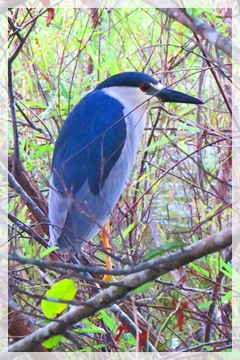 Yesterday I happened upon a wood stork enjoying a fish breakfast. I was astonished as the stork swallowed the whole wriggling fish in one big gulp. “I’ll have to put that in my gratitude journal,” I thought as I walked on. Later, I spotted two woodpeckers hammering away at a tree and got up close and personal with a pond snail laying eggs. Two more for the journal, I thought. Did I put those little blessings in my journal last night? Shamefully, I forgot to write in it at all; worse, I totally forgot about them in my nightly prayers!
 “How do you get to Carnegie Hall?” asks the comedian. “Practice, practice, practice,” is his answer. “Nothing ever comes to one, that is worth having, except as a result of hard work,” said Booker T. Washington, a man who truly knew the value of hard work. Most of us, having been raised with a strong work ethic, would agree with Washington’s words. If we want something we must work for it. If we want to be musicians, we practice; if we want to get on the team, we train; if we want a scholarship, we study. Success comes through determination and lots of hard work. We’ve heard all the maxims; there’s no elevator to success so we have to take the stairs. We know there’s no such thing as a free lunch, we must work our way up the ladder, and we’ve got to pull ourselves up by our bootstraps. Success is never handed to you and it’s only in the dictionary that success comes before work.
 While some might groan, others may cheer on this the first day of winter. I remember being asked my favorite season and, since we were skiing in the mountains at the time, I said it was winter. I loved it for the powder days on the slopes, pines laden with snow cookies, and aspens glistening with hoarfrost. Winter meant snuggling by the fire with a hot drink while watching the snow fall and the wind blow the trees. Then, I remembered that winter brings shoveling, cleaning off the car, cold toes, drippy noses, falling on the ice, and heating bills so I quickly changed my answer.
 Fortunately, the words to Vivaldi’s “Laudamus te” from his Gloria were shown on the screen in the front of the auditorium: “We praise you. We bless you. We adore you. We glorify you.” The soprano’s exquisite voice did that beautifully. When she was finished, I thought back to last summer when hiking in the Canadian Rockies. While gazing at the breathtaking scenery, I turned to my husband and said, “I’m singing at the top of my lungs—you just can’t hear me!” While relishing the splendor of a glacial lake and waterfall, I was silently singing the Doxology for a private audience and the One for whom I sang heard me loud and clear. Had I sung that song of praise aloud, however, it wouldn’t have sounded anywhere as pleasant as that soprano’s clear voice. Nevertheless, I think God enjoyed my song just as much.
 Devotions of the Heart