
Give thanks to the Lord, for he is good! His faithful love endures forever.
Give thanks to the God of gods. His faithful love endures forever.
Give thanks to the Lord of lords. His faithful love endures forever. [Psalm 136:1-3 (NLT)]
 Like many of the psalms, Psalm 136 opens with words of thanksgiving. Beginning with creation, this beautiful psalm reviews God’s goodness in regard to his people and encourages them to praise Him for his merciful and steadfast love. Where it differs from the other psalms of thanksgiving is that every line is followed by a refrain of “His faithful love endures forever.” From those first three verses, it continues giving thanks “to him who alone does mighty miracles. … who made the heavens so skillfully. … who placed the earth among the waters. … who made the heavenly lights … the sun to rule the day… and the moon and stars to rule the night,” with its refrain following each verse. The next 13 verses recount Israel’s’ history…bringing them out of Egypt, parting the Red Sea, leading his people through the wilderness, defeating Pharaoh’s army, striking down powerful kings, and giving the land to Israel. Psalm 136 tells us that life is neither random nor meaningless; we are not here accidentally. Our lives are meticulously planned and intelligently designed.
The psalm’s author is unknown, but Scripture tells us that, when the Ark of the Covenant was brought to Jerusalem, David appointed the Levites to write a psalm of thanks because God’s “faithful love endures forever.” This psalm was also sung at the Temple’s dedication and at the three pilgrimage festivals. I picture the people gathered together in the Temple courts. While a priest or Levite sang a reason to thank God, the entire congregation answered with, “His faithful love endures forever!” Accompanied by trumpets and cymbals, it must have been an amazing sight to behold!
Although it never uses the Hebrew words “hallelu jah,” meaning “praise the Lord,” this psalm is called “the Great Hallel” (or Great Psalm of Praise) by our Jewish brothers and sisters. In traditional congregations, it is recited or chanted during the verses of praise on Shabbat/Sabbath morning services. Additionally, along with the “Egyptian Hallel” (Psalms 113 through 118), it is sung at the conclusion of the Passover Seder.
God, however, didn’t stop being good to His people some 3,000 years ago. For the 21st century Christian, there’s no reason to stop praising God’s goodness at twenty-six verses. Think of all the lines we could add to this Psalm. Verses like, “He sent his one and only Son, to give His life as ransom for sinners. His faithful love endures forever. Everyone who believes in him will not perish but have eternal life. His faithful love endures forever.” Consider how long the psalm would be!
When I read this psalm, however, I revisit the many ways God has personally shown me how “His faithful love endures forever.” I think of the people He’s placed in my path and the often fortuitous timing of their placement, the blessings of children and grands, the years He’s given me, the many ways He protected me from others and from myself, the healing of broken relationships, the restoration of health, His guidance, and His unending love, along with the many little blessings of life—things like sunshine, rainbows, chocolate, laughter, music, and butterflies! Indeed, “His faithful love endures forever.”
The refrain of “His faithful love endures forever” is repeated twenty-six times in this psalm. It could be repeated 2,600 times and that wouldn’t be enough. Regardless of what we give to the Lord in the way of time, talent, or tithes, He always gives us more. When life takes a downturn, as it often does, may we recall God’s past blessings and claim the promise that, “His faithful love endures forever.”
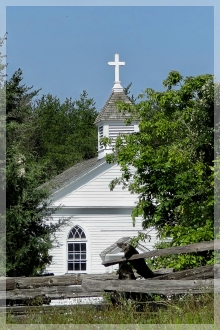 Since her church attendance is limited to Christmas and Easter, with an occasional funeral or wedding thrown in, a neighbor describes herself as being a “Birth and Resurrectionist.” People like her are often categorized as “nominal” or “non-practicing” Christians. Granted, church attendance is not the litmus test for Christianity. Nevertheless, lack of church attendance indicates a lack of commitment and a token or non-practicing faith. While such people identify as “Christians,” their Christianity is a more a matter of culture, habit, or tradition than one of faith, creed, and rebirth.
 Every year a friend sends me a bayberry candle to burn on New Year’s Eve. Legend has it that lighting a bayberry candle when the first star appears, burning it past midnight into the new year, and letting it burn all the way down will bring good luck, wealth, and prosperity to a home. We can’t stay awake past midnight and allowing an unattended candle to burn down to its socket seems more a guarantee of fire and disaster than good luck. Nevertheless, in honor of our friend, we light our candle every New Year’s Eve and extinguish it shortly after the new year begins in Greenland (three time zones east).
 With just one week until Christmas, we may find ourselves sorely tempted to repeat Scrooge’s “Bah, humbug!” We’ve been busy with planning, cooking, baking, cleaning, decorating, shopping, wrapping, packing, and shipping; chances are that our expectations have become unrealistic and impossible to achieve. It’s easy to get so wrapped up in doing and getting that we forget the purpose of this wonderful holiday.
 I began my prayer with the words of John Baille found in A Diary of Private Prayer. He opened the prayer by praising the “Lord and Maker of all things” for things like “the life that stirs within me” and “the bright and beautiful world around me.” But it was the inclusion of “all you have given me to fill my hours of leisure…music and books and good company and all the harmless and delightful pleasures” that gave me pause. How often do we offer praise and thanksgiving for “leisure” and the “delightful pleasures” of life? Do we regularly praise and thank Him for the taste of strawberries, the scent of lilacs, the joy of making love, napping in a hammock on a summer day, enjoying a latte and a fresh-baked almond croissant, completing a sudoku or crossword puzzle, a good workout at the gym, a game of mahjong or golf with friends, snuggling on the sofa with the cat, eating s’mores around a campfire, playing Crazy 8’s or Uno with the kids, binge watching Netflix on a rainy day, or warm apple pie with vanilla ice cream? Each of us has our favorite leisure activities and sources of pleasure and yet pleasure is not one of the words typically associated with Christian belief. In fact, many consider pleasures to be the devil’s tool used to keep us from a godly life!
 Devotions of the Heart