
Dear brothers and sisters, when troubles of any kind come your way, consider it an opportunity for great joy. For you know that when your faith is tested, your endurance has a chance to grow. So let it grow, for when your endurance is fully developed, you will be perfect and complete, needing nothing. [James 1:2-4 (NLT)]

“May the Holy Spirit give us grace to not begrudge the pedagogy of God,” wrote John Piper. Pedagogy being a somewhat archaic word, I was unsure what Piper meant. Associating pedagogy with an old, boring, stodgy, and authoritarian teacher, I thought it wise to consult the dictionary. “Pedagogy” comes from two Greek words: pais, meaning child, and agogos, meaning leader. A paidagogos was a slave who led the boys to and from school, taught them manners, and tutored them after school. “Pedagogy” eventually came to mean the method and practice of teaching and “pedagogue” to mean teacher. While God is neither boring nor stodgy, He is older than time and an authoritarian (but loving) teacher with some unique, innovative and often challenging teaching methods or pedagogy.
I don’t know about boys in ancient Greece, but I imagine they were like boys today: often less than enthusiastic about learning their lessons, spending time in a classroom, and being taught restraint, civility, and good behavior. Like schoolboys, we are often less than enthusiastic about learning the lessons God is teaching us. Sometimes life seems bizarre or unreasonable and other times it’s downright difficult or heartbreaking; almost all of the time it’s hard to understand. It’s easy to begrudge the way God teaches us.
I think of a scene from the movie Peggy Sue Got Married in which the middle-aged Peggy Sue goes back in time to high school. When asked to solve a problem in algebra class, she responds, “I happen to know that, in the future, I will not have the slightest use for algebra, and I speak from experience.” I agree with Peggy Sue—once out of school, I had no need to know about coefficients, variables, constants or exponents. But, I didn’t know that when I took freshman algebra more than half a century ago.
We are finite beings and can only see what is right before us. God, however, is infinite and can see far into our future both here and in the hereafter. When He teaches us lessons about patience, humility, loss, conflict resolution, pain, worry, pride, fear, trust, obedience, persistence, and faith, we rarely know for what purpose we’re in His schoolroom or when we’re going to need the skill we’re being taught. God’s pedagogy only makes sense when we look back in time. It is then that we realize the benefit we’ve gained from His extraordinary and often bizarre teaching methods. Indeed, as John Piper said, “May the Holy Spirit give us grace to not begrudge the pedagogy of God.”
I never had a trial I wanted to have, but I never had trial I wasn’t glad I had. [Jack Hyles]
 But the wisdom from above is first of all pure. It is also peace loving, gentle at all times, and willing to yield to others. It is full of mercy and the fruit of good deeds. It shows no favoritism and is always sincere. And those who are peacemakers will plant seeds of peace and reap a harvest of righteousness. [James 3:17-18 (NLT)]
 Our sermon series was titled “Cage Fighting” but, rather than learning about fighting one another, we were learning about the ways Satan attacks and keeps us in his stronghold with things like shame, doubt, fear, and unforgiveness. While chatting with the pastor before church, I asked about the day’s topic. When he said offense, I immediately thought we’d learn how to take offensive action against the enemy.
 It was the first night of a new small group study and, as we gathered our books to leave, one woman said she’d have to read more about the author since he sounded like a Calvinist. Believing that everyone has the God-given ability to choose God’s grace, she didn’t want to participate in the class if the book’s author believed that, in the past, God chose some among mankind for His own and that that Christ died only for those elect.
 For I am the Lord, your healer. [Exodus 15:26b (RSV)]
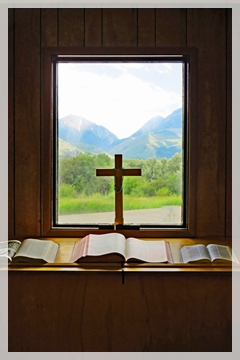 Before the incarnation of Christ, God dwelt first in the tabernacle and then in the temple. The innermost room of the temple was called the “Most Holy Place” and it was in this inner room that God’s glory was said to dwell. This was where the Ark of the Covenant was kept and where the high priest came with a sacrifice to atone for his and the nation’s sins every year. With the incarnation of Jesus, God no longer dwelt in the temple but in the flesh of His son and, for a brief time, God actually walked among His people. Yet, when Jesus lived as a man, only a few people at a time could be in His presence. With His death, there is no yearly atonement ritual because Jesus atoned for our sins once and for all. Moreover, because of His resurrection, ascension, and the presence of the Holy Spirit, it is possible for countless people, everywhere, to be in His presence at the same time. Once we become believers, the Holy Spirit moves into our hearts and each one of us, as members of Christ’s church, become part of His body and the temple of God.
 Devotions of the Heart