
So Cain left the Lord’s presence and settled in the land of Nod, east of Eden. Cain had sexual relations with his wife, and she became pregnant and gave birth to Enoch. Then Cain founded a city, which he named Enoch, after his son. [Genesis 4:16-17 (NLT)]
 Our pastor often says that the hardest part of giving his sermon is afterwards when someone asks him a question. I understood what he meant after finishing my sermon last Sunday. Opening our series on women in the Bible, I’d spoken about Eve. After service, a woman pulled me aside and said she’d always had trouble understanding how Cain, after being banished and settling in the land of Nod, could find a wife there. If Adam and Eve were the first parents, where did those people in Nod come from?
Skeptics of the Bible often use the identity of Cain’s wife in an attempt to discredit the book of Genesis. Sunday’s question came from two common misconceptions. The first occurs because only three of Adam and Eve’s children are named in Scripture and they’re all boys. Cain’s and Able’s births are recorded first and then Seth’s when Adam is 130 years old. We know Adam lived another 800 years after Seth’s birth and that “other sons and daughters” were born, but we’re not told when that happened. Scripture never says that Cain and Able were the only children born in the first 130 years and simple logic tells us that Adam and Eve did not average only one child every 43 years. Several more unnamed children had to have been born both before and after Seth’s birth. By the time of Cain’s banishment, the first couple probably had grandchildren, great-grands, and even great-great-grands. Assuming that about half of them were female, Cain had several women he could have married.
Of course, that means those early men married their sisters and, later, their nieces and cousins. Today, we gasp at the thought of incest but it wasn’t condemned in the beginning. While God’s command to leave one’s parents in marriage prohibited parent-child marriage [Genesis 2:24], His law against other intermarriage wasn’t given until thousands of years later when Moses recorded it in Leviticus. [Lev. 18:6] Remembering that Adam and Eve were perfect, with flawless DNA, and lived in an unpolluted environment, the danger from genetic defects with inbreeding was minimal in the beginning. Given the few number of people and the tribal structure of ancient society, intermarriage couldn’t be avoided. The righteous Abraham married his half-sister Sarah, Isaac married his cousin Rebecca, Jacob married his cousins Leah and Rachel, and Moses’s father married his aunt.
The second misconception is that Cain met his wife in the land of Nod; Scripture, however, never tells us that. The event that took place in the land of Nod was Cain having sex with his wife and getting her pregnant; an entirely different matter. Moreover, Scripture never tells us how old Cain and Abel were when Cain murdered his brother. Since Adam was already 120 by that time and the brothers worked as a shepherd and farmer, it’s logical to think they were grown men and already had families of their own. That Cain was frightened after killing Abel and needed a mark from God to protect him, would indicate that he feared repercussions from Abel’s line. In answer to the woman’s question, Cain brought his wife (who was most likely his sister) with him to Nod. Since he founded a city there, he probably brought several people in his clan with him.
We sometimes think that the Bible should read as concisely and unambiguously as an American history text; it simply doesn’t. Moreover, we must be careful of assuming that because someone or something isn’t mentioned that they didn’t exist. That there are only three birds in today’s picture doesn’t mean there were only three birds at the beach any more than only three boys’ names means there were only three sons. We can’t even assume that Abel was the second son. We only know that he came after Cain but how much after and whether there were other children in between, we don’t know. Perhaps his name is mentioned only because he was later murdered by his brother.
In the infamous Scopes trial, William Jennings Bryan was questioned by Clarence Darrow about the origins of Cain’s wife. Bryan was defending the Bible and yet this church elder had no idea where Cain got his wife and couldn’t even answer whether or not other people were on the earth at the time. Let’s do a better job than the famed lawyer in defending the Word of God! Of course, to defend it, we must first read it!
 There’s a therapeutic riding center across the highway from one of the churches we attend. Along with horses, barn cat, and dog, they have a rooster. No matter what the time of day we’re there, that rooster crows. Every time I hear that bird’s loud “cock-a-doodle-do!” I remember Jesus’s words to Peter and ask myself, “Have I denied my Lord today?”
 I don’t want Satan to outwit us. After all, we are not ignorant about Satan’s scheming. [2 Corinthians 2:11 (GW)]
 Yesterday, I wrote about Cyrus Teed, the Koreshan Unity, their strange theology, and Cellular Cosmogony: the belief that the earth is a hollow shell and the entire universe exists inside that shell. Whether he was a charlatan or insane fanatic, Cyrus Teed claimed to be immortal. When he died in 1908, his followers kept his body in a bathtub for five days and waited for his resurrection. Rather than rising, Teed began to stink and authorities forced his corpse to be buried. Nevertheless, many of his followers faithfully waited another thirteen years for his return.
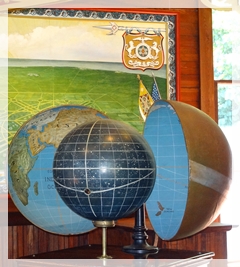 Just north of us is a state park that once was home to a group called the Koreshan Unity. In 1894, Dr. Cyrus Teed, known as the Prophet Koresh, brought about 250 of his followers to the banks of the Estero River where they hoped to establish a “New Jerusalem.” The Koreshans believed that the Bible needed prophets to interpret it and that Teed was the seventh in a line of biblical prophets. As the designated prophet, Teed would reveal everything about the universe that Jesus failed to explain. Taking verses out of context from both testaments of the Bible, the Koreshans believed in reincarnation, communal living, heaven and hell, immortality, and celibacy.
 We recently saw a stage production of Les Miserables (“Les Miz”), a musical based on Victor Hugo’s novel. Set in France in the early 1800s, it tells the story of Jean Valjean, a man who spent 19 years in prison for stealing a loaf of bread to feed his starving family. When Valjean, known as “Prisoner 24601,” is released, he is issued a “yellow passport” which he’s required to present to the police in any village he passes through. Stating he has been released from prison but listing his crimes, this yellow piece of paper marks him as a criminal forever.
