
So I say to you: Ask and it will be given to you; seek and you will find; knock and the door will be opened to you. For everyone who asks receives; the one who seeks finds; and to the one who knocks, the door will be opened. [Luke 11:9-10 (NIV)]
 In the comic strip Peanuts, drawn by Charles Schultz, Linus and Lucy van Pelt are brother and sister who, like many siblings, often fight. For several days last week, Lucy tried to convince Linus to give her a Christmas gift. When she insisted the giving of Christmas presents is in the Bible, he called her bluff saying, “You can’t fool an old theologian.” Two days later, while Lucy searched in the Bible, she exclaimed, “I found it!…The word ‘sister’ in the Bible!…That proves you have to give me a Christmas present!” Her little brother merely sighed, “Oh, good grief.” While not as blatant as Lucy, we often find people taking Scripture out of context to justify their own meaning.
Luke 11:9-10 may be the most misinterpreted verse, especially by those who preach a “prosperity gospel” version of Christianity. At first glance, “ask and it will be given” sounds like God runs an Amazon wish fulfillment center in Heaven. Mercedes, check…winning lottery ticket, check…40-foot boat, check! By ignoring the verse’s context, people miss its meaning. Jesus’s reassurance of answered prayers follows the prayer model given to His disciples in what we know as “The Lord’s Prayer.” The requests in this perfect prayer are that God’s name be kept holy, His Kingdom will soon come, for the day’s food, for forgiveness, and not yielding to temptation. Jesus didn’t ask for a new robe, a purse full of money, or a chariot to transport him on His travels! He asked for what was needed to serve God. Following His prayer, Jesus told a parable about a persistent man who boldly begged his neighbor for bread because he had a visitor and no food for him to give him. Jewish culture demanded that hospitality be offered to travelers and the entire village’s reputation was a stake if kindness was not extended. The man didn’t ask for a jug of vintage wine or a newly slaughtered lamb. He asked for the bare minimum: 3 loaves (each about the size of a pita) for a hungry guest so he could abide by the law of hospitality. Looking at Luke 11:9 in context makes it clear that Jesus’s words were not an invitation to “name it and claim it” from God’s vending machine. We wouldn’t open a novel and read a few random sentences and think we know what the story is saying but, like Lucy, we tend to do that with Scripture.
As it turns out, having forgotten about forgiveness, Linus was no better a theologian than his sister. Had Lucy read that Bible more carefully, she could have made an excellent argument for receiving a gift (and even used a verse that included the word “sister”). Linus’ refusal to give Lucy a Christmas present was because she punched him in the face several days earlier. After putting the verse in context, Lucy should have quoted Matthew 18:34-35. When Peter asked if he should forgive someone up to seven times, Jesus replied seventy times seven times and told the parable of the unmerciful servant. After the king forgave his servant’s enormous debt, the man refused to forgive a small debt owed to him and threw the debtor in prison. Upon discovering his servant’s lack of mercy, “In anger his master handed him over to the jailers to be tortured, until he should pay back all he owed. This is how my heavenly Father will treat each of you unless you forgive your brother or sister from your heart.” [Matthew 18:34-35] Using Scripture properly might have gotten Linus to rethink his position and Lucy her present!
George Bernard Shaw said that, “No man ever believes that the Bible means what it says: He is always convinced that it says what he means.” That should never be true of a Christian. We’re not trying to convince a little brother to give us a Christmas gift; we’re sharing the Gospel message. Let’s make sure we do it right!
 Years ago, we were acquainted with “Henry, dear” and “Mary, darling.” We called them that because we never heard them refer to one another any other way. They always were so sweet and charming in public that halos seemed to hover over their heads. My husband and I often wondered what they called one another behind closed doors and, as we got to know them better, we realized our wariness was well-founded. As noble as they appeared in public, there always seemed to be an ulterior motive behind their kindness and, while “Henry, dear” was patting your back, his other hand probably was reaching into your back pocket. While we never knew what they called one another in private, we knew that what the public saw was not what they actually got.
 There was a bit of a kerfuffle behind us during church last week; it started during the Old Testament reading and continued to the Gospel. As best as I can figure, a bottle of water had leaked onto the pew. The women behind me sat on the damp cushion and made quite a production of detecting, discussing, and complaining about it first to her husband and then to her neighbor (whose water it had been). There was room enough to move down in that pew and plenty of other pews (with dry cushions) available, but the couple never moved. Nevertheless, throughout the rest of the service, I felt the woman’s breath on my neck every time she exhaled another loud sigh of misery.
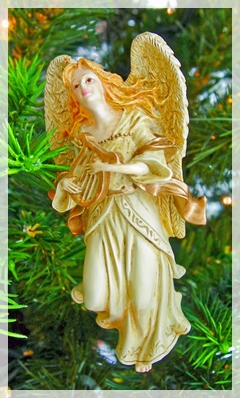 It’s no wonder that the angel Gabriel told Mary not to be afraid. Angels were not an everyday occurrence and, when they arrived, lives were changed. As God’s messengers, angels sometimes brought good news, offered protection, or comforted people, but they also brought warnings and executed God’s judgment. Although angels rescued Lot, they also warned of Sodom’s destruction! Balaam received a stern warning from a sword-bearing angel, David wrote of destroying angels, and 2 Samuel tells of an angel nearly destroying Jerusalem. Mary’s initial confusion and concern at seeing an angel is understandable. When reassuring the girl, Gabriel tells her she is “highly favored” by God; he’s not brought bad news, but good. Nevertheless, she knows her life is going to change; she just doesn’t know how!
 My Advent devotional suggested taking a prayer walk while looking for signs of hope. I took my regular route and, since I often pray while walking, I wasn’t sure how this walk would be different. Nevertheless, I went in search of hope. The first thing I noticed was the sun rising in the east—a sure sign of hope with its promise of a new day and all of its possibilities. I spotted a family of ducks waddling down to the pond. The five youngsters were no longer little yellow fluffs of feathers but mama duck still kept her eyes on them. Mothers of every species hope to keep their children safe—even when they’re no longer children! I noticed the lilies, canna, and arrowhead that had been planted at waters’ edge last spring to prevent shoreline erosion. They were starting to bear their first flowers—another sign of hope because it means they took root and will serve their purpose. A few people had decorated their houses for the holiday; since not all the décor was secular, I found hope that some people still keep Christ in Christmas. Further on, a patient great blue heron stood absolutely still, neck fully extended, hoping to catch a tasty fish breakfast. It reminded me that we must remain patient in our hope—all things in God’s time. Seeing a few wood storks wading in the water also was a hopeful sign; once an “endangered” breed, their status has been upgraded to “threatened,” meaning there is hope for the survival of their species.
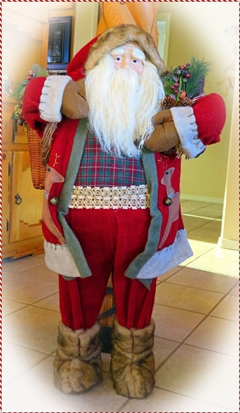 The National Retail Federation estimates that Americans will spend between 727.9 and 730.7 billion dollars on Christmas gifts and merchandise between November 1 and the end of the year. If they’re correct, we’ll have spent nearly $95 for every one of the 7.7 billion people on earth (most of whom won’t get any of those purchases). It’s ironic that a day set aside to honor the birth of Jesus, the Savior who sacrificed His life for us, has become a frenzied season of obtaining and consuming.
 Devotions of the Heart