DOWN BUT NOT OUT

No one lights a lamp and then hides it or puts it under a basket. Instead, a lamp is placed on a stand, where its light can be seen by all who enter the house. Your eye is like a lamp that provides light for your body. When your eye is healthy, your whole body is filled with light. But when it is unhealthy, your body is filled with darkness. Make sure that the light you think you have is not actually darkness. If you are filled with light, with no dark corners, then your whole life will be radiant, as though a floodlight were filling you with light. [Luke 11:34-36 (NLT)]
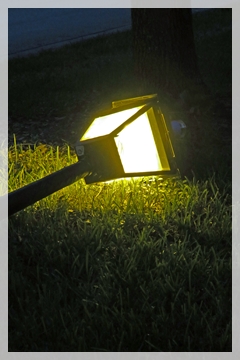
broken lightTo avoid the southwest Florida heat, I waited until dusk to take my walk. Thanks to Hurricane Irma, most of the street lamps in my neighborhood don’t work. For a light to function, electrical energy has to be converted into light energy and both a source of electricity and a working connection are needed. For many of the lights, the connection was broken when blowing debris shattered their bulbs. For others, Irma’s 150 mph winds broke the connection when it blew off their tops, wrapped their poles around trees, or knocked them to the ground. Without a connection to their source of power, those street lights are useless—they’re just a tangle of wires and a pile of glass, plastic and metal. Even though they don’t work, people have been cautioned to remember that their exposed wires are live. It’s not the electricity that is missing; it’s the connection that is inoperative. Two poles, however, were down but not out. Even though they’d been flattened by the storm, neither wires nor bulb had broken. In spite of the storm’s violence, they remained connected and were beacons in the night’s darkness.

When the storms of life batter us and knock us down, like those street lamps, we can lose our connection, not to electricity, but to God. Our minds may get so caught up in anger, worry, fear, depression, or self-pity that we become separated from our true source of power—Jesus. He told us to let our lights shine but we can’t shine if we’re not connected to Him. When our lives go dark, we should remember that God hasn’t gone anywhere—like the electricity, He’s still there. We’re the ones who are broken. Unfortunately, no Florida Power & Light truck is going to arrive and reconnect us to God.

Reconnecting is a choice we have to make. Reconnecting is trusting God and ceding to His will. It is prayer and reading the Bible; it is praise, thanksgiving and worship. Reconnecting is turning to God and choosing joy over misery, light over darkness, love over hate, forgiveness over rancor, peace over anger and service over selfishness. Fortunately, we’re not alone in this. We may not have FP&L but we have something more powerful (and far more dependable)—the Holy Spirit! If we allow Him, He will reconnect us to the light of the world. We may be down, but we don’t ever have to go out! By His power, our lights can continue to shine.

Remember this. When people choose to withdraw far from a fire, the fire continues to give warmth, but they grow cold. When people choose to withdraw far from light, the light continues to be bright in itself but they are in darkness. This is also the case when people withdraw from God. [Augustine]
And now I will send the Holy Spirit, just as my Father promised. But stay here in the city until the Holy Spirit comes and fills you with power from heaven. [Luke 24:49 (NLT)]

Jesus spoke to the people once more and said, “I am the light of the world. If you follow me, you won’t have to walk in darkness, because you will have the light that leads to life.” [John 8:12 (NLT)]

Copyright ©2017 jsjdevotions. All rights reserved.

OUR FOUNDATION

In that day he will be your sure foundation, providing a rich store of salvation, wisdom, and knowledge. The fear of the Lord will be your treasure. [Isaiah 33:6 (NLT)]

Dear God, what misery I beheld! The ordinary person, especially in the villages, knows nothing about the Christian faith, and unfortunately many pastors are completely unskilled and incompetent teachers. [Martin Luther]

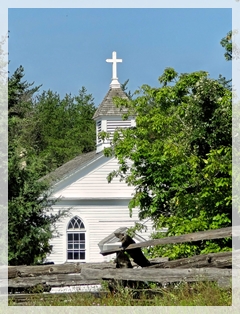
Old World Wisconsin churchYesterday I mentioned getting an email with the subject, “How firm is your foundation?” Although it was an advertisement for a new study Bible connecting Biblical teachings to Christian beliefs, that very question has been the topic of discussion in our northern church for the last few weeks. The parish is doing a church-wide study of Martin Luther’s Small Catechism. Back in the 1500s, Martin Luther was appalled at the lack of knowledge of both pastors and their congregations. Not especially tactful, he accused some pastors of being “lazy bellies and presumptuous saints!” His words for their congregations, “simple cattle and mindless pigs!” were no more diplomatic. People who called themselves Christians had no idea what that meant. They didn’t know the Ten Commandments, the Apostle’s Creed or even the Lord’s Prayer, let alone anything else in the Bible. Last week, our Pastor asked us what Luther might say if he visited today’s churches. We agreed that his words for our pastors would be more complimentary but that his words for their congregations might be the same or worse!
To remedy the deplorable lack of knowledge he found, Luther wrote his Small Catechism in 1529. This little book of Christian instruction was written not for theologians and priests but for ordinary people. It covers the Ten Commandments, the Apostle’s Creed, the Lord’s Prayer, Holy Baptism, confession, Holy Communion, daily prayers and even offers a Household Chart of Bible passages describing the duties of people in various walks of life. Much of the catechism is done in question and answer form with the answer succinctly provided. For example, after listing the first commandment, it asks, “What does this mean?” and then explains: “We are to fear, love, and trust God above all things.” In short, Luther’s Small Catechism is a 16th Century version of Christianity for Dummies. Surprisingly, given its age, it is amazingly straightforward. Without theological minutia or argument, it is easily understood and certainly not limited to the Lutheran church.

This brings me back to the question that appeared in my email yesterday, “How firm is your foundation?” Do you know and understand what it is you profess to believe? Do you know why you believe it? How firm is your foundation?

How firm a foundation, ye saints of the Lord,
Is laid for your faith in His excellent Word!
What more can He say than to you He hath said,
You, who unto Jesus for refuge have fled? [John Rippon]

Anyone who listens to my teaching and follows it is wise, like a person who builds a house on solid rock. Though the rain comes in torrents and the floodwaters rise and the winds beat against that house, it won’t collapse because it is built on bedrock. But anyone who hears my teaching and doesn’t obey it is foolish, like a person who builds a house on sand. When the rains and floods come and the winds beat against that house, it will collapse with a mighty crash. [Matthew 7:24-27 (NLT)]

Copyright ©2017 jsjdevotions. All rights reserved.

IF SOMEONE ASKS

And if someone asks about your hope as a believer, always be ready to explain it. [1 Peter 3:15b (NLT)]

Yesterday, I echoed Paul’s words that, when witnessing, we need to speak our words with love. Of course, before that can happen we need to speak and, therein lies our problem. To speak, we need words and most of us are sure we don’t have them. Granted, the way we conduct ourselves is a continuous sermon but, if we never speak, no one will know what makes us the way we are. Actions may speak louder than words but that doesn’t mean words aren’t necessary.

We don’t have to go knocking on doors, stand on street corners with a sign, accost strangers, or go on a mission trip; we just have to be open to the opportunities that arise nearly every day to share our love of God. Peter instructed us to be ready to explain the reason for our hope; I think we’re asked that question more than we realize. There’s a good chance people have commented on your joy, peace, or calmness. In all likelihood someone may have said something like, “How do you do it?” or, “You don’t seem to worry,” or even, “I wish I had your life!” In reality, that person is asking about the source of your hope. Rarely have my answers to such comments revealed the true source of that hope, strength, peace and joy. I’ve chosen the innocuous reply rather than the true one simply because I didn’t think I had the right words to explain! When Jesus told us to go out into the world and be His witnesses, He promised we wouldn’t have to do it alone. Since the Holy Spirit will empower us to be His messengers, let’s allow Him to do His work! We can’t speak with love until we speak!

God forbid that I should travel with anybody a quarter of an hour without speaking of Christ to them. [George Whitefield]

But this will be your opportunity to tell them about me. So don’t worry in advance about how to answer the charges against you, for I will give you the right words and such wisdom that none of your opponents will be able to reply or refute you! [Luke 21:13-15 (NLT)]

Copyright ©2017 jsjdevotions. All rights reserved.

STORMS

God is our refuge and strength, always ready to help in times of trouble. So we will not fear when earthquakes come and the mountains crumble into the sea. Let the oceans roar and foam. Let the mountains tremble as the waters surge! [Psalm 46:1-3 (NLT)]

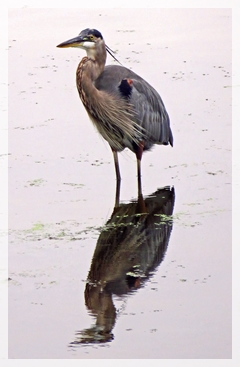
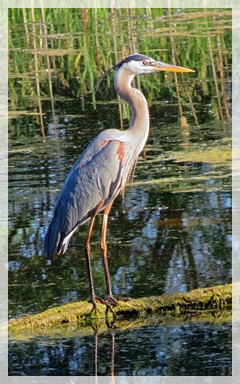
great blue heronThe damage done by Hurricane Harvey seemed unbelievable until Irma hammered the entire state of Florida. Fortunately, our Florida home was prepared and we were safely situated in the Midwest during Irma’s tirade. Would that all the storms of life announced themselves a week in advance to give us time to put up storm shutters and evacuate to safety.
Unfortunately, most of life’s storms are more like tornadoes and hit with little or no warning. Yesterday, sixteen years after 9/11, we were again reminded how unpredictable and precarious life can be. Plywood, sand bags, flashlights, batteries, generators, and stores of fuel, water, and canned goods are of no use when a plane crashes into a building, a spouse has a disabling stroke, a car careens into a crowd, or a stray bullet hits. Addiction, Alzheimer’s, job loss, divorce, cancer, mental illness or a drunken driver don’t warn us before wreaking havoc with our lives. We cannot escape from life’s tempests and trials and they can be far more destructive than any hurricane with its accompanying storm surge.

Someone asked if I had a digital record of our property and another if I was worried about losing anything. Possessions were the least of my concerns; “It’s just stuff!” was my response. We did our best to protect our Florida home and belongings but they are things. I can’t take them with me at the end so, if I lose them now, what difference does it really make? Perhaps I’m being cavalier; it’s our second home so, even if everything is destroyed, I still have a place to rest my head. Nevertheless, although most of those affected have only one home, the same holds true for us all; it really is just stuff. Eventually, power will be restored and homes and businesses will be rebuilt; life goes on.

The question about what I didn’t want to lose got me wondering about my answer—if not house and possessions, to what am I attached? The answer is my faith and relationships, neither of which can be insured or replaced. In the last few days I’ve heard from friends far and near, checking on us and offering their help. These are people who already have more than enough on their plates and yet they offered us both moral support and helping hands. I would mourn losing relationships like those far more than anything in my houses. As for my faith, I’d like to think it will take more than a hurricane or even a terrorist attack to topple it.

Our Florida home was built to withstand a hurricane and should have survived the storm’s onslaught; I don’t yet know. The more important question is whether my faith and relationships can survive the sort of pounding that Irma inflicted on Florida. Are they strong enough to survive gale force winds? Rather than taking pictures of stuff, shuttering the windows or putting furniture up on blocks, what am I doing to reinforce and protect both my faith and relationships to make sure they survive whatever storms come my way?

Heavenly Father, thank you for keeping us strong during life’s storms. Let your written word and the Spirit’s voice bolster us when we start to waver in the wind. Thank you for the gift of friends and family—the people who love and strengthen us so we can survive the squalls, challenges, and losses of our troubled world. Help us be the kind of friends who can be counted on to encourage, reinforce and sustain those around us.

Two people are better off than one, for they can help each other succeed. If one person falls, the other can reach out and help. But someone who falls alone is in real trouble. Likewise, two people lying close together can keep each other warm. But how can one be warm alone? A person standing alone can be attacked and defeated, but two can stand back-to-back and conquer. Three are even better, for a triple-braided cord is not easily broken. [Ecclesiastes 4:9-12 (NLT)]

Copyright ©2017 jsjdevotions. All rights reserved.

MASTER WEAVERS

And we know that God causes everything to work together for the good of those who love God and are called according to his purpose for them. [Romans 8:28 (NLT)]

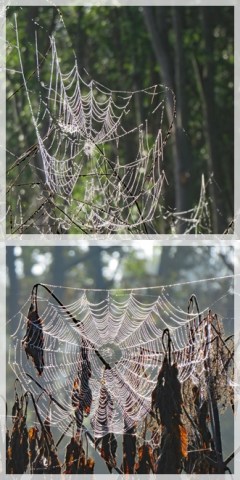
spider websIt rained last night. During our early morning walk, we looked out over the prairie and saw hundreds of sparkling spider webs. As the morning sun caught the water droplets on the silk, the master weavers’ work glistened in the mist. Although we take that trail several times a week, it was the first time this season we saw those arachnidan works of art. The spiders didn’t start spinning just the previous night; their webs have been there all summer but weather and light conditions kept us from seeing them. In fact, had we chosen to walk the loop in the other direction, we never would have seen them at all!
God, like his eight legged creations, is always busy weaving the strands of our lives. Much of the time, however, as with the spider webs, we don’t see or understand what He’s doing. “Where is God in all of this?” we ask. It is usually in hindsight that we recognize His presence—the way He moved, guided, protected, instructed, disciplined or provided for us. Nevertheless, whether or not we see His hand in our circumstances, we know that He, like the spiders, is ever-present and busy weaving.

I find those beautiful webs reassuring. They show me that God will give us beautiful gifts when we least expect them but that we must be willing to look for them in the most unlikely places. The webs remind me that we don’t need to see God to know that He is always there and always working. Moreover, God reveals himself in a variety of ways. While an angel or burning bush is dramatic and impressive, let’s remember that Elijah did not find God in the mighty wind, earthquake or fire. He found God in a gentle whisper. As for me, spiders’ webs on a misty morning are one of the ways God reassures me of His presence and His amazing plan; they are God’s gentle whisper of reassurance from the Master Weaver!

Our lives are but fine weavings
That God and we prepare
Each life becomes a fabric planned
And fashioned in His care.
We may not always see just how
The weavings intertwine,
But we must trust the Master’s hand
And follow His design,
For He can view the pattern
Upon the upper side,
While we must look from underneath
And trust in Him to guide.
Sometimes a strand of sorrow
Is added to His plan,
And though it is difficult for us,
We still must understand
That it is He who fills the shuttle,
It is He who knows what is best,
So we must weave in patience
And leave to Him the rest.
Not till the loom is silent
And the shuttles cease to fly
Shall God unroll the canvas
And explain the reason why
The dark threads are as needed
In the Weaver’s skillful hand
As the threads of gold and silver
In the pattern He has planned. [Author unknown]

Just as you cannot understand the path of the wind or the mystery of a tiny baby growing in its mother’s womb, so you cannot understand the activity of God, who does all things. [Ecclesiastes 11:5 (NLT)]

Copyright ©2017 jsjdevotions. All rights reserved.

FOR OUR ENEMIES

O Lord, oppose those who oppose me. Fight those who fight against me. … Make their path dark and slippery, with the angel of the Lord pursuing them. [Psalm 35:1,6 (NLT)

Let death stalk my enemies; let the grave swallow them alive, for evil makes its home within them. [Psalm 55:15 (NLT)]

great blue heronA few nights ago, I had some unwelcome visitors—worry and anger—and they wouldn’t let me sleep. I responded to their visit with prayer and yet it seemed God had closed His office for the night. We’d just received an accusatory and demanding “do this or else” letter from an attorney and my prayers had been as accusing and vindictive as was the letter. No wonder God turned a deaf ear to them.

Throughout much of King David’s life, he was beset by enemies: Philistines, Babylonians, Moabites, Ammonites, King Saul, and even his own son Absalom. As a result, many of his Psalms include what are known as imprecatory prayers in which he asks God to punish and destroy his enemies, sometimes in quite horrible ways. Although David was asking God to settle the matter of evil, I find it hard to reconcile his words with Christianity’s love, forgiveness, meekness and peace. As Christians, no matter how much we dislike someone or how malicious or nasty he (or she) happens to be, we are never to curse them or wish evil upon anyone. In fact, Jesus tells us to do the exact opposite—we are to love, pray for and bless those who curse us. Moreover, we are to submit to God’s sovereignty and pray that His (not our) will be done. The only way to be at peace with God is to be at peace with his children.

I’ve encountered opposition several times, but having flesh and blood adversaries or enemies is new to me. Our integrity has never been questioned before this and I was wounded, confused and irate. I knew I had to pray for our legal enemies and, while I didn’t curse them with imprecatory prayer, I certainly wasn’t blessing them either. As I prayed that they would be reasonable, see the light, change their minds, concede the error of their ways, and go away quietly, I was really praying about me, not for them. Again, it seemed that God was deaf to my pleas. It took me awhile before I understood that my real enemy wasn’t human; he was right there in my mind, tormenting me with outraged, vengeful and worrisome thoughts. It was not until I stopped thinking of these people as foes and started to pray blessings for them that I felt God again open His door to me and my prayers. As I prayed for them, for their health and happiness and even their prosperity, my anger subsided and my worry disappeared.

While I think we’ve acted honorably and been honest and forthright, I’m sure the other party is as sure they’re justified in their accusations and demands. In actuality, the truth probably lies somewhere in between. I’ll leave it to the lawyers and God to figure out a sensible and peaceful solution. I’ve already lost one night’s sleep over this; I’m not about to lose my soul, as well. As for me, I’m going to love, forgive and pray blessings for my enemy and, if need be, even turn the other cheek.

Bless those who persecute you. Don’t curse them; pray that God will bless them. … Never pay back evil with more evil. Do things in such a way that everyone can see you are honorable. Do all that you can to live in peace with everyone. Dear friends, never take revenge. [Romans 12:14,17-19a (NLT)]

But to you who are willing to listen, I say, love your enemies! Do good to those who hate you. Bless those who curse you. Pray for those who hurt you. If someone slaps you on one cheek, offer the other cheek also. If someone demands your coat, offer your shirt also. Give to anyone who asks; and when things are taken away from you, don’t try to get them back. Do to others as you would like them to do to you. [Luke 6:27-31 (NLT)]

Copyright ©2017 jsjdevotions. All rights reserved.