
Jesus, full of the Holy Spirit, left the Jordan and was led by the Spirit into the wilderness, where for forty days he was tempted by the devil. He ate nothing during those days, and at the end of them he was hungry.… When the devil had finished all this tempting, he left him until an opportune time. [Luke 4:1-2,13 (NIV)]
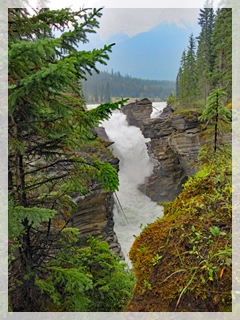 As I viewed the picturesque waterfall, the tremendous amount of water pouring over the rock, and the deep gorge formed by the glacial river, I thought of H. Jackson Brown’s quote: “In the confrontation between the stream and the rock, the stream always wins, not through strength but by perseverance.” Thinking it a good start for a devotion about patience and determination, I looked forward to writing it when I got home. Having been out of town thirty out of the last seventy days, however, I’ve been playing “catch-up” since returning from Canada. Domestic chores, family obligations, paper work, commitments, appointments, assorted health issues, and then my mother-in-law’s hospitalization have eaten away at me and I’m physically and emotionally exhausted. Today, during prayers, it occurred to me that something else is as persistent (and effective) as that rushing water—Satan! While the enemy enjoys throwing major disasters our way, as he did with Job, he also likes to peck at us like a troublesome woodpecker or whittle away at us as water does to rock. Through persistence, water defeats rock; like that persistent water, the enemy is determined to defeat us.
Satan came to Jesus when he was weakest—alone, tired and hungry after forty days of fasting in the wilderness. He does the same with us. It doesn’t take much for him to start his work. Even a small amount of worry, exhaustion, illness, busyness, discouragement, fear, delay, discontent, frustration, adversity, anger, anxiety, or pain makes us vulnerable to the enemy’s attacks. Add enough of them together for a long enough time and what seemed rock solid may break down or collapse.
The Apostle Peter likened Satan to a prowling lion and we should be wary of his attacks. If he can’t devour us in one assault, however, he’ll take a nibble out of our souls whenever an opportunity arises. Enough little nibbles can erode our spirit the same way water erodes rock. This morning, I realized that Satan was making inroads; it was time to shine up my armor of God and go on the offense. Instead of spending less time in Bible study and prayer, I needed to spend more (especially in the praise and thanksgiving departments)! While it may have taken five million years for water to carve the Grand Canyon, it wouldn’t take the enemy that long to leave a large chasm in my heart.
Almighty Father, Creator of all, thank you for the blessings of this and every day. Strengthen us so that we can resist the enemy’s attacks. Give us wisdom to understand your word and grace that we may live in obedience to it. May our faith increase daily so that we can do your work and fulfill your purpose for us; through Jesus Christ our Lord. Amen.
 Not all of us have the benefit of eighty years’ experience as did Moses when God called on him. Take David, for example, he was just a young shepherd boy when called on to become both warrior and king. Peter and John were fishermen; nothing in their backgrounds prepared them for their roles as Apostles and founders of a church. Mary was just a girl, in the town of Nazareth, engaged to be married to a local carpenter. What preparation did she have to become the mother of God? Gideon was a farmer, hiding from the Midianites in a wine press while threshing wheat, when God called to him. In fact, Gideon protested that, as the most insignificant member of the weakest clan, he couldn’t be the one to rescue Israel.
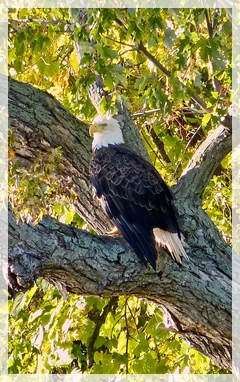 The eagle is mentioned more than any other bird of prey in the Bible. References are made to its swiftness of flight, ability to soar high in the air, excellent vision, the way it sets its nest in high places, and the strength of its wings. The above two verses about eagles, however, are more figurative than literal and have no scientific basis. Although mother eagles do hover over their young, they cannot carry them. A bald eagle’s lifting power is only about a third of its weight. An eaglet ready to fly is as heavy as its parents. If Mrs. Eagle tried to carry junior, they’d both fall! The second verse about being renewed like an eagle is probably connected to an ancient belief that every ten years the eagle disappeared into the sun, dove down into the sea with the setting sun, and emerged young again. There’s a similar urban myth that at 30 years of age, the eagle flies to a high mountain top and makes the difficult decision between death or the painful plucking out of all of its feathers and the destruction of its beak and talons. After waiting several months for everything to grow back again, it will be transformed and the refreshed bird will be able to live another 30 years. Not so; like the rest of us, when it’s time to grow old and die, the eagle has no choice. Like other birds, however, when the eagle molts, old worn feathers will drop and new ones will replace them.
 When writing yesterday’s devotion (“It’s Curtains”), I couldn’t help but feel a brief pang of regret because I never had those conversations with my parents before they died. The thoughts, “Please forgive me. I forgive you. Thank you. I love you,” may have been assumed but never were spoken. I was fifteen when my mother succumbed to cancer. I saw her that day in hospital but, when I walked out that afternoon, I was sure I’d see her again when I visited the following day. I never thought the next time I saw her she’d be lying in a casket. When people would say, “She looks so good,” I wanted to shout at them and say, “She doesn’t look good; she looks dead!” Five years later, I was in the same funeral home and surrounded by many of the same mourners. That time, it was my father’s body lying so still in the front of the room. Two day earlier he’d been hunting pheasants when his heart failed; he died in the middle of a corn field. I’d seen him just a few weeks before that and never thought our farewell was the final one. Did my parents know how much I loved them? Did they know how sorry I was for my failings? Did they know I forgave them for theirs? Did they know how thankful I was for the life they gave me?
 The terrible storm raged for many days, blotting out the sun and the stars, until at last all hope was gone. [Acts 27:20 (NLT)]
