
Be devoted to one another in love. Honor one another above yourselves. Never be lacking in zeal, but keep your spiritual fervor, serving the Lord. [Romans 12:10-11 (NIV)]
It is not the extent of your knowledge, though that is useful; it is not the extent of your talent, though that is not to be despised; it is your zeal that shall do great exploits. This zeal is the fruit of the Holy Spirit: it draws its vital force from the continued operations of the Holy Ghost in the soul. [Charles Spurgeon]
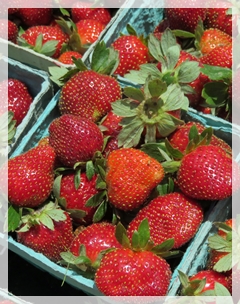 We just received one of those beautiful edible arrangements of fruit. The fruit was displayed as if we had an enormous flower arrangement. It seemed a pity to pull off the enormous ripe strawberries or take the melon balls from the centers of the pineapple slices but it was necessary if we were ever going to truly appreciate it. Fruit is meant to be eaten and that much fruit was meant to be shared before it spoiled. As I packed it up (all the while tasting as I worked), I couldn’t help but think of another gift of fruit—the fruit of the Spirit. Like juicy strawberries and sweet melon, it’s meant to be shared. Moreover, the Holy Spirit’s fruit doesn’t need to be refrigerated, can’t spoil, and is even more beautiful than real fruit, no matter how artfully arranged.
Paul gave us a list of the fruits of the Spirit but I’m not so sure it is all-inclusive. I recently read a devotion by Charles Spurgeon that suggests zeal is also a fruit of the Spirit. Surely, all those other traits—love, joy, peace, patience, kindheartedness, goodness, faithfulness, gentleness, and self-control—wouldn’t come to much without some zeal and enthusiasm for doing God’s work! Maybe zeal is a bit like the chocolate that covered some of those berry, apple and pineapple pieces—it enhances the Fruit of the Spirit!
As Christians, our worship, prayers, praise, faith, and service shouldn’t be lackluster and the Fruit of the Spirit shouldn’t be like a can of bland fruit cocktail. A pinch of zeal, however, can turn that flavorless canned fruit into a scrumptious and beautiful arrangement of fresh fruit.
Thus, by their fruit you will recognize them. [Matthew 7:20 (NIV)]
I am the vine; you are the branches. If you remain in me and I in you, you will bear much fruit; apart from me you can do nothing. … This is to my Father’s glory, that you bear much fruit, showing yourselves to be my disciples. [John 15:5,8 (NIV)]
Copyright ©2016 jsjdevotions. All rights reserved.
 As earth’s first gardener, God knew a thing or two about agriculture. Recognizing that continually working a field depletes the soil of valuable nutrients, He commanded the Israelites to let their land remain fallow every seven years. During this yearlong land Sabbath, no produce was to be planted, pruned or harvested and any food that grew by itself, such as grapes or figs, could not be harvested, sold or stored. God promised to grant an abundant crop in the sixth year so there would be plenty of food to carry the people through the Sabbath year and well into the next years until a new crop was harvested. Considered ownerless, the produce that grew by itself could be eaten by anyone or fed to the animals. The Sabbath year was a test of faith; it required the Israelites to acknowledge God as the true master of the land, to trust Him for His provision, and to share with those less fortunate.
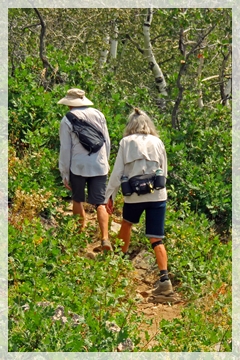 While visiting family in California, I joined my daughter-in-law and her walking group on their morning hike. The leader advised us that it was about a six mile walk—what she didn’t mention was it was all uphill for the first three plus miles. Although we started off together, the group quickly fragmented. The leader and some exceptionally fit and fast walkers were in the lead. I was in the middle group; unfamiliar with the area, I was not about to lose sight of our leader and risk getting lost. Behind us was another group and, bringing up the rear, were three stragglers who abandoned us within the first twenty minutes. After an hour of walking uphill, we finally reached level ground and heaved sighs of relief. The dozen remaining walkers stopped briefly while our leader explained the rest of the course—about a mile more of climbing before starting the descent back to the parking lot. At that point, mutiny occurred and more than half the group decided to take an easier and mostly downhill route back. Used to the flatlands of southwest Florida, I was happy to join my daughter-in-law in her desertion.
 Several “Nancy” comics have inspired my writing and I was curious about the strip’s artist/writer, Guy Gilchrist. From the tenor of his work, I was not surprised to learn that he is a Christian but that was not always so. As a boy, he was poor, lonely, abused and searching for someone and something in which to believe. Missing a dad, he found a father figure in an unlikely place—television—and in a remarkable person—a radio, television and movie star by the name of Roy Rogers. Since there was no difference between Rogers’ screen persona and the man himself, Gilchrist chose an excellent role model in this man of integrity. Kind and honest, Rogers was a devout Christian who stood for decency, truth and justice. Gilchrist, however, didn’t know about his hero’s faith until many years later. When the young cartoonist was unsure how to behave, he’d look to the singing cowboy and ask himself, “What would Roy do?” He knew his cowboy hero would always take the right course of action. Of course, the boy didn’t know that the Christian entertainer had his own model for behavior: Jesus. While Gilchrist was asking himself what Roy would do, the star was probably asking himself, “What would Jesus do?”
 O Lord, hear me praying; listen to my plea, O God my King, for I will never pray to anyone but you. Each morning I will look to you in heaven and lay my requests before you, praying earnestly. [Psalm 5:1-3 (TLB)]
 Devotions of the Heart