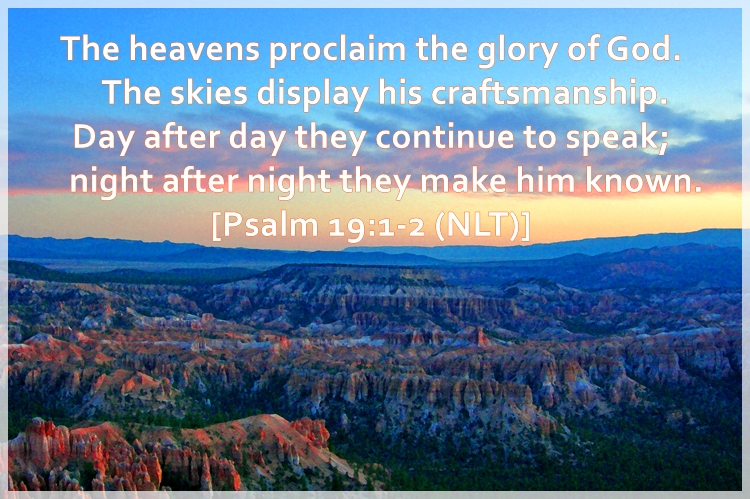
Bryce Canyon Sunrise

Bryce Canyon Sunrise
 If I told you that 88% of Americans own four or five of these, you’d probably think of televisions until I told you that less than a fifth of Americans actually use them regularly. It’s the Bible—almost all of us have more than one and yet few of us ever open it more than a few times a year.
It’s estimated that over six billion Bibles have been printed since Gutenberg printed the first one in 1454. Since then, the entire Bible has been translated into 554 languages and some portion of the Bible has been translated into 2,932 languages. Within our language, we can choose from a vast array of translations—from word for word versions such as the King James to thought for thought ones like the New Living Translation to paraphrase versions such as the Message. There are large print, study, chronological, life application, and even journaling Bibles (“Journibles”) that allow us to express our creativity with doodles and sketches on the page margins. For the younger generation, the Bible has entered the 21st Century with both the Kingstone Bible, which presents the Bible in graphic novel form, and the Emoji Bible – Scripture 4 Millennials, with its Unicode-approved emojis and internet slang and contractions. We have Bibles enough for every preference and faith—we just need Bible readers.
The Bible is the foundation of our faith—it’s our history, God’s love letter to us and our ode to Him. It’s our Lord’s biography, the Church’s handbook and our instruction manual for life. Today is the International Day of the Bible. At noon, local time, people of all ages are invited to celebrate the Bible, in public or online, by reading or creatively expressing their love of God’s word. While hoping that people will share favorite Bible verses with family and friends, the event’s sponsor, The National Bible Association, hopes for more creativity such as flash mobs, singing or dancing to Scripture, and artwork or photography that capture God’s glory and add a few lines of verse.
I don’t hold out much hope for a massive demonstration of Bible lovers because, according to a recent study by the Barna Group, only 37% of those who consider themselves “practicing Christians” regularly read the Bible and more than half read it only four times a year. If we love it so much, I wonder why we don’t read it more. Two-thirds of Americans say they would like to do just that but they just can’t find the time. Somehow, I think we can all find at least five minutes a day in our busy lives for God! Today, if you don’t share your love of the Bible with someone else, perhaps you will observe this day by pausing for a few minutes to open and read your Bible and to thank God for the privilege of reading His word. And, maybe, if you don’t already do so, you’ll commit to reading God’s word regularly.
When we open the Bible, it does not say to us, “Listen: God is there!” Instead, the voice of the Spirit whispers through each line, “Look: I am here!” [Chris Webb]
 I recently walked by a home that has a large sign at its front door: “Smile, you’re on camera!” We’ve got baby monitors and nanny cams and can see who is at the door with a glance at our cell phones! Cameras are disguised as working clocks, lightbulbs, phone chargers and smoke detectors. No moment is private if a cell phone is nearby and our most embarrassing moments may find their way onto Facebook or YouTube. Police have body cams, cyclists have Go-Pros, drivers have dash cams, drones can watch us sunbathing in the yard, and schools embed RFID chips in student ID badges. We’re even monitored while in department store dressing rooms (an unsettling thought when trying on bathing suits!) Two years ago, hidden cameras were found in a beach house that was rented out to unsuspecting vacationers. Cameras are everywhere and no place is private; this whole surveillance thing is rather disquieting.
While I find human surveillance and our lack of privacy disturbing, I’m reassured by God’s knowledge of our comings and goings. Surveillance means “watching over” and is derived from the French words “sur,” meaning “from above,” and “veiller,” meaning “to watch.” Our Heavenly Father truly surveils or watches over us from above. While most of today’s surveillance is to record us doing something wrong in order to catch and punish us, to capture us at our worst for others’ entertainment, or to record our intimate moments for salacious reasons, that’s not so with God’s surveillance. Although He sees us when we’re erring and straying (at our best and worst and even in our bedrooms), He’s not going to post anything on Facebook, sell our secrets to the tabloids, send us traffic tickets, arrest us for jaywalking, or exploit our privacy. The purpose of His surveillance has as much to do with guiding us when we’re lost, protecting us from harm, helping us in difficulty, comforting us in sorrow and encouraging us in weakness as it does with admonishing or correcting us when we’re in error.
El Roi, the God Who Sees Me, is what a slave girl named Hagar called God when she realized her plight was not hidden from the Lord of the Universe. She took comfort in knowing that He watched over her and knew all about her troubles. Like Hagar, I’m comforted by having a God who sees me. Nothing escapes El Roi and, knowing that His eye is on the sparrow, I can be sure that He sees and cares for me.
“Let not your heart be troubled,” His tender word I hear,
And resting on His goodness, I lose my doubts and fears;
Though by the path He leadeth, but one step I may see;
His eye is on the sparrow, and I know He watches me;
His eye is on the sparrow, and I know He watches me.
[“His Eye is on the Sparrow” (Civilla D. Martin)]
 In our part of Florida, yellow lights tend to mean “speed up” and red lights are just mere suggestions so no one really expects anyone to stop at a yellow. Although the light had just turned yellow, the elderly gentleman stopped his car. “The #@!% idiot should have sped through the intersection!” said the women following him. Having been tailgating his car, she was furious at having to brake so abruptly. Already late, now she’d be even later. Moreover, the unexpected stop caused her to spill her coffee and drop both her cell phone and makeup. Angry, she laid on the horn, called him a few more choice expletives, shook her fists and even gave him the middle-finger salute! She was in mid-rant when she looked up to see a police officer at her window. He politely ordered her to exit the car. Having forgotten her driver’s license in another purse, she was transported to the police station, fingerprinted, photographed, and finally placed in a holding cell.
A few hours later, the woman was released and escorted her to the booking desk where the arresting officer waited for her. “I’m so sorry for this mistake,” he meekly apologized. “You see, I pulled up behind you while you were honking your horn, cussing a blue streak, and flipping off the old man. I noticed the ‘What Would Jesus Do’ and ‘Follow Me to Sunday School’ bumper stickers, the ‘Choose Life’ license plate, the cross decal and the chrome-plated Christian fish on the trunk. Naturally, I assumed you had stolen the car!”
I thought of this Internet humor today when I received an ad for a new line of Christian sportswear. Founded by Christian athletes, the apparel has faith inspired designs and messages like “Fearfully and Wonderfully Made” or “My Game His Glory.” If we wear our faith on our shirts or cars, we better make sure our conduct lives up to it. We wouldn’t want anyone to think we stole either the shirt or the car. We should be sure that our behavior would make someone want to follow us to Sunday school rather than run the other way!
Father in heaven, guide us today so that our actions reflect our faith. Let everything we do demonstrate not only our love for you but also the love we should have for our neighbors. Don’t let our poor behavior contradict your message of peace, love and forgiveness. May our conduct show the world that we truly are your disciples. In those moments that try our patience or spark our temper, remind us to lovingly pray for people when we’d much prefer yelling at them.
Be such a man, and live such a life, that if every man were such as you, and every life like yours, this earth would be God’s Paradise. [Phillips Brooks]
 In preparation for my mother-in-law’s 100th birthday, I’ve been creating a timeline. After perusing a century’s worth of history, I juxtaposed high points in her life with what was happening in the world around her. During her life-time, my mother-in-law saw the advent of everything from three-colored traffic lights and the Monopoly game to E-Z-Passes and X-Boxes, from pop-up toasters and World Book encyclopedias to microwave ovens and Google, from rotary dial phones and the first airmail to iPhones and email, from the first transatlantic flight and Admiral Byrd’s South Pole expedition to space shuttles, lunar landings and Mars’ probes.
As I searched through the Web, what truly struck me was something I didn’t include in her timeline—man’s ability to be monstrous. It wasn’t just that World War II, Korea, Vietnam, the Gulf War, ISIL, Afghanistan and all the clashes in-between proved that the First World War wasn’t the “war to end all wars.” It was events like 9/11, Boko Haram’s kidnapping of school girls in Nigeria, lynch mobs, and the murders of civil right workers. It was Israeli athletes being massacred by Black September, Charles Whitman shooting 49 people from a tower, Columbine and every other school shooting. It was the Holocaust, the Ku Klux Klan, and genocide in places like Armenia, Bosnia, Rwanda, and Dafur. It was reading of 100 years of atrocities—of man’s inhumanity to man—riots, beatings, intolerance, slaughter, and torture. The world my mother-in-law came into wasn’t all that different from today’s hate-filled world. Terrorism is nothing new; ninety-six years ago, a dynamite-rigged carriage exploded on Wall Street, killing thirty-eight and injuring hundreds. The last century had its share of violence, carnage and horror. It’s just that today we’re more efficient in delivering hate and the horrific results of our actions are better publicized.
In a recent Nancy comic (written by Guy Gilchrist), Sluggo asks Nancy if she’s afraid of monsters. “Nah,” she responds, “Wolfman, King Kong, Frankenstein’s monster—I kinda feel sorry for them.” Then she adds, “I’ve never been afraid of the monsters who look like monsters. I’m afraid of the monsters who look like people.” Although I got the timeline done (minus the monstrousness of the last century), my heart is heavy from the task. I wonder how to fight off all those monsters who look like people. Perhaps we simply do it by refusing to become one of them. We must never stop loving God and our neighbor—no matter who he is, what he looks like, where he lives, or what he believes. The Apostle Paul put it succinctly: “Three things will last forever—faith, hope, and love—and the greatest of these is love.”
Although I think I have plenty of faith and love, right now I’m a bit short of hope. Father God, we so desperately need your guidance in the days ahead. Forgive us for the past and fill us with hope for the future.
God is the only one who can make the valley of trouble a door of hope. [Catherine Marshall]
 Also, the Spirit helps us with our weakness. We do not know how to pray as we should. But the Spirit himself speaks to God for us, even begs God for us with deep feelings that words cannot explain. God can see what is in people’s hearts. And he knows what is in the mind of the Spirit, because the Spirit speaks to God for his people in the way God wants. [Romans 8:26-27 (NCV)]
In yesterday’s message, I wrote that a friend prays and yet I’m amazed how rarely that actually happens. Yes, a friend may pray for someone but how often do we, as friends, pray with that someone? Twice when visiting someone in hospital, a chaplain has dropped in to visit. Twice, the chaplain spoke briefly with us and then turned to leave without offering a prayer. Twice, I was the one who asked for prayer—one time for a prayer of thanksgiving and the other for one of strength and healing. Afterwards, I wondered why these hospital chaplains didn’t offer to pray with us. Isn’t prayer part of their job? As I started to point my finger, I saw three fingers pointing back at me and had to admit that I’m not one for offering spur-of-the-moment prayers either. I asked God not to allow me to leave a prayer unoffered or unsaid.
Last month, shortly after the second hospital incident, I was talking with a recently widowed friend. A trip with flowers to the cemetery had left her sad and teary-eyed. We hugged as I departed. I’d only taken a few steps toward my car when the Holy Spirit convicted me: “Here’s your opportunity—pray with her!” I turned back to my friend, held her hands and lifted her needs up to the Lord. I wasn’t eloquent and couldn’t remember any Bible verses; whatever I said was unremarkable, but that didn’t matter. The Holy Spirit knew my friend’s needs and lifted our prayers heavenward.
I’m a writer, not a prayer warrior, and offering prayer is way out of my comfort zone. My comfort, however, is not high on God’s priority list. Last week, while taking pictures in the park before worship service, I stopped to chat with a young woman who’s started attending our church. I know little about her except that she’s new to the area, belongs to a friendly Dalmatian, and is job hunting. As I stooped to get a photo of her dog, I asked how the job search was going. Answering that she’d not gotten the job for which she applied, I replied with a few encouraging words. When I stepped away to continue taking pictures, I realized my work was not done. Turning back, I asked, “Can we pray?” We held hands and I offered a quick prayer that God would lead this lovely woman to the right job opening. There was nothing memorable or eloquent about my words; they were, however, heartfelt and sincere.
It’s easy to say, “I’ll pray for you,” but a bit harder to actually do it. For many of us, it’s even harder to pray with someone right then and there, but isn’t that what all Christians (not just hospital chaplains) should do? The sincere agreement of two believers in prayer is powerful and effective because the Holy Spirit is with them, guiding their requests. Our prayers don’t have to be eloquent or deeply profound; they just have to be said.
Rich is the person who has a praying friend. [Janice Hughes]
 Devotions of the Heart