
No one lights a lamp and then hides it or puts it under a basket. Instead, a lamp is placed on a stand, where its light can be seen by all who enter the house. Your eye is like a lamp that provides light for your body. When your eye is healthy, your whole body is filled with light. But when it is unhealthy, your body is filled with darkness. Make sure that the light you think you have is not actually darkness. If you are filled with light, with no dark corners, then your whole life will be radiant, as though a floodlight were filling you with light. [Luke 11:34-36 (NLT)]
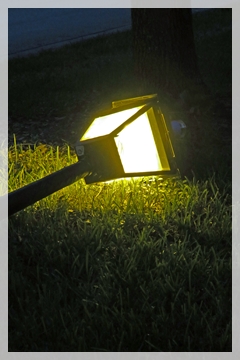 To avoid the southwest Florida heat, I waited until dusk to take my walk. Thanks to Hurricane Irma, most of the street lamps in my neighborhood don’t work. For a light to function, electrical energy has to be converted into light energy and both a source of electricity and a working connection are needed. For many of the lights, the connection was broken when blowing debris shattered their bulbs. For others, Irma’s 150 mph winds broke the connection when it blew off their tops, wrapped their poles around trees, or knocked them to the ground. Without a connection to their source of power, those street lights are useless—they’re just a tangle of wires and a pile of glass, plastic and metal. Even though they don’t work, people have been cautioned to remember that their exposed wires are live. It’s not the electricity that is missing; it’s the connection that is inoperative. Two poles, however, were down but not out. Even though they’d been flattened by the storm, neither wires nor bulb had broken. In spite of the storm’s violence, they remained connected and were beacons in the night’s darkness.
When the storms of life batter us and knock us down, like those street lamps, we can lose our connection, not to electricity, but to God. Our minds may get so caught up in anger, worry, fear, depression, or self-pity that we become separated from our true source of power—Jesus. He told us to let our lights shine but we can’t shine if we’re not connected to Him. When our lives go dark, we should remember that God hasn’t gone anywhere—like the electricity, He’s still there. We’re the ones who are broken. Unfortunately, no Florida Power & Light truck is going to arrive and reconnect us to God.
Reconnecting is a choice we have to make. Reconnecting is trusting God and ceding to His will. It is prayer and reading the Bible; it is praise, thanksgiving and worship. Reconnecting is turning to God and choosing joy over misery, light over darkness, love over hate, forgiveness over rancor, peace over anger and service over selfishness. Fortunately, we’re not alone in this. We may not have FP&L but we have something more powerful (and far more dependable)—the Holy Spirit! If we allow Him, He will reconnect us to the light of the world. We may be down, but we don’t ever have to go out! By His power, our lights can continue to shine.
Remember this. When people choose to withdraw far from a fire, the fire continues to give warmth, but they grow cold. When people choose to withdraw far from light, the light continues to be bright in itself but they are in darkness. This is also the case when people withdraw from God. [Augustine]
 The celebration of the Eucharist or Holy Communion has been central to our Christian worship since the early church. If asked the meaning of the word eucharist, most of us would probably respond that it is the Christian sacrament that commemorates the Last Supper with bread and wine. While it has come to mean that and often refers to the consecrated elements, especially the bread, the word eucharist originally meant something else entirely. Coming from the Greek words eukharistos, meaning grateful, and kharizesthai, meaning to offer graciously, it is a translation of the Hebrew word berekah which means a blessing or benediction. Acknowledging God as the source of all good things, a berekah would be similar to the grace or table blessing we offer before or after a meal.
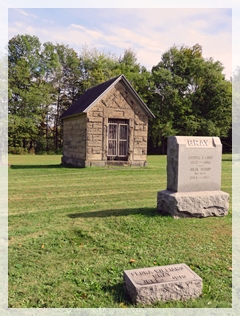 When touring a nearby resort town, a beautiful old mansion was pointed out. It was once owned by a man who made so much money on his invention of the sanitary milk bottle cap that he retired at the age of 26. For 93 years, the Chicago White Sox played at a ball field named for the team’s founder. In 2003, the field was renamed US Cellular Park and then, in 2016, it became the Guaranteed Rate Field. When I went to Northwestern University, the football venue was named for a former Evanston mayor. In 1997, the stadium was renamed to honor the family of a generous donor to the school’s athletic facilities. A friend’s daughter is attending a school named for a German immigrant who opened a Chicago butcher shop in 1883. Who were these men?
 The men from the church were enjoying their monthly breakfast at their favorite diner. The new minister, Pastor Tim, decided to join them. Wanting to get to know the men better, he asked who would like to offer grace before the meal. John, a retired farmer from Iowa volunteered. After taking off his cap, he stood and said loudly, “Lord, I sure do hate buttermilk!” The old farmer then added, “And, Lord, I don’t care much for lard.” Pastor Tim wasn’t sure how to react but decided to see where this prayer was leading. Then John continued with, “Tell the truth, white flour doesn’t taste like much either and baking powder sure is bitter.” Pastor Tim started to stand up and take over saying grace when, in his booming voice, John added, “But, Lord, when you mix them all together and bake them, I truly do love those fresh biscuits! Thank you, Heavenly Father, for the biscuits, gravy, eggs, and bacon with which we are blessed this fine morning. Amen.”
 Yesterday I mentioned getting an email with the subject, “How firm is your foundation?” Although it was an advertisement for a new study Bible connecting Biblical teachings to Christian beliefs, that very question has been the topic of discussion in our northern church for the last few weeks. The parish is doing a church-wide study of Martin Luther’s Small Catechism. Back in the 1500s, Martin Luther was appalled at the lack of knowledge of both pastors and their congregations. Not especially tactful, he accused some pastors of being “lazy bellies and presumptuous saints!” His words for their congregations, “simple cattle and mindless pigs!” were no more diplomatic. People who called themselves Christians had no idea what that meant. They didn’t know the Ten Commandments, the Apostle’s Creed or even the Lord’s Prayer, let alone anything else in the Bible. Last week, our Pastor asked us what Luther might say if he visited today’s churches. We agreed that his words for our pastors would be more complimentary but that his words for their congregations might be the same or worse!
 Devotions of the Heart