
As they were eating, Jesus took some bread and blessed it. Then he broke it in pieces and gave it to the disciples, saying, “Take this and eat it, for this is my body.” And he took a cup of wine and gave thanks to God for it. He gave it to them and said, “Each of you drink from it, for this is my blood, which confirms the covenant between God and his people. It is poured out as a sacrifice to forgive the sins of many. [Matthew 26:26-28 (NLT)]
 The celebration of the Eucharist or Holy Communion has been central to our Christian worship since the early church. If asked the meaning of the word eucharist, most of us would probably respond that it is the Christian sacrament that commemorates the Last Supper with bread and wine. While it has come to mean that and often refers to the consecrated elements, especially the bread, the word eucharist originally meant something else entirely. Coming from the Greek words eukharistos, meaning grateful, and kharizesthai, meaning to offer graciously, it is a translation of the Hebrew word berekah which means a blessing or benediction. Acknowledging God as the source of all good things, a berekah would be similar to the grace or table blessing we offer before or after a meal.
When Jesus spoke the traditional Passover meal berakahot that night in the upper room, he gave them new meaning when he added the words, “this is my body” and “this is my blood.” In thanks, He raised the bread just as his body soon would be raised on the cross. He took the matzah that symbolized the suffering of Israel, thanked God for it, and broke it, knowing that his body would be broken in less than a day. As He passed it to the disciples, the bread that once symbolized Israel’s suffering became the bread that would symbolize His. The disciples may have thought he was simply offering a blessing for the Passover bread but Jesus was offering thanks for the body which soon would be defeated by thorns, whip, nails and cross. He then thanked God as he poured out the wine that symbolized Israel’s redemption from Egypt and passed it around. The disciples may have thought he was giving thanks for Israel’s redemption from Egypt but Jesus knew it was for their redemption from sin. For something to be redeemed, however, a price must be paid and Jesus knew that price would be his blood. While pouring out the wine, He knew his blood would soon pour from his body and yet he still gave thanks. Knowing full well the torment he would suffer, He graciously offered himself for us and gave thanks.
Last week, when the Words of Institution were spoken before Communion and the bread and wine were consecrated, I realized I hadn’t fully appreciated the circumstances in which those words originally were spoken. Jesus knew He’d be betrayed, disappointed and denied within hours. He knew the agony that would soon occur. Jesus knew he would be broken and bleed. He knew the real sacrifice was not the lamb on which they’d supped; He was the sacrificial Lamb of God and yet He acknowledged God as the source of all blessings and thanked Him! Blessed be the Lord; let us give thanks!
Blessed are You, Lord our God, King of the Universe, who brings bread from the earth. … Blessed are You, Lord our God, King of the Universe, who creates the fruit of the vine. [Jewish prayers over bread and wine]
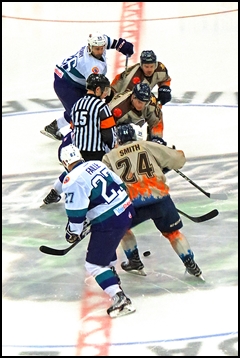
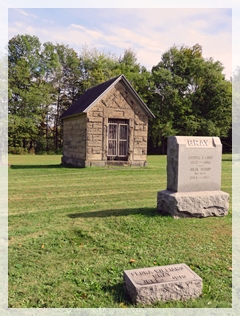 When touring a nearby resort town, a beautiful old mansion was pointed out. It was once owned by a man who made so much money on his invention of the sanitary milk bottle cap that he retired at the age of 26. For 93 years, the Chicago White Sox played at a ball field named for the team’s founder. In 2003, the field was renamed US Cellular Park and then, in 2016, it became the Guaranteed Rate Field. When I went to Northwestern University, the football venue was named for a former Evanston mayor. In 1997, the stadium was renamed to honor the family of a generous donor to the school’s athletic facilities. A friend’s daughter is attending a school named for a German immigrant who opened a Chicago butcher shop in 1883. Who were these men?
 The men from the church were enjoying their monthly breakfast at their favorite diner. The new minister, Pastor Tim, decided to join them. Wanting to get to know the men better, he asked who would like to offer grace before the meal. John, a retired farmer from Iowa volunteered. After taking off his cap, he stood and said loudly, “Lord, I sure do hate buttermilk!” The old farmer then added, “And, Lord, I don’t care much for lard.” Pastor Tim wasn’t sure how to react but decided to see where this prayer was leading. Then John continued with, “Tell the truth, white flour doesn’t taste like much either and baking powder sure is bitter.” Pastor Tim started to stand up and take over saying grace when, in his booming voice, John added, “But, Lord, when you mix them all together and bake them, I truly do love those fresh biscuits! Thank you, Heavenly Father, for the biscuits, gravy, eggs, and bacon with which we are blessed this fine morning. Amen.”
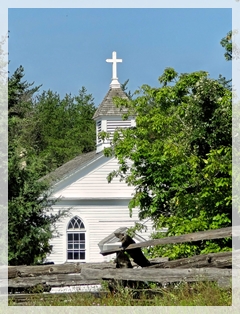 Yesterday I mentioned getting an email with the subject, “How firm is your foundation?” Although it was an advertisement for a new study Bible connecting Biblical teachings to Christian beliefs, that very question has been the topic of discussion in our northern church for the last few weeks. The parish is doing a church-wide study of Martin Luther’s Small Catechism. Back in the 1500s, Martin Luther was appalled at the lack of knowledge of both pastors and their congregations. Not especially tactful, he accused some pastors of being “lazy bellies and presumptuous saints!” His words for their congregations, “simple cattle and mindless pigs!” were no more diplomatic. People who called themselves Christians had no idea what that meant. They didn’t know the Ten Commandments, the Apostle’s Creed or even the Lord’s Prayer, let alone anything else in the Bible. Last week, our Pastor asked us what Luther might say if he visited today’s churches. We agreed that his words for our pastors would be more complimentary but that his words for their congregations might be the same or worse!
 Devotions of the Heart