
And so, dear brothers and sisters, I plead with you to give your bodies to God because of all he has done for you. Let them be a living and holy sacrifice—the kind he will find acceptable. This is truly the way to worship him. [Romans 12:1-2 (NLT)]
 If you ever visited the Mayan ruins near Cancun, Mexico, chances are you saw the remains of a stone ball court with sloping walls. Nowhere near as impressive as the Mayan pyramids, I didn’t even take a picture when I saw one. Two stone rings hang about 20 feet up the walls. A ball game called pok-ta-pok was played there. As in volleyball, players passed a solid rubber ball around by hitting it with various parts of their bodies. Unlike volleyball, however, they could not touch the ball with their hands. The goal was to get the ball through one of the rings.
This game was a reenactment of the Mayan creation story and had ritual significance. When prisoners of war were forced to play the game, it became a prelude to their sacrifice by decapitation, heart removal, or disembowelment. Since blood was considered nourishment for the gods, the sacrifice of a living creature was a powerful one and the sacrifice of a human was the most powerful.
When we hear the word sacrifice, we tend to picture something as brutal and gruesome as the Mayans, satanic cults, King Manasseh sacrificing his son to Molech, or even Abraham placing his son on an altar and bringing a knife to his throat. We think of sacrifice as suffering terrible loss: the destruction or surrender of something precious to us. Having a negative connotation, we tend to see sacrifice as unpleasant, involuntary, or punishing.
There was, however, another scenario to that Mayan ball game. In some cases, it was the winners who were sacrificed. Teams willingly played in the hopes of winning and being sacrificed to the gods. This sacrifice was a privilege that gave great honor to the player and his family. Although the game’s losers lived, they were disgraced and may have become slaves. While it still seems barbaric to us, rather than a giving up of something, that sacrifice was seen as a gain.
God clearly prohibited human sacrifice when he gave the law to the Israelites, yet Paul tells the Romans to be living sacrifices! This is neither a forced sacrifice nor one of punishment; we are not defeated warriors being sacrificed in shame. This is an enthusiastic sacrifice, like that of the Mayan warriors who chose to compete in that sacrificial game. Like them, we are victors but, unlike them, ours is not a one-time sacrifice resulting in death but rather a constant placement of our lives at God’s disposal. It is a joyful and willing sacrifice of worship—a consecration of our lives to Him.
Sunday, we sang these words from Frances Havergal’s hymn: “Take my life and let it be consecrated, Lord, to Thee.” As we sang, we offered Him our time, hands, feet, voices, lips, money, intellect, will, heart, and love. That is what it means to be a living sacrifice to God. Four years after writing her hymn, Havergal responded to her own words, “Take my silver and my gold,” by giving away all of her jewelry (nearly fifty items) to a missionary society. About this sacrifice, she wrote a friend of her “extreme delight” and said, “I don’t think I ever packed a box with such pleasure.” Her words, actions, and joyful attitude are an example of what it means to be a living and holy sacrifice,
Take my love, my Lord, I pour at thy feet its treasure store.
Take myself and I will be ever, only, all for Thee.
[Frances R. Havergal (1874)]
 We were at the symphony watching Alfred Hitchcock’s Psycho while the orchestra played Bernard Herrman’s chilling soundtrack. When Janet Leigh’s character, Marion Crane, stepped into the shower, a man in the audience yelled, ”Don’t do it!” Since most of us saw the movie decades ago, we didn’t want her to take that fatal shower either. In spite of the warning, however, she did. Since Marion was at the Bates Motel because she’d embezzled $40,000 from her boss, perhaps that man should have yelled, “Don’t do it!” much sooner.
 In 2009, the United Methodist Church and the Evangelical Lutheran Church of America became full Communion partners. This agreement, while showing respect for each other’s differences, created a relationship based on a common confession of faith and a mutual recognition of Baptism and the sharing of Holy Communion. That the partnership included a mutual recognition of ordained ministers of both denominations meant that a local Methodist church could hire a soon-to-be ordained Lutheran minister. Her ordination, done by the Lutheran bishop, was held in the Methodist church she would be serving. The only sticking point for the rite was the Lutheran Bishop’s insistence that actual wine be used for Communion. Methodists have a strong temperance tradition and this church uses only grape juice. The senior Methodist pastor managed to find an excellent compromise when he obtained a non-alcoholic wine that satisfied both Methodist and Lutheran sensibilities; the ordination went off without a hitch.
 It was every parent’s nightmare; while the Dad was changing the toddler’s diaper, his four-year old daughter wandered away and disappeared in the zoo! We saw him as he was frantically asking people, “Did you see a little girl in a pink bike helmet?” As he went racing down the path toward the alligators and lions, we went toward the lemurs and play area. Fortunately that pink helmet made her easy to spot as she stood watching the black bears lumber through their enclosure. As we walked her back to her father, I said a prayer of thanksgiving that she would be returning home safely that day.
 The eight of us were brainstorming a difficult and heartbreaking situation facing a family we know. We had plenty of ideas about getting them the assistance and guidance they needed but we could only direct them to the resources. They were the ones who needed to take action. Unfortunately, people often want the easy way out of their problems and desire money rather than counsel. Money, however, is usually only a stop gap measure and it frequently enables a bad situation to continue or get worse. The problem we were discussing required change, compromise, work and sacrifice far more than money. These people had to take action and, truth be told, I’m not so sure they wanted to step forward and act.
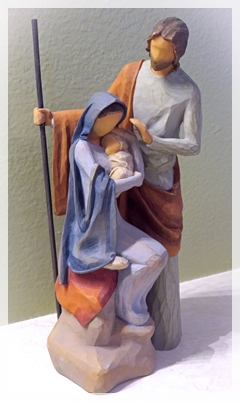 Although Epiphany celebrates the magi’s visit to the Christ child, for many people it simply marks the official end to the holiday season. It’s the day the tree goes down, lights are removed, and nativity scenes get stowed for another year. British tradition holds that if you haven’t removed the holiday décor by January 6, you must leave it in place all year long to avoid misfortune. I don’t know about misfortune but, in our community, you’ll face a fine if holiday lights or decorations remain after this week!
 Devotions of the Heart