
Then he said, “Beware! Guard against every kind of greed. Life is not measured by how much you own.” [Luke 12:15 (NLT)]
You say, “I am rich. I have everything I want. I don’t need a thing!” And you don’t realize that you are wretched and miserable and poor and blind and naked. [Revelation 3:17 (NLT)]
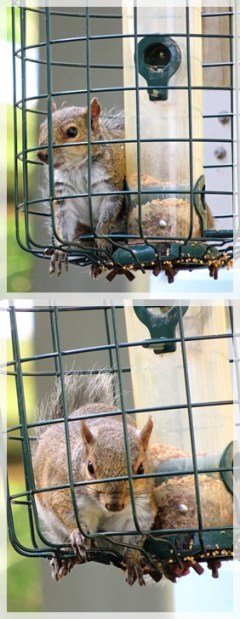 I looked at the greedy squirrel caught in the bird feeder. He’d managed to get himself in but couldn’t get out and wasn’t even able to enjoy the seeds that enticed him there in the first place. Other squirrels, however, were gathered beneath the feeder feasting on the seeds he knocked out of the feeder with his frantic movements. That silly squirrel lives in a bird sanctuary where there is more than enough food in the way of fungi, nuts, seeds, fruit, caterpillars and insects (along with the bird seed that frequently spills from the bird feeders) to keep him plump and happy all year long. Nevertheless, unsatisfied with enough, he hungered for more. We’re not much different.
I thought about King Solomon; while best known for his wisdom, like the squirrel, he was greedy. Although God had warned against a king amassing great amounts of gold, Solomon collected 25 tons of it every year and, unlike those bird seeds, his wealth didn’t even scatter down to his people. After Solomon’s death, they begged King Rehoboam for relief from their labors and heavy taxes. Perhaps hungry for an even more extravagant lifestyle than his father’s, Rehoboam refused and lost it all to the king of Egypt within five years.
Some say wealth brings happiness but, if anyone should know about wealth and happiness, it would be wise King Solomon. His words in Ecclesiastes, however, are not those of a happy man: “Those who love money will never have enough. How meaningless to think that wealth brings true happiness!” [5:10] Amassing money and possessions is like running on a treadmill: a never ending journey. We think that bigger, better or more will bring contentment but what once seemed a luxury soon becomes commonplace and a mere necessity. So, wanting something even more extravagant, we get back on the treadmill of acquisition. So rich that he considered silver worthless, Solomon got rid of his silver goblets and utensils and replaced them with gold. Had platinum been discovered in his time, I imagine he would have replaced the gold with it.
Wealth is not evil; in fact, it can do wonderful things. Wealth, however, is dangerous because loving it and all that comes with it can lead us into temptation and trap us in spots far worse than a bird feeder.
Don’t feel sorry for the squirrel; a naturalist freed him that afternoon. But, chances are, many of us are still on a treadmill of acquisition, foolishly striving for that elusive place over the rainbow where dreams come true, “troubles melt like lemon drops,” and that pot of gold is hidden. The squirrel’s desire for more held him hostage; we mustn’t let our craving for more do the same to us!
You say, “If I had a little more, I should be very satisfied.” You make a mistake. If you are not content with what you have, you would not be satisfied if it were doubled. [Charles Spurgeon]
 This is my command—be strong and courageous! Do not be afraid or discouraged. For the Lord your God is with you wherever you go.” [Joshua 1:6a,9 (NLT)]
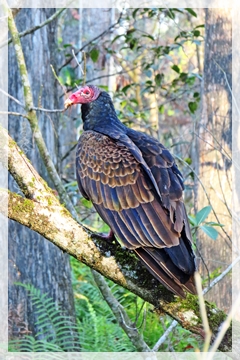 Yesterday, when I compared vultures to mankind, I did vultures a disservice. Although unattractive, smelly, and with rather disgusting eating habits, vultures play a valuable role in keeping our ecosystem healthy and clean by disposing of rotting carcasses and preventing the spread of disease.
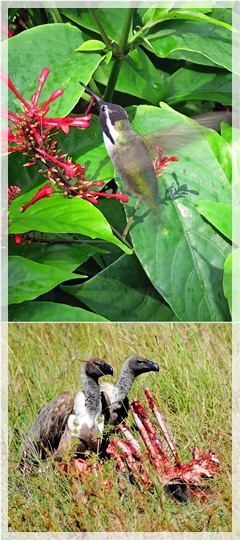 We were enjoying hundreds of exotic butterflies amid tropical plants in the conservatory of a nearby botanic garden when I turned around to see a hummingbird hovering nearby. In spite of the building’s double-door containment procedures, this beautiful little bird managed to find his way into what, for him, must be paradise and no one seemed to mind. Seeing him reminded me of a question asked several years ago: “Which would you rather be—a hummingbird or a vulture?” I thought, “That’s a no-brainer!” as I watched the iridescent bird hover over the flowers; then I remembered the question wasn’t what we wanted to be but rather what we actually were.
 The next day John saw Jesus coming toward him and said, “Look! The Lamb of God who takes away the sin of the world! [John 1:29 (NLT)]
 Fitbit recently notified me that I’ve logged 4,132 miles and awarded me a badge for having walked the length of the Nile River. And to think—I managed to do it all without ever leaving the country. With the aim of averaging 10,000 steps a day, I was curious to see how close to that goal I’ve gotten since getting the Fitbit. Some complicated math told me that, by now, I should have logged enough steps to be three-quarters of the way from the North to the South Pole. Granted, I haven’t always worn my pedometer and both foot and knee injuries temporarily benched me. Nevertheless, surprised to see how short I was of my goal, I realized how easy it is to think we’ve done far more than we actually have.
 Devotions of the Heart