
Don’t misunderstand why I have come. I did not come to abolish the law of Moses or the writings of the prophets. No, I came to accomplish their purpose. [Matthew 5:17 (NLT)]
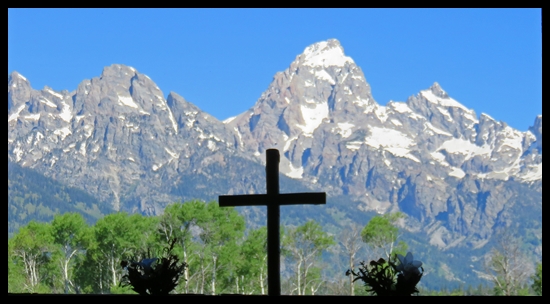
In the middle of Grand Teton Nation Park is a small log church, the Chapel of the Transfiguration. Built in 1925, it offers a beautiful view of the majestic Teton Mountain Range through a window behind the altar. When people gaze out that window, I wonder how many think of the amazing event—the transfiguration—that took place on another mountaintop more than 2,000 years ago.
About a week after Peter called Jesus “the Messiah sent from God!” and Jesus explained that He’d suffer, die, and be raised, Peter, John and James accompanied Him up a mountain to pray. While tradition says it was Mt. Tabor, both its height (only 1,800 feet) and location make that unlikely. While not as high as the 13,000 ft. Grand Teton, Mt. Hermon’s height (9,000 feet) and location make it the more likely location of this glorious event.
While praying, Jesus made a dramatic change: his face transformed and his clothes turned white and gleaming. Having only seen Jesus in his human form, His now glorious presence gave the disciples a greater understanding of his deity. Two men then appeared and spoke with Jesus about his exodus (or departure) from this world. They were Moses and Elijah—representing, at least symbolically, the Law and the Prophets. Jesus, as we know, was their fulfillment.
Amazed at what was the ultimate mountaintop experience, Peter foolishly suggested building three shelters for Jesus and his visitors. That, of course, was a mistake; neither the lawgiver not the prophet were Jesus’s equal. Furthermore, that Peter wanted this glorious event to continue would have kept Jesus from the mission He’d already explained to His disciples. A cloud then enveloped them all and a voice, unmistakably that of God, said, “This is my dearly loved Son, who brings me great joy. Listen to him.” [Matthew 17:5] The “Listen to him,” made it clear that the One who was new would be replacing the old way. After this powerfully dramatic event, the four men found themselves alone on the mountaintop.
Jesus commanded the disciples to keep silent as to what had taken place until after his resurrection. Looking for a Messiah who’d be a political deliverer rather than one who was a suffering servant, the world wouldn’t understand what had transpired. Even the disciples, the men who’d walked with Him for three years, didn’t fully understand the meaning of their mountaintop experience. It was not until Jesus joined them in that locked room on Easter that they finally understood that He’d come to conquer death rather than Romans.
The transfiguration was a foretaste of things yet to come and, someday, we all will see the fullness of Christ’s glory as did Peter, James, and John. Although Jesus told His disciples to keep his identity a secret, let us not forget that was only a temporary request. He later told them to “make disciples of all the nations.”
 The day’s gospel was from Mark 10 and, as the sermon began, the pastor shared having spent three hours earlier that week in a tiresome meeting on evangelism. The speakers had been lauded for the high number of “first public professions of faith” in their parishes. As the meeting went on, the pastor furtively checked his phone to see if memory had served him right. Indeed, his church far exceeded the numbers of the keynote speakers. Part of him (the bad part), like James and John, wanted to boast and be honored but the other part reminded him that ministry is about people and not numbers. He ate a little humble pie and said nothing. As often happens in long meetings, his mind wandered and he thought back to an encounter some twenty-eight years ago when he first came to the parish.
 The Lord instructed Moses that this prayer was to be used by Aaron and his descendants (Israel’s priests) as a blessing for the people of Israel. Since then, this familiar benediction, often said at the end of a worship service, has been used by synagogues and Christian churches throughout the world.
 When Meg and John walked into the church narthex, Meg was visibly disturbed. “I just can’t believe they said that. How can they call themselves Christians?” she asked her husband. Seeing Meg’s obvious distress, the pastor who’d been greeting at the door went over to talk. The two had been at a small group study before service when, after class, another couple nonchalantly dismissed the virgin birth as fiction and, as they walked out the door, added that the resurrection was as much a fabrication as the virgin birth.
 Call to me and I will answer you, and will tell you great and hidden things that you have not known. [Jeremiah 33:3 (ESV)]
 This is the message you have heard from the beginning: We should love one another. [1 John 3:11 (NLT)]
 Devotions of the Heart