
And so, dear brothers and sisters, I plead with you to give your bodies to God because of all he has done for you. Let them be a living and holy sacrifice—the kind he will find acceptable. This is truly the way to worship him. [Romans 12:1-2 (NLT)]
 If you ever visited the Mayan ruins near Cancun, Mexico, chances are you saw the remains of a stone ball court with sloping walls. Nowhere near as impressive as the Mayan pyramids, I didn’t even take a picture when I saw one. Two stone rings hang about 20 feet up the walls. A ball game called pok-ta-pok was played there. As in volleyball, players passed a solid rubber ball around by hitting it with various parts of their bodies. Unlike volleyball, however, they could not touch the ball with their hands. The goal was to get the ball through one of the rings.
This game was a reenactment of the Mayan creation story and had ritual significance. When prisoners of war were forced to play the game, it became a prelude to their sacrifice by decapitation, heart removal, or disembowelment. Since blood was considered nourishment for the gods, the sacrifice of a living creature was a powerful one and the sacrifice of a human was the most powerful.
When we hear the word sacrifice, we tend to picture something as brutal and gruesome as the Mayans, satanic cults, King Manasseh sacrificing his son to Molech, or even Abraham placing his son on an altar and bringing a knife to his throat. We think of sacrifice as suffering terrible loss: the destruction or surrender of something precious to us. Having a negative connotation, we tend to see sacrifice as unpleasant, involuntary, or punishing.
There was, however, another scenario to that Mayan ball game. In some cases, it was the winners who were sacrificed. Teams willingly played in the hopes of winning and being sacrificed to the gods. This sacrifice was a privilege that gave great honor to the player and his family. Although the game’s losers lived, they were disgraced and may have become slaves. While it still seems barbaric to us, rather than a giving up of something, that sacrifice was seen as a gain.
God clearly prohibited human sacrifice when he gave the law to the Israelites, yet Paul tells the Romans to be living sacrifices! This is neither a forced sacrifice nor one of punishment; we are not defeated warriors being sacrificed in shame. This is an enthusiastic sacrifice, like that of the Mayan warriors who chose to compete in that sacrificial game. Like them, we are victors but, unlike them, ours is not a one-time sacrifice resulting in death but rather a constant placement of our lives at God’s disposal. It is a joyful and willing sacrifice of worship—a consecration of our lives to Him.
Sunday, we sang these words from Frances Havergal’s hymn: “Take my life and let it be consecrated, Lord, to Thee.” As we sang, we offered Him our time, hands, feet, voices, lips, money, intellect, will, heart, and love. That is what it means to be a living sacrifice to God. Four years after writing her hymn, Havergal responded to her own words, “Take my silver and my gold,” by giving away all of her jewelry (nearly fifty items) to a missionary society. About this sacrifice, she wrote a friend of her “extreme delight” and said, “I don’t think I ever packed a box with such pleasure.” Her words, actions, and joyful attitude are an example of what it means to be a living and holy sacrifice,
Take my love, my Lord, I pour at thy feet its treasure store.
Take myself and I will be ever, only, all for Thee.
[Frances R. Havergal (1874)]
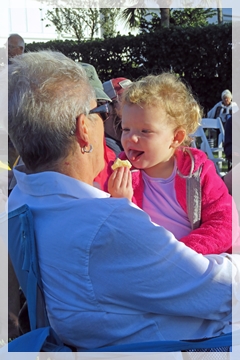 As we sang carols at the beach Christmas Eve, Sarah’s grand sat on her lap while finishing off a holiday cookie. By the time the little one was done with the cookie and cuddling her gram, Sarah’s shirt was a wrinkled mess of frosting, crumbs and cookie drool. I couldn’t help but think of the gospel story of parents bringing their children to Jesus for a blessing. Even in the first century, I imagine little children meant grubby hands, sticky fingers, and runny noses. From what we know of Jesus, though, I picture him welcoming those children onto His lap along with all of the mess that came with them. Perhaps some even left drool on his robe.
 In honor of that first Christmas, the one without decorations, piles of gaily wrapped presents or a feast, let’s try to keep it simple today and tomorrow. It’s not too late to change our plans and readjust our expectations. I’m sure Joseph and Mary didn’t plan on birthing in a stable, but their Christmas was a blessed one even though life didn’t go as they’d intended. Accept in advance that some things are certain to go wrong: guests won’t arrive on time, a gift will disappoint, food will burn, a drink will spill, toys will break, tears will be shed, directions will get thrown away, someone’s feelings will be hurt, and we’ll miss those who are absent. That’s as much a part of this holiday as church, carols, family, prayers, candy canes, laughter, a Christmas tree, and pine-scented candles.
 The following is a holiday pass-along story that has made the rounds on the Internet. Years ago, little Jimmy was shocked when his big sister told him there was no Santa. He tearfully went to his grandmother and asked her. Assuring Jimmy that Santa existed and she’d prove it to him, Grandma took him to the local department store. Instead of seeing the store Santa, as Jimmy expected they would, his grandmother gave him $10 and told him to use it to purchase a present for someone who needed one. Alone in the store, the boy pondered who should get a gift and finally decided on Robby, a boy in his classroom. Robby never went out at recess; although he said it was because he wanted to study, everyone knew it was because he didn’t have a warm coat. Jimmy found a brown wool coat, took it to the clerk and asked the price. After telling her he hoped he could afford it since it was a gift for a boy at school who didn’t have a coat, the clerk questioned how much he had. Proudly showing her his ten dollar bill, she told him that was the exactly what the coat cost and bagged it up for him.
 Look carefully then how you walk, not as unwise but as wise, making the best use of the time, because the days are evil. Therefore do not be foolish, but understand what the will of the Lord is. [Ephesians 5:15-17 (ESV)]
 Since he had a business meeting in Switzerland later in the week, my son went to London over the weekend to see his daughter who is in college there. Nearly every photo texted back to us showed my grand eating. Admittedly, she is a starving college student, living on a tight budget, who has grown tired of eating peanut butter, hummus with veggies, Raman noodles, and pasta in her apartment, so she took advantage of having access to her father and his credit card. With Dad paying the bill, she could again eat steak and lamb chops, indulge in gelato, and stock her pantry with fruit, meat, and cheese from Borough Market. As much as this starving coed needed food, what she really needed was a visit from home. Hugs from her father probably offered more nourishment than any amount of food. His visit did more than replenish her cupboards; it recharged her emotional batteries.
