LITTLE THINGS WITH LOVE

Feed the hungry! Help those in trouble! Then your light will shine out from the darkness, and the darkness around you shall be as bright as day. [Isaiah 58:10 (TLB)]

food bankWhile tucking toothbrushes, dental floss, Band-Aids, and soap into shoeboxes already filled with pencils, notebooks, markers, tee-shirts, and toys, I thanked God, not just for the privilege of giving, but also that basic items like these are not a luxury in my world. In many parts of the world, however, they are! For example, our pastor just returned from Cuba where a sample-size tube of toothpaste costs the equivalent of $5 and is so sparingly squeezed that it lasts a family of four one month. The gifts he’d packed in his suitcase were simple drugstore items such as toothpaste, feminine hygiene products, and pain relievers, but the people who received those basics were as appreciative as if he’d delivered a treasure chest of gold and diamonds.

Dwight Moody once told of a man at sea who was ill and confined to his cabin. Hearing that a sailor had fallen overboard and not knowing what he could do to help, the man picked up his light and held it against the port-hole. Upon hearing that the sailor had been rescued, the man returned to his bunk. When walking on the deck after his recovery, this gentleman met the fellow who’d fallen overboard that night. Recounting the frightening episode, the sailor said he’d been sure no one would see him in the darkness as he desperately tried to stay afloat in the churning waves. But, just as he started to go down for what he was sure was the last time, a light from out of a port-hole shone on him; finally seeing the drowning sailor, a man caught his hand and pulled him into the life-boat.

Our pastor’s suitcase of basics and the clothes he and his wife left behind in Cuba can’t stop the blackouts, ease the nation’s food shortages, or shorten the queues waiting for a bus or a few gallons of gas. The Samaritan’s Purse shoeboxes our church filled won’t change governments, provide jobs, or feed the hungry. The meals packed for food banks, clothes donated to resale shops, gifts purchased for strangers whose names hang on a giving tree, food served at a homeless shelter, change dropped into the bell ringers’ buckets, checks written to the Salvation Army, or the animal purchased for Heifer International won’t solve the world’s problems. Nevertheless, while we can’t change the world, we all can do our part to change the world for someone, even if it’s just with a toothbrush or a tube of toothpaste!

“Let us take the torch of salvation and go into these dark homes and hold up Christ to the people as the Savior of the world,” said Moody as he finished his story of the light in the port-hole. “Not all of us can do great things. But we can do small things with great love,” were the words of Mother Teresa. Few, if any, of us will pull a drowning sailor from the sea and we’re not likely to win a Nobel Peace Prize for our humanitarian efforts. Nevertheless, in our own small ways, we each can make a difference by shining a light for those in despair. Let us be the light that brings Christ’s love into the world!
You are the world’s light—a city on a hill, glowing in the night for all to see. Don’t hide your light! Let it shine for all; let your good deeds glow for all to see, so that they will praise your heavenly Father. [Matthew 5:14-16 (TLB)]

Eternal life is in him, and this life gives light to all mankind. His life is the light that shines through the darkness—and the darkness can never extinguish it. [John 1:4-5 (TLB)]

Copyright ©2019 jsjdevotions. All rights reserved.

WORLD KINDNESS DAY

Don’t ever forget kindness and truth. Wear them like a necklace. Write them on your heart as if on a tablet. Then you will be respected and will please both God and people. [Proverbs 3:3-4 (NCV)]

Too often we underestimate the power of a touch, a smile, a kind word, a listening ear, an honest compliment, or the smallest act of caring, all of which have the potential to turn a life around. [Leo Buscaglia]

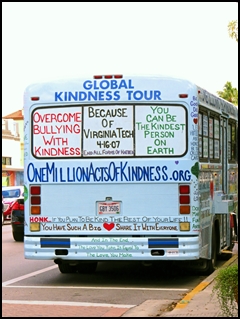
world kindnessThe mission of the World Kindness Movement (WKM) is to “inspire individuals and connect nations to create a kinder world.” Having no political or religious affiliations, the WKM is an international coalition of like-minded kindness NGOs (non-governmental organizations typically set up to address a social or political issue). Since its introduction in 1998, “World Kindness Day” has been observed every November 13. The purpose of this day is to “highlight good deeds in the community because kindness is the common thread that unites us all.”

When I looked at one kindness NGO website, it asked participants to pledge a good deed for today. Another site, hoping to make kindness a norm, made a series of suggestions, not just for November 13, but for every day! They suggested things like sharing a compliment or letting someone merge into your lane with a smile and a wave (and I don’t think they were suggesting using your middle finger in that wave). Other sites’ suggestions for Kindness Day included extra big hugs, three random acts of kindness, writing a thank you note, spending ten minutes cleaning up a park or playground, sending flowers to a friend, wheeling out your neighbor’s trash bin, visiting with someone who’s lonely, hiding a love note in that special someone’s purse or pocket, providing donuts to your co-workers, and bringing cookies to a neighbor. In this day and age, I’d be rather cautious about those extra big hugs unless you’re absolutely sure they’d be welcome, but the other ideas are all good. What bothers me is that we seem to need a day dedicated to kindness and a list of ways to do it. As Christians, shouldn’t kindness be the norm? After all, kindness is a fruit of the Holy Spirit and we all should be bearing His fruit!

While working on this devotion, I came across a recent “Pearls before Swine” comic (by Stephan Pastis). In the first frame, Pig is adding the 37th hash mark to his whiteboard list of “Badness in the World.” In the next frames, he’s seen walking into the city and then down a dark alley where he gives money to a ragged man sitting by a trash can. In the final frame, we again see Pig’s whiteboard. While it still has 37 marks in the “Badness” column, a “Goodness” column has been added. Pig confides to his friend Goat, “I’ll even this thing yet.” “Good for you, Pig!” I thought, “We can make a difference.”

Curious about the comic strip, I did a little research. Pig’s creator, Stephan Pastis, describes him as a “gentle, sweet and naïve soul…a bit slow-witted…a living rebuttal to those people who say that swine are intelligent animals.” Based on his description of Pig, I don’t know if Pastis was encouraging acts of kindness or was saying that only the dim-witted think they’ll ever be able to change the world!

Perhaps I’m being as naïve and gullible as Pig, but I truly believe that kindness can make a difference. As individual Christians, while we may not be able to change the world, we can change the world for someone. Moreover, when we work together, we can help change the world for many! When Jesus told us to love the Lord with all our heart, soul, mind, and strength, He also told us to love our neighbor as we love ourselves. [Mark 12:30-31] In short, He told us to be kind—every day and in every way. We don’t need to make a pledge to do a good deed today; as the hands and feet of Jesus, we should be doing good deeds all day, every day! Let’s put some more hash marks on Pig’s “Goodness” list!

Christ has no body now but yours. No hands, no feet on earth but yours. Yours are the eyes through which he looks compassion on this world. Yours are the feet with which he walks to do good. Yours are the hands through which he blesses all the world. Yours are the hands, yours are the feet, yours are the eyes, you are his body. Christ has no body now on earth but yours. [Teresa of Avila]

We show we are servants of God by our pure lives, our understanding, patience, and kindness, by the Holy Spirit, by true love, by speaking the truth, and by God’s power. [2 Corinthians 6:6 (NCV)]

God has chosen you and made you his holy people. He loves you. So you should always clothe yourselves with mercy, kindness, humility, gentleness, and patience. Bear with each other, and forgive each other. [Colossians 3:12-13a (NCV)]

Copyright ©2019 jsjdevotions. All rights reserved.

DID THEY KNOW?

Yes, I am the vine; you are the branches. Those who remain in me, and I in them, will produce much fruit. For apart from me you can do nothing. [John 15:5 (NLT)]

Twenty-one of the twenty-seven books of the New Testament are letters (epistles) written by Paul, James, Peter, John, and Jude. While the gospels tell us about the life, death, and resurrection of Jesus, the epistles are letters of instruction, clarification, encouragement and, sometimes, caution to the new Christian community. I can’t help but wonder if those early letter writers realized the scope of their writing. Did they have any idea how fast and wide Christianity would spread? Did they envision how many people would come to know both their names and words? While they expected their messages to be read aloud to the members of the 1st century church, did they even dare hope that 2,000 years later their letters still would be read aloud regularly in many churches, that some of their words would even be used in Christian liturgy, or that people around the world would gather together to study their messages?

The God-inspired words of those men live today and still apply to us. While the issues we face are different than those in the 1st century, the underlying problems and concerns remain the same: false doctrine, dissension, immorality, and even persecution. We are still called to be godly, avoid foolish disputes, love one another, preach Christ to the world, and walk in a manner worthy of Jesus. We never will outgrow the need to understand doctrine and its application to our lives.

The story is told of a frail old man planting seeds in a garden. A passerby stopped to chat and the old gardener offered him a mango from one of his trees. When asked what he was planting, the aged man replied more mango trees. “But why bother?” asked the man. “It will be fifteen years before they produce a full crop and you’ll not live to see that day.” Pausing from his work, the gardener replied that the mango he gave the stranger was from a tree his grandfather had planted more than fifty years earlier. He was now planting trees for his grandchildren to enjoy long after his death.

Although they saw the church expand, the epistles’ writers never lived long enough to see the magnitude of their work. They did, however, know the promises of God: if they abided in Him, their work would bear fruit and His church would be built. The seeds they planted with their letters continue to bear fruit today.

Let us remember that, like the writers of the epistles (and the old man in the story), we should be committed to planting the seeds of faith, even though we may not see them bear fruit. It’s been said that, “The best time to plant a tree was 20 years ago. The second best time is now.” Indeed, it is.

This same Good News that came to you is going out all over the world. It is bearing fruit everywhere by changing lives, just as it changed your lives from the day you first heard and understood the truth about God’s wonderful grace. [Colossians 1:6 (NLT)]

Copyright ©2019 jsjdevotions. All rights reserved.

FINDING SOMETHING NEW

“But this is the new covenant I will make with the people of Israel after those days,” says the LORD. “I will put my instructions deep within them, and I will write them on their hearts. I will be their God, and they will be my people.” [Jeremiah 31:33 (NLT)]

pikaSpencer Johnson’s Who Moved My Cheese? is an uncomplicated parable about two mice and two “little people” (Hem and Haw) who are looking for the “cheese” that will bring them happiness. When the cheese disappears, the mice quickly scurry off in search of more. Hem and Haw, however, have built their life around that cheese. Arrogantly thinking their brains are superior to those of their four-legged friends, they are unwilling to change and search for different cheese. Eventually, hunger drives Haw to leave his comfort zone and go in search of new cheese. When he finds it, he also finds those simple creatures, the mice, who’d been there for quite a while and enjoying the delicious new cheese.

The cheese is a metaphor for what we desire in life, whether a relationship, job, money, or peace of mind, and the book is about dealing with change, keeping things simple, and not confusing ourselves with fearful beliefs. Hem and Haw always thought that change would lead only to something worse. It is not until Haw understands that change also can lead to something better that he starts looking for new cheese. Sadly, left behind in the maze is Hem. Paralyzed with fear, in spite of his hunger, he stays in his comfort zone where the old cheese had been.

Throughout the story, Haw writes messages on the wall. When he writes, “The more important your cheese is to you, the more you want to hold on to it,” I couldn’t help but think of the Pharisees in Jesus’s time. The law was their cheese; they held tight to it and then over-complicated it. The simple law of keeping the Sabbath day became burdensome with its thirty-nine categories (and hundreds of subcategories) of prohibited work and exceptions to the rules. While tying knots was prohibited, if the knot could be untied with just one hand, it was allowed! People couldn’t carry their clothes out of a burning house on the Sabbath but they could put on several layers of clothing and wear them out! As happened with Hem, the Pharisees became over-confident and arrogant; for them, their complicated set of rules was the only cheese, even when it ceased making sense!

Jesus, however, introduced a new kind of cheese: a new covenant of salvation through faith, not works. Rather than the law being written with ink on paper it was written with the blood of Jesus upon men’s hearts. Although God’s promise of a new covenant came true in Jesus, the Pharisees refused to change and stayed hungry in their corner of the maze.

A great many of us in the 21st century are little different from those who resisted Jesus in the 1st. We may not cling to a long list of prohibitions and rules as did the Pharisees but, out of fear of change, we cling to a way of life that isn’t working. We’re like the rich man who asked Jesus what he needed to do for eternal life. When told that he must give up the old cheese (his riches), he walked away rather than accept Jesus’s offer of salvation. Like Hem, could we be going hungry when all we need to do is step out of our comfort zone and seek the Bread of Life? Or, like, Haw, will we seek and find?

His purpose was for the nations to seek after God and perhaps feel their way toward him and find him—though he is not far from any one of us. For in him we live and move and exist. [Acts 17:27-28a (NLT)]

Jesus replied, “I am the bread of life. Whoever comes to me will never be hungry again. Whoever believes in me will never be thirsty.” [John 6:35 (NLT)]

Copyright ©2019 jsjdevotions. All rights reserved.

THE BEST TIME TO MEET HIM

I am the resurrection and the life. Anyone who believes in me will live, even after dying. Everyone who lives in me and believes in me will never ever die. [John 11:25-26 (NLT)]

In commenting about the unexpected death of a young man, the pastor said, “The best time to meet God is when you’re right with God!” For a good part of his brief life, the young man about whom he was speaking had been a troubled unbeliever but, shortly before his death, he came to know Christ. While he will be missed by his grieving family and friends, they can find comfort in knowing his final destination. Since they, too, are believers, they know they will see him again in the future.

The pastor’s comment made me remember a sympathy note written by C.S. Lewis in 1944 to the wife of fellow professor at Oxford. After expressing how much he missed the man, Lewis told the new widow how deeply the professor’s funeral had affected him. Mentioning the many times he’d heard the same service read for non-believers, he admitted to a sense of relief at hearing those same words said for a true man of faith: “a man not unworthy of the service.” Lewis admitted that, “In some queer way it enormously strengthened my faith, and before we filed out of chapel I really felt…a kind of joy—a feeling that all was well, just as well as it could be.” Understanding that the best time to meet God is when you’re right with God, Lewis knew the professor had been welcomed home by his Father in Heaven.

I think of a friend, whose husband is nearing the end of his life.  As non-believers, she knows a religious service would be hypocritical and has been pondering what sort of funeral she might have for her husband when the time comes. For a non-believer, there is little comfort in hearing that Jesus is the resurrection and the life and His believers will never die or that our bodies “buried in brokenness…will be raised in glory.” Scripture’s words of assurance that Jesus has prepared a place for us in His Father’s house or that nothing can separate us from Christ’s love are meaningless to someone who doesn’t know Jesus.

Believers and non-believers alike experience grief but it was the faith C.S. Lewis shared with his fellow professor that allowed him to experience joy at his friend’s funeral. The words of a traditional Christian funeral/celebration of life service are only comforting to a believer if the dearly departed was a believer.

When my friend’s husband dies, I don’t know how she will mark his passing, but it won’t be with words of Scripture, prayers, psalms, or hymns. When that day comes, I will choose my words of sympathy carefully; they probably will be something innocuous about hoping her memories bring her comfort and solace. (Her lack of faith certainly won’t!) No matter how nice the memorial program or beautiful the music, I will not feel a kind of joy as I depart because I know that the best time to meet God is not when you deny His existence. The best time to meet God is when you’re good with Him!

Our bodies are buried in brokenness, but they will be raised in glory. They are buried in weakness, but they will be raised in strength. [1 Corinthians 15:43-44 (NLT)]

Copyright ©2019 jsjdevotions. All rights reserved.

ACT ON IT

Grand Canyon - Bright Angel PointAs Jesus was walking along, he saw a man named Matthew sitting at his tax collector’s booth. “Follow me and be my disciple,” Jesus said to him. So Matthew got up and followed him. [Matthew 9:9 (NLT)]

In Arizona, sightseers can walk out on the Skywalk, a transparent horseshoe-shaped cantilevered bridge that juts out 70 feet and stands 4,000 feet above the floor of the Grand Canyon. In Illinois, visitors to the Willis (Sears) Tower in Chicago can step off the Skydeck onto The Ledge, a glass box that extends out more than four feet and is suspended 1,353 feet (103 stories) above the city streets. Two miles away, in the John Hancock building, visitors to the Windy City can get another unique cityscape as eight visitors at a time hang out on the TILT from the Hancock’s 94th floor. Called a thrill ride, riders stand on a glass platform 1,030 feet over the city that that tips down over the edge of the building at a 30-degree angle.

The Skywalk is bolted to the canyon’s rim and can support seventy 747-passenger jets. The Willis Tower Ledge is made of three layers of half-inch glass and topped by another quarter-inch protective layer. Designed to hold five tons, over six million people have safely ventured out on it. Like it, the TILT is constructed of precision fabricated steel and several layers of reinforced glass and over one million riders have safely dangled 94 stories above the street on it. Although I believe all of these viewing platforms are well supported, regularly inspected, and considered safe, I will never set foot on any of them. I will never experience the thrill or enjoy the stunning views they offer simply because believing these structures are safe isn’t enough to make me commit to stepping out onto any of them. Intellectually believing something is true doesn’t necessarily mean we will act on that thought.

While I’ll miss seeing the Grand Canyon from the Skywalk, viewing fifty miles across four states from The Ledge, and hanging over Michigan Avenue on the TILT because of my lack of faith, there is one experience I don’t want to miss because of a lack of faith: a relationship with God the Father, God the Son and God the Holy Spirit. Let us never make the mistake of intellectually believing in Jesus, that he actually existed and even rose from the dead, and then not believing deeply enough to take the necessary steps to actually follow wherever He may lead us! We’ve got to step out in faith to walk with Him. The view from Heaven is one experience I don’t want to miss. How about you?

We don’t believe something by merely saying we believe it, or even when we believe that we believe it. We believe something when we act as if it were true. [Dallas Willard]

And now, just as you accepted Christ Jesus as your Lord, you must continue to follow him. [Colossians 2:6 (NLT)]

Copyright ©2019 jsjdevotions. All rights reserved.