
I pray that God, the source of hope, will fill you completely with joy and peace because you trust in him. Then you will overflow with confident hope through the power of the Holy Spirit. [Romans 15:13 (NLT)]
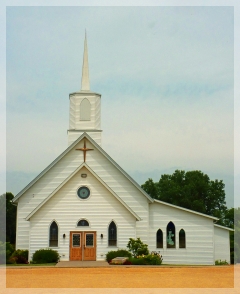
Shutting their doors last Sunday was not an easy choice for church boards or parishioners. We are designed for community; gathering together for prayer, praise, instruction, fellowship, and the Lord’s Supper is part and parcel of being a Christian. Suddenly, our worship experience, traditions, rituals, and church family were taken from us with this new concept of “social distancing.” What it comes down to is simple: Jesus’ command to love one another. Right now, the best way to love one another is to avoid putting anyone, most especially those at high risk, in danger. Unfortunately, that means no longer meeting together in houses of worship.
I imagine Satan was chuckling in devilish glee last week as church after church cancelled services and closed their doors. What Satan doesn’t understand is that, while a church is a building, the Church isn’t! Scripture likens the Church to being a family, a flock of sheep, a body, and the “bride” of Christ. Whether a cathedral or a gazebo at the beach, the Church isn’t where we go, it’s who we are! Simply put, the church is a body of believers who live out the Gospel in their words and actions. We don’t need walls, pews, sound systems, kneelers, hymnals, programs, and video screens or an altar, stage, organ, choir, sanctuary, sacristy or narthex to do that!
Not attending church services or Bible study doesn’t mean we stop worshiping, praying, learning, or serving. We just have to do it another way by taking advantage of 21st century technology with things like streaming, pod casts, conference calls, FaceTime, App offerings, and on-line studies. Granted, it’s difficult to be the church when we can’t meet together, even in small groups. Nevertheless, we can still check on and encourage one another, paying special attention to those who live alone or may be without any support system. When necessary to leave our homes for supplies, we can continue to be Christ’s hands and feet by picking up necessities for house-bound neighbors. We even can evangelize by sharing our church’s online services with others. Although we all have suffered economically, some are better off than others. For those who are still able, continued (or even increased) support of our churches, missions, and relief organizations is a must. The need doesn’t go away when church doors shut! We’ll have to be creative, but we can continue to love and serve our sisters and brothers—even from a distance.
We can seek the hidden blessings in our isolation. Between closures and cancellations, I deleted forty events from my calendar for the next thirty days. My habitual complaint has been lack of time but, now that my calendar is free and I have nowhere to go, I have plenty of it! Let us endeavor to look at this forced isolation as a blessing rather than a curse!
Even though we can’t meet together, we must continue to encourage one another by finding joy in our trials and inspiring others to do the same. Using WhatsApp to spread the news, a Spanish trainer held a workout class on a low rooftop. Looking down through their windows, his class did jumping jacks and squats while sequestered in their apartments! Locked-down Italians have been having impromptu concerts from their balconies: a guitar and flute duet was presented in Turin, a man performed a trumpet solo in Trapani, and the streets of Siena and Salerno were filled with song as housebound people sang to one another. Last Friday, the term “flash mob” took on a new meaning when thousands of confined Italians stood on their balconies or hung out windows and made music with whatever they could find. A quarantined magician aboard the Diamond Princess is offering a daily televised magic show to his fellow room-bound passengers!
Most of us can’t lead an exercise class, sing from our balconies or make quarters disappear (except into vending machines), but we all can find a way to be the church. For example, the young people from a Colorado SK8 church are making grocery and pharmacy runs for the community’s elderly and housebound. As Christ followers, we continue to praise God, find joy in our circumstances, and bring light into darkness! While church doors are closed, our hearts and minds remain open to receive the joy of the Lord. We will pass that joy and His good news on to others because we are the church!
 My latest exercise in learning how to live the abundant life promised by Jesus was both easy and difficult: I was to speak to one person about God, even if all I said was, “God is good” or “God loves you.” Since I write about God five days a week, said “God bless you!” to a friend, and talked about God with my pastor, I figured I was done, except I knew I wasn’t.
 The story has been told of a shoemaker who dreamt that Jesus would come to his shop the following day. His dream was so realistic that he washed his shop windows and dusted every shelf in preparation for his holy guest. The man patiently waited at his bench for the Lord to arrive but the only person to come through his door that morning was an old man seeking shelter from the icy winter rain. When the cobbler looked down at the man’s wet feet, he saw toes poking out of his beat-up shoes. Selecting a new pair of shoes, the shoemaker sat the old man down, dried off his feet, gave him a fresh pair of socks, and fitted him with the new shoes. When the rain stopped, the old man went on his way.
 Ecclesiastes tells us there is a right time for everything, Colossians and Ephesians tell us to use our time wisely, Proverbs warns about wasting time, James cautions that we don’t know what tomorrow will bring, Corinthians warns us time is short and, readily admitting that his time and future are in God’s hands, David tells us to number our days. Nowhere does Scripture tell us how to have more time!
 Instead, be kind to each other, tenderhearted, forgiving one another, just as God through Christ has forgiven you. [Ephesians 4:32 (NLT)]
 While “Don’t cry over spilled milk,” isn’t one of Solomon’s proverbs, that wise advice is several centuries old. “No weeping for shed milk,” appeared in a book of English proverbs back in 1659 and some historians believe the saying dates back to medieval days. Superstitious, people left spilled food for the fairies or elves to eat and drink. If someone cried over spilled milk, it was feared that the fairies might think the offering was begrudged and bad luck would visit the house.
