LITTLE BROWN BIRDS

My brothers and sisters, believers in our glorious Lord Jesus Christ must not show favoritism. [James 2:1 (NIV)]

The Lord does not look at the things people look at. People look at the outward appearance, but the Lord looks at the heart. [1 Samuel 16:7 b (NIV)]

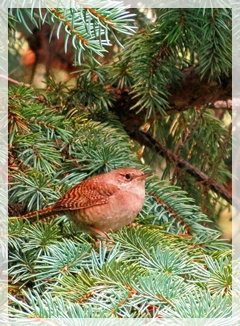
house wren

Unless a bird is impressive and memorable, I give it little notice and classify it broadly by size and color. Yesterday’s devotion reminded us that people aren’t nameless/faceless little brown birds to God. I then asked myself if they are to me. Do I truly see the people around me for the unique and beautiful individuals they are or are some just little brown birds? Think of the quiet unobtrusive people we see every day but barely notice: the bagger at the grocery, the busser at the restaurant, the lady with the schnauzer, the fast food cashier, the fellow stocking shelves, the landscaper, the old man at the coffee shop, or the parking lot attendant. Do we simply look past or even through them without a second glance? I hate to admit how many times wait staff and sales clerks have introduced themselves only to have me immediately forget both their names and faces.

Do we only take notice of the eagles, cardinals, and great blue herons of life? When Samuel anointed Israel’s first king, it was Saul. Described as the most handsome man in Israel and taller than anyone else in the land, he may have been as impressive as an eagle but he was a weak leader and a cowardly king. In contrast, Israel’s next king, David, was more like a little brown bird. He may have been handpicked by God but he was overlooked and ignored by everyone else. When Samuel came to Jesse in search of a new king, he invited Jesse and all of his boys to a sacrifice. It was only after every one of Jesse’s sons was rejected by the Lord that Samuel learned the youngest boy, David, hadn’t even been invited to the feast. In spite of being anointed by Samuel, David continued to be insignificant to his father and brothers until he defeated Goliath. It was the little brown bird rather than the showy eagle who saved the Israelites with a slingshot and a few well-placed stones.

A pharmaceutical ad begins with psoriasis patients saying the words, “See me.” It’s not just people with skin conditions who want to be seen as individuals; we all want to be seen as the unique people we are. Consider Jesus; there were many who met a poor itinerant rabbi, a carpenter’s son from Nazareth, and never really looked at Him or listened to His words. That unimpressive little brown bird they so easily dismissed was God!

We don’t need a scope or telephoto lens to help us see the little brown birds of daily life and we certainly don’t need an Audubon book to learn their identities. We just have to open our eyes to the people around us, really look at them, acknowledge their presence, and listen to their words. In actuality, rather than elegant egrets or gaudy peacocks, most of us are more like little brown birds—ordinary, inconspicuous, and easy to overlook. Nevertheless, we are extraordinary in our own ways and we all want to be seen for who we are. God doesn’t judge by outward appearance and neither should we. After all, it’s the little brown birds that sing the sweetest songs in the forest.

He grew up before him like a tender shoot, and like a root out of dry ground. He had no beauty or majesty to attract us to him, nothing in his appearance that we should desire him. He was despised and rejected by mankind, a man of suffering, and familiar with pain. Like one from whom people hide their faces he was despised, and we held him in low esteem. [Isaiah 53:2-3 (NIV)]

Copyright ©2018 jsjdevotions. All rights reserved.

HE KNOWS OUR NAMES

O Lord, you have examined my heart and know everything about me. You know when I sit down or stand up. You know my thoughts even when I’m far away. You see me when I travel and when I rest at home. You know everything I do. You know what I am going to say even before I say it, Lord. You go before me and follow me. You place your hand of blessing on my head. Such knowledge is too wonderful for me, too great for me to understand! [Psalm 139:1-6 (NLT)]

house sparrowRomper Room, a children’s program that first aired in 1953, was like a televised pre-school/kindergarten class. At the end of every show, the hostess would pick up her magic mirror and recite the words, “Magic Mirror, tell me today, did all my friends have fun at play?” Looking through an open frame shaped like a hand mirror, she’d then call out various children’s names: “I see Johnny had a special day today, Olivia had a special day yesterday, and I see Bonnie, Tammy and Gregory had special days, as well, and Brandon, you know I see you…” For forty years, small children patiently sat in front of their TVs hoping to hear their names called. While that illustrates the naiveté of youngsters back then, it also demonstrates how much we all want to be noticed and recognized.
When the man at the park asked me what kind of bird it was, I identified it as an LBB and explained that meant “little brown bird.” Chances are it was one of the twenty kinds of sparrows around here. Then again, it could have been some sort of wren or finch. Had it been a little larger, it would have qualified as the equally vague BBB (bigger brown bird). As much as I enjoy spotting the peepers in the trees and even taking their pictures when they remain still long enough, I don’t care enough about them to know their names or the songs they sing.

Fortunately, God knows not just our names but all there is to know about us: our hopes, needs, fears, and concerns. There are no LBBs (little boring biddies), LOLs (loud old ladies), BFMs (big fat men), TWAs (teens with attitude), TTs (troublesome tots), CCs (chronic complainers), or PWPs (people with problems) in His kingdom. To God, we all have distinctive names, faces, personalities and voices. Unlike me, He doesn’t need a field guide with our pictures or a CD with our songs to know who we are. Unlike the Romper Room hostess, He doesn’t pretend to have a magic mirror that allows Him to see us or know how we feel. The author of our days, He knows what today was like for us and what tomorrow will bring to us. God not only sees each and every one of us but He sees into us—into our very hearts and souls—and, somehow, He still manages to love and value us as only a father can.

What is the price of two sparrows—one copper coin? But not a single sparrow can fall to the ground without your Father knowing it. And the very hairs on your head are all numbered. So don’t be afraid; you are more valuable to God than a whole flock of sparrows. [Matthew 10:29-31 (NLT)]

Copyright ©2018 jsjdevotions. All rights reserved.


LIVING WATER

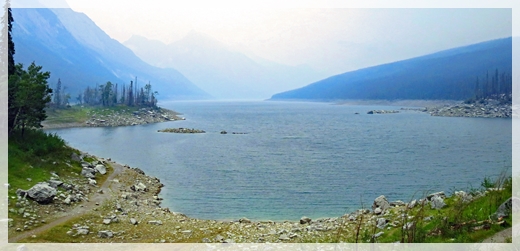
Medicine LakeJesus replied, “If you only knew the gift God has for you and who you are speaking to, you would ask me, and I would give you living water. … But those who drink the water I give will never be thirsty again. It becomes a fresh, bubbling spring within them, giving them eternal life.” [John 4:10,14 (NLT)]
When in Canada last summer, we came across a strange body of water called Medicine Lake; although it looks like a lake, it really isn’t. It’s where the Maligne River backs up before disappearing into several underground pipelines. The cave system draining this river is one of the most extensive in the world. Every spring, the runoff from melting glaciers and snow fills the river with water much faster than it can drain and, as the water backs up, the river becomes a lake. As the summer progresses, the inflow slows and the water level gradually lowers until, in autumn, it once again looks like a river. The disappearing water resurfaces far away in lakes and rivers throughout the Canadian Rockies and eventually ends up in the Pacific Ocean. Medicine Lake is like a bathtub without a stopper that is being filled faster than it can drain; once the faucet’s flow slows down, the tub’s water level lowers but it never quite empties.

On the other hand, the bogs near our northern home are more like bathtubs with drains so gunked up from hair, soap and other yucky stuff that the water can’t empty. Typically, rain and snow are the only source of a bog’s water. Formed when a lake fills with debris, a bog has little or no drainage and the water that enters it stays there. Without movement, the bog’s water becomes stagnant, gets a foul odor, and can become a breeding ground for insects, bacteria, parasites and disease. Thinking of these two bodies of water, I wondered if I’m like Medicine Lake or a bog. Like the lake, do I spread God’s blessings or, like the bog, do I keep them all to myself? The water that feeds both starts clear and fresh, but only water that flows (as it does in the lake) remains that way.

Jesus said He gives us living water, the Holy Spirit, so that we’ll never thirst again. For the water to remain fresh and sweet, however, we can’t allow it to become stagnant; it must flow in and through us and, like the water from Medicine Lake, spread far and wide. Like those underground streams, we must be His pipelines, not just of our blessings, but of the fruit of the Holy Spirit. Only when Jesus’ living water pours through us can we bring life to the world. Are we stagnant cisterns or flowing pipelines with rivers of living water flowing from our hearts?

Jesus stood and shouted to the crowds, “Anyone who is thirsty may come to me! Anyone who believes in me may come and drink! For the Scriptures declare, ‘Rivers of living water will flow from his heart.’” (When he said “living water,” he was speaking of the Spirit, who would be given to everyone believing in him. [John 7:37-39a (NLT)]

The Lord will guide you continually, giving you water when you are dry and restoring your strength. You will be like a well-watered garden, like an ever-flowing spring. [Isaiah 58:11 (NLT)]

Copyright ©2018 jsjdevotions. All rights reserved.

GIVING THANKS

Make thankfulness your sacrifice to God, and keep the vows you made to the Most High. … But giving thanks is a sacrifice that truly honors me. If you keep to my path, I will reveal to you the salvation of God. [Psalm 50:14,23 (NLT)]

It’s one thing to be grateful. It’s another to give thanks. Gratitude is what you feel. Thanksgiving is what you do. [Tim Keller]

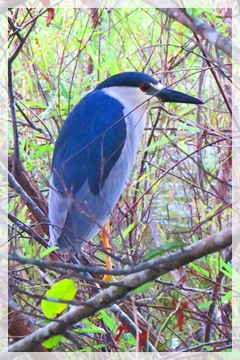
Black-crowned night heronYesterday I happened upon a wood stork enjoying a fish breakfast. I was astonished as the stork swallowed the whole wriggling fish in one big gulp. “I’ll have to put that in my gratitude journal,” I thought as I walked on. Later, I spotted two woodpeckers hammering away at a tree and got up close and personal with a pond snail laying eggs. Two more for the journal, I thought. Did I put those little blessings in my journal last night? Shamefully, I forgot to write in it at all; worse, I totally forgot about them in my nightly prayers!
When I look back at the rest of yesterday, all sorts of wonderful little things happened for which I was grateful and yet failed to thank God. Without having one red light, I got to an appointment with time enough to take a short walk on the beach. I’m not self-centered enough to think God turned all those lights green just for me; nevertheless, my day went better because of it and it deserved thanks. I met a delightful young couple at cooking class. Did God put them there just for me? I don’t know, but I was thankful to have them as cooking partners for the afternoon. There was a beautiful cooling breeze and the sunset was magnificent. Did God arrange the weather to my wishes? I doubt it, but I should have told Him how much I appreciated it! I was remiss in acknowledging God’s presence or thanking him for the day’s numerous small blessings.

Today, I set out again and spotted a black-crowned night heron hiding in the bushes. While getting a photo, I thought, “I’ll have to put that in my gratitude journal.” This time, however, that small voice reminded me how lackadaisical I’ve gotten with my journal and asked me why I was waiting to thank the creator of all those beautiful moments. That gave me pause. If I’d been walking with someone else, I would have shared those sightings. Although I wasn’t walking with another person, I was walking with God. Why wasn’t I talking to Him? Why wasn’t I sharing my joy with the one who gave it to me? God was right beside me and He shouldn’t have to wait until I get around to thanking him or writing in my journal, especially since I’m not good about remembering to do so. Thanks should be speedy and sincere.

We thank God through our prayer. We don’t need church, a table blessing or a gratitude journal to do so. We certainly don’t need to wait until our regular prayer time to offer thanks and, most especially, we shouldn’t wait until November for Thanksgiving Day! Our whole day, every day, should consist of a prayer of thanksgiving. God is with us as we take our daily walk; let us remember to thank him for the joy we find along with way.

We need to discover all over again that worship is natural to the Christian, as it was to the godly Israelites who wrote the psalms, and that the habit of celebrating the greatness and graciousness of God yields an endless flow of thankfulness, joy, and zeal. [J.I. Packer]

And give thanks for everything to God the Father in the name of our Lord Jesus Christ. [Ephesians 5:20 (NLT)]

 Give thanks to the Lord, for he is good! His faithful love endures forever. [1 Chronicles 16:34 (NLT)]

Copyright ©2018 jsjdevotions. All rights reserved.

ROOTS

And now, just as you accepted Christ Jesus as your Lord, you must continue to follow him. Let your roots grow down into him, and let your lives be built on him. Then your faith will grow strong in the truth you were taught, and you will overflow with thankfulness. [Colossians 2:6-7 (NLT)]

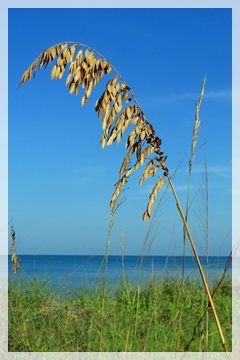
sea oatsIt’s not just light poles that were destroyed by Hurricane Irma’s winds; many trees also met their end at her hands. As I looked at the upended roots of a once mighty oak, I thought of one of Aesop’s fables about an oak in a storm. A proud oak stood by a stream, and like this one, had survived several storms in its many years. One day, a hurricane the likes of Irma arrived and the great oak fell with a thunderous crash. As the water rose, it was carried down to the sea. When the oak eventually came to rest along the shore, it looked up at the sea oats that were waving in the now gentle sea breeze, “How did you manage to weather such a terrible storm?” it asked. “I’m a great oak and even I didn’t have strength enough to battle the wind.”

The sea oats replied, “That was your problem. You were too proud to bend and yield a little and so the wind knocked you over. I’m just an insubstantial sea oats plant but, knowing my weakness, I didn’t resist as the wind gusted. The harder it blew, the more I humbled myself and the lower I bent. So, here I am, still enjoying the beach. Aesop’s moral is that it is better to bend than to break. “Perhaps there a message here,” I thought and, yet, I wasn’t sure it was just about pride and humility.

The Apostle Paul was very clear about standing firm in the face of trials and temptation. He told the early church to stand firm and not to waver; he wanted them to be oaks and not sea oats. When facing one of life’s hurricanes, however, it’s pretty hard not to wobble, quiver and quake wildly. If we stand firm, will we be knocked down and end up a piece of drift wood or ground up into mulch? If that mighty oak couldn’t weather the storm, how can we?

The Apostle also said that growing roots in Jesus is what will keep us strong. That fallen oak’s upended roots were taller than me and yet they didn’t do the oak much good when Irma arrived. The roots of which Paul speaks are deep roots that grown down into our Lord. It is strong deep roots that will serve to anchor a tree in the ground. I’m not an arborist, but I could easily see that there was nothing deep about that oak’s roots (or the roots of the many other uprooted oaks throughout our community).

In Jesus’ parable about soil, he told of seed scattered on good soil that grew, seed strewn on a path that was eaten by the birds, seed that was crowded out by the thorns, and seed that fell on rocky soil. Those plants in rockyy soil grew quickly but, since their roots weren’t deep, they withered in the hot sun. If He’d been in a tropical climate like Florida’s, Jesus could have used sand and hurricanes instead of rocks and sun in His analogy. Good nutritious soil is necessary for a plant’s success and Florida’s soil is shallow and mostly sand. The many fallen oaks’ roots, while wide, were shallow and certainly not the kind of roots of which Jesus and Paul spoke.

Aesop’s fable was about pride and humility but the many uprooted oaks in town tell me something more. Granted, there may be times we need to bend a little, as do the sea oats, but we must never bend if that means compromising our faith. I think of Daniel, Shadrach, Meshach, and Abednego. Their roots were so deep that they were willing to die before they bent down to worship a false god or failed to worship the true one. While a miracle saved them, there was no miracle for Stephen, a man whose deep roots in Christ gave him strength enough to stand and testify before the Jewish high council knowing he’d die because of it. These men were willing to be sacrificed and broken before bending to the prevailing wind.

Given a choice, I would rather stand strong, like an oak with deep roots, than fall because of the wind. Nevertheless, if the wind is blowing in the wrong direction, like Stephen and other Christian martyrs, I would rather be broken and fall than bend and survive as do the sea oats.

I pray from his glorious, unlimited resources he will empower you with inner strength through his Spirit. Then Christ will make his home in your hearts as you trust in him. Your roots will grow down into God’s love and keep you strong. [Ephesians 3:16-17 (NLT]

Copyright ©2017 jsjdevotions. All rights reserved.

MASTER WEAVERS

And we know that God causes everything to work together for the good of those who love God and are called according to his purpose for them. [Romans 8:28 (NLT)]

spider websIt rained last night. During our early morning walk, we looked out over the prairie and saw hundreds of sparkling spider webs. As the morning sun caught the water droplets on the silk, the master weavers’ work glistened in the mist. Although we take that trail several times a week, it was the first time this season we saw those arachnidan works of art. The spiders didn’t start spinning just the previous night; their webs have been there all summer but weather and light conditions kept us from seeing them. In fact, had we chosen to walk the loop in the other direction, we never would have seen them at all!

God, like his eight legged creations, is always busy weaving the strands of our lives. Much of the time, however, as with the spider webs, we don’t see or understand what He’s doing. “Where is God in all of this?” we ask. It is usually in hindsight that we recognize His presence—the way He moved, guided, protected, instructed, disciplined or provided for us. Nevertheless, whether or not we see His hand in our circumstances, we know that He, like the spiders, is ever-present and busy weaving.

I find those beautiful webs reassuring. They show me that God will give us beautiful gifts when we least expect them but that we must be willing to look for them in the most unlikely places. The webs remind me that we don’t need to see God to know that He is always there and always working. Moreover, God reveals himself in a variety of ways. While an angel or burning bush is dramatic and impressive, let’s remember that Elijah did not find God in the mighty wind, earthquake or fire. He found God in a gentle whisper. As for me, spiders’ webs on a misty morning are one of the ways God reassures me of His presence and His amazing plan; they are God’s gentle whisper of reassurance from the Master Weaver!

Our lives are but fine weavings
That God and we prepare
Each life becomes a fabric planned
And fashioned in His care.
We may not always see just how
The weavings intertwine,
But we must trust the Master’s hand
And follow His design,
For He can view the pattern
Upon the upper side,
While we must look from underneath
And trust in Him to guide.
Sometimes a strand of sorrow
Is added to His plan,
And though it is difficult for us,
We still must understand
That it is He who fills the shuttle,
It is He who knows what is best,
So we must weave in patience
And leave to Him the rest.
Not till the loom is silent
And the shuttles cease to fly
Shall God unroll the canvas
And explain the reason why
The dark threads are as needed
In the Weaver’s skillful hand
As the threads of gold and silver
In the pattern He has planned. [Author unknown]

Just as you cannot understand the path of the wind or the mystery of a tiny baby growing in its mother’s womb, so you cannot understand the activity of God, who does all things. [Ecclesiastes 11:5 (NLT)]

Copyright ©2017 jsjdevotions. All rights reserved.