GONE IN A FLASH – EASTER MONDAY

And just as each person is destined to die once and after that comes judgment, so also Christ was offered once for all time as a sacrifice to take away the sins of many people. He will come again, not to deal with our sins, but to bring salvation to all who are eagerly waiting for him. [Hebrews 9:27-28 (NLT)]
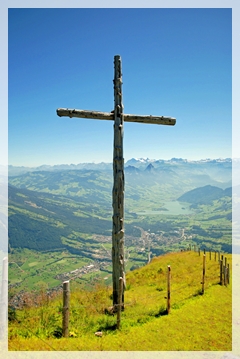
Zermatt - Switzerland - crossAfter warning us not to put them in our pockets and accidentally take them home (or put them in the dryer if we did), small pieces of paper were given to everyone in attendance at last week’s Good Friday service. Following the sermon, we were asked to write a sin (or sins) for which we repent on the papers, come forward, and nail them to a cross resting on the steps before the altar. Listening to the hammering echoing in the sanctuary, I thought of what it must have sounded like two thousand years ago when Jesus and the others were hammered to their crosses: the loud pounding of the hammers, the commotion of the crowd, the mockery of the soldiers, and the cries of agony from the men as those blunt tipped nails pierced their bodies.

Those slips of paper were made of nitrocellulose; often used by magicians, they are commonly known as flash papers. Once we’d nailed our papers to the cross, the pastor ignited them and they instantly disappeared in a brilliant display of fire. Nothing, neither smoke nor ash, was left of them. What a powerful illustration of the way Jesus’s blood, shed on the cross as those nails were hammered into Him, made our sins disappear forever.

Next to the small olive wood cross on my desk, I now have a three-inch square-cut nail, a souvenir from Good Friday’s service. The cross, with its distinctive grain, artistic shape, and smooth finish, is so beautiful that it’s easy to forget it represents an instrument of torture. The dark rustic nail beside it will better remind me of the sacrifice Jesus made for all of us. Paying the price for our sins, His death brought us back into fellowship with God the Father. After the joy of Resurrection Sunday, however, it’s easy to forget the magnitude of that sacrifice until Lent rolls around next year. Let us never forget the miracle of forgiveness that occurred when a suffering bleeding and totally sinless Jesus endured torture and death for the forgiveness of our sins.

He has redeemed me, a lost and condemned human being. He has purchased and freed me from all sins, from death, and from the power of the devil, not with gold or silver but with his holy, precious blood and with his innocent suffering and death. [Martin Luther]
Christ suffered for our sins once for all time. He never sinned, but he died for sinners to bring you safely home to God. He suffered physical death, but he was raised to life in the Spirit. [1 Peter 3:18 (NLT)]

Now all of us can come to the Father through the same Holy Spirit because of what Christ has done for us. [Ephesians 2:18 (NLT)]

Copyright ©2018 jsjdevotions. All rights reserved.

TEFILLIN

So commit yourselves wholeheartedly to these words of mine. Tie them to your hands and wear them on your forehead as reminders. Teach them to your children. Talk about them when you are at home and when you are on the road, when you are going to bed and when you are getting up. [Deuteronomy 11:18-19 (NLT)]

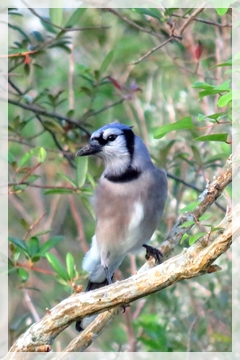
Blue jayFor thousands of years, during their weekday morning prayers, observant Jews have worn tefillin. Sometimes called phylacteries, they are small black leather boxes attached to leather straps. Inside the boxes are four sections of the Torah from Exodus and Deuteronomy. The verses pronounce the unity of one God in what’s called the Shema, the promise of blessings for obedience and warning of retribution for disobedience, the obligation to remember the Jews’ bondage in Egypt, and the responsibility to transmit their faith to their children. One box is strapped on the left arm so to be near the heart and the other is strapped on the forehead. The placement symbolizes that God’s word is to be impressed upon both the heart and soul.
I don’t have words from Exodus and Deuteronomy written on parchment and placed on my body, but I do have sticky notes with Bible verses stuck on my bathroom mirror and on the wall by my desk, along with a verse-filled envelope in my purse, and lists in my journal and by my bed. Struggling with my Lenten discipline of memorizing Bible verses, I’d put them in a box on my forehead if I thought that would help! A few days ago, however, I realized part of my problem—the verses I was memorizing were someone else’s choice and not mine!

Several years ago, admitting my inability to quote Scripture, I asked how a church friend always seemed to have the perfect Bible verse on the tip of her tongue. “Verses are easy to memorize,” she replied, “when they mean something to you.”  Recalling that conversation, I scrapped the ready-made list of Bible verses I was using and selected some verses of my own.

While all Scripture is worthy of memory work, we each have verses that speak to us personally, as if God spoke those words just for us (and, indeed, He did.) We’ve probably underlined them in our Bibles or written them down in our journals. These are the words that speak directly to us about something in our lives and they’re the ones we want to be able to pull out of our memory banks. While it’s still difficult to memorize the verses I’ve selected, it’s gotten easier. Instead of my Lenten practice feeling like a burden, it has become a joy. The point of this memory work, however, is not to impress someone with my ability to quote Scripture at the drop of a hat. The point is to internalize those words—to make them truly a part of me.

One of my pastors suggested that, no matter how we choose to observe Lent, we should make its six weeks different from the other forty-six in the year. While I’m making these six weeks of Lent different from the previous 3,674 weeks of my life, I hope to continue memorizing meaningful verses in all the remaining weeks God chooses to give me. Rather than putting those verses in tefillin, however, I will slowly, but joyfully, tuck them into my heart and soul.

I have hidden your word in my heart, that I might not sin against you. … How sweet your words taste to me; they are sweeter than honey. … Your word is a lamp to guide my feet and a light for my path. [Psalm 119:11,103,105 (NLT)]

Copyright ©2018 jsjdevotions. All rights reserved.

LIVING WATER

Medicine LakeJesus replied, “If you only knew the gift God has for you and who you are speaking to, you would ask me, and I would give you living water. … But those who drink the water I give will never be thirsty again. It becomes a fresh, bubbling spring within them, giving them eternal life.” [John 4:10,14 (NLT)]
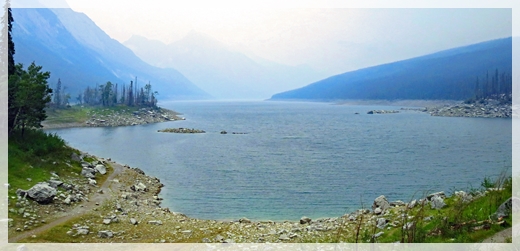
When in Canada last summer, we came across a strange body of water called Medicine Lake; although it looks like a lake, it really isn’t. It’s where the Maligne River backs up before disappearing into several underground pipelines. The cave system draining this river is one of the most extensive in the world. Every spring, the runoff from melting glaciers and snow fills the river with water much faster than it can drain and, as the water backs up, the river becomes a lake. As the summer progresses, the inflow slows and the water level gradually lowers until, in autumn, it once again looks like a river. The disappearing water resurfaces far away in lakes and rivers throughout the Canadian Rockies and eventually ends up in the Pacific Ocean. Medicine Lake is like a bathtub without a stopper that is being filled faster than it can drain; once the faucet’s flow slows down, the tub’s water level lowers but it never quite empties.

On the other hand, the bogs near our northern home are more like bathtubs with drains so gunked up from hair, soap and other yucky stuff that the water can’t empty. Typically, rain and snow are the only source of a bog’s water. Formed when a lake fills with debris, a bog has little or no drainage and the water that enters it stays there. Without movement, the bog’s water becomes stagnant, gets a foul odor, and can become a breeding ground for insects, bacteria, parasites and disease. Thinking of these two bodies of water, I wondered if I’m like Medicine Lake or a bog. Like the lake, do I spread God’s blessings or, like the bog, do I keep them all to myself? The water that feeds both starts clear and fresh, but only water that flows (as it does in the lake) remains that way.

Jesus said He gives us living water, the Holy Spirit, so that we’ll never thirst again. For the water to remain fresh and sweet, however, we can’t allow it to become stagnant; it must flow in and through us and, like the water from Medicine Lake, spread far and wide. Like those underground streams, we must be His pipelines, not just of our blessings, but of the fruit of the Holy Spirit. Only when Jesus’ living water pours through us can we bring life to the world. Are we stagnant cisterns or flowing pipelines with rivers of living water flowing from our hearts?

Jesus stood and shouted to the crowds, “Anyone who is thirsty may come to me! Anyone who believes in me may come and drink! For the Scriptures declare, ‘Rivers of living water will flow from his heart.’” (When he said “living water,” he was speaking of the Spirit, who would be given to everyone believing in him. [John 7:37-39a (NLT)]

The Lord will guide you continually, giving you water when you are dry and restoring your strength. You will be like a well-watered garden, like an ever-flowing spring. [Isaiah 58:11 (NLT)]

Copyright ©2018 jsjdevotions. All rights reserved.

MEMORY WORK REDUX

Whenever you fast, don’t be sad-faced like the hypocrites. For they make their faces unattractive so their fasting is obvious to people. I assure you: They’ve got their reward! But when you fast, put oil on your head, and wash your face, so that you don’t show your fasting to people but to your Father who is in secret. [Matthew 6:16-18a (HCSB)]

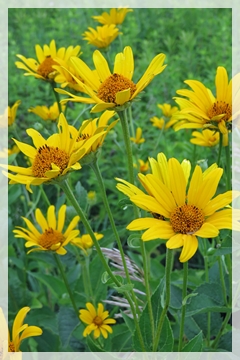
sunflowerA young pastor friend admits to not being good at reciting Bible verses from memory. A product of the computer/Internet age, he just taps in a key word or topic and, almost instantly, the verses are right in front of him in whatever translation he wants. There’s no need to memorize verses when, with just a few keystrokes, the words appear. I may read the Bible every day and predate the age of computers but I’m no better at knowing verses by heart than he. If I  remember my passwords for both computer and Internet, I can find whatever verses I need. While that works when I’m researching or writing, my desk is not where most witnessing opportunities occur. I could plead age as an excuse but I didn’t memorize Bible verses even when my brain was younger and possessed far less useless trivia than it does now. My pastor friend and I both profess to love God’s word and yet we don’t seem to love it enough to learn it by heart.
For decades, I have given up some thing or things for Lent, often sweets and alcohol. I know those minor denials have nothing to do with my salvation or righteousness. They are just a way to remind me Christ’s difficult days in the wilderness and what God gave up when He sacrificed His only son for my sins. Although Jesus told his followers that fasting should be private, I often found myself needing to explain my refusal to partake in the host’s decadent dessert or the great bottle of wine he purchased in Napa. I also admit to occasionally feeling a sense of self-righteous pride when I denied myself chocolate chip cookies or a glass of pinot noir. Since self-denial should be private and never lead to self-righteousness, God and I decided to rethink my Lenten practices.

Last June, in a devotion called “Memory Work,” I wrote about four-year old Tanner Hemness who memorized a Bible verse for every letter of the alphabet. At that time, I downloaded the twenty-six verses he memorized with the intention of doing the same thing. Somehow, my good intention got side-tracked and I stopped after “Ask and it will be given to you; seek and you will find; knock and the door will be opened to you.” [Matthew 7:7]

Rather than a season of fasting, this Lent will be my season of growth. There will be no need to worry about looking sad or explaining why I won’t eat someone’s homemade pie. Rather than a period of self-denial, it will be one of self-discipline. If four-year old Tanner could memorize those twenty-six verses in seven months, even with my neuron-challenged brain, I should be able to do it in the forty-six days between Ash Wednesday and Easter. After all, I’ve already learned one! We are to put God’s word to work in our lives and the first place to start is by putting His word into our hearts. God’s word in my heart can only put a smile on my face and His promises on my lips.

Bible memorization is absolutely fundamental to spiritual formation. If I had to choose between all the disciplines of the spiritual life, I would choose Bible memorization, because it is a fundamental way of filling our minds with what it needs. This book of the law shall not depart out of your mouth. That’s where you need it! How does it get in your mouth? Memorization. [Dallas Willard]

This book of instruction must not depart from your mouth; you are to recite it day and night so that you may carefully observe everything written in it. For then you will prosper and succeed in whatever you do. [Joshua 1:8 (HCSB)]

I have your decrees as a heritage forever; indeed, they are the joy of my heart. [Psalm 119:111 (HCSB)]

Copyright ©2018 jsjdevotions. All rights reserved.

GIVING THANKS

Make thankfulness your sacrifice to God, and keep the vows you made to the Most High. … But giving thanks is a sacrifice that truly honors me. If you keep to my path, I will reveal to you the salvation of God. [Psalm 50:14,23 (NLT)]

It’s one thing to be grateful. It’s another to give thanks. Gratitude is what you feel. Thanksgiving is what you do. [Tim Keller]

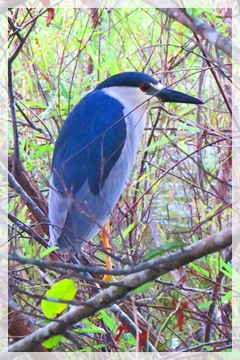
Black-crowned night heronYesterday I happened upon a wood stork enjoying a fish breakfast. I was astonished as the stork swallowed the whole wriggling fish in one big gulp. “I’ll have to put that in my gratitude journal,” I thought as I walked on. Later, I spotted two woodpeckers hammering away at a tree and got up close and personal with a pond snail laying eggs. Two more for the journal, I thought. Did I put those little blessings in my journal last night? Shamefully, I forgot to write in it at all; worse, I totally forgot about them in my nightly prayers!
When I look back at the rest of yesterday, all sorts of wonderful little things happened for which I was grateful and yet failed to thank God. Without having one red light, I got to an appointment with time enough to take a short walk on the beach. I’m not self-centered enough to think God turned all those lights green just for me; nevertheless, my day went better because of it and it deserved thanks. I met a delightful young couple at cooking class. Did God put them there just for me? I don’t know, but I was thankful to have them as cooking partners for the afternoon. There was a beautiful cooling breeze and the sunset was magnificent. Did God arrange the weather to my wishes? I doubt it, but I should have told Him how much I appreciated it! I was remiss in acknowledging God’s presence or thanking him for the day’s numerous small blessings.

Today, I set out again and spotted a black-crowned night heron hiding in the bushes. While getting a photo, I thought, “I’ll have to put that in my gratitude journal.” This time, however, that small voice reminded me how lackadaisical I’ve gotten with my journal and asked me why I was waiting to thank the creator of all those beautiful moments. That gave me pause. If I’d been walking with someone else, I would have shared those sightings. Although I wasn’t walking with another person, I was walking with God. Why wasn’t I talking to Him? Why wasn’t I sharing my joy with the one who gave it to me? God was right beside me and He shouldn’t have to wait until I get around to thanking him or writing in my journal, especially since I’m not good about remembering to do so. Thanks should be speedy and sincere.

We thank God through our prayer. We don’t need church, a table blessing or a gratitude journal to do so. We certainly don’t need to wait until our regular prayer time to offer thanks and, most especially, we shouldn’t wait until November for Thanksgiving Day! Our whole day, every day, should consist of a prayer of thanksgiving. God is with us as we take our daily walk; let us remember to thank him for the joy we find along with way.

We need to discover all over again that worship is natural to the Christian, as it was to the godly Israelites who wrote the psalms, and that the habit of celebrating the greatness and graciousness of God yields an endless flow of thankfulness, joy, and zeal. [J.I. Packer]

And give thanks for everything to God the Father in the name of our Lord Jesus Christ. [Ephesians 5:20 (NLT)]

 Give thanks to the Lord, for he is good! His faithful love endures forever. [1 Chronicles 16:34 (NLT)]

Copyright ©2018 jsjdevotions. All rights reserved.

PEACE ON EARTH

Suddenly, the angel was joined by a vast host of others—the armies of heaven—praising God and saying, “Glory to God in highest heaven, and peace on earth to those with whom God is pleased.” [Luke 2:13-14 NLT)]

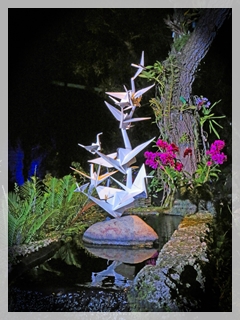
Naples botanic gardenWhile visiting a church recently, the pastor announced a new security precaution: ten minutes after the service started, the outside doors would be locked from the inside and no one could enter the building. Yesterday afternoon, another church offered a four hour class for their congregation. Led by a private security company, topics included ways to identify threats, how to develop layers of security, and techniques for conflict resolution. While talking with my daughter about a recent school shooting in her area, I learned that my grand’s school has regular “lock-down” drills in preparation for such an attack. Is no place safe from violence?

In 1947, the Bulletin of the Atomic Scientists created what is known at the Doomsday Clock. Designed to show the world how close it is to destroying itself with technology, the clock was originally set to 7 minutes before midnight with midnight being catastrophe—the end of the world as we know it. After the Soviet Union tested their first atomic bomb in 1949, it was reset to three minutes before the hour and, by 1953, it was down to two minutes. I was in first grade at the time; rather than “lock-down” drills, we had air-aid drills and practiced ducking under our desks in case a bomb was dropped. In 1991, with the end of the Cold War, the clock’s hands were set back to seventeen minutes before midnight. Since 2007, disruptions from climate change have figured into the calculations. This past year, the clock was set to only two and half minutes until midnight. Locking down a church or school, ducking under a desk, or building a bomb shelter won’t protect any of us if the minute hand reaches the twelve.

The world is in turmoil; we’re no closer to peace now than two thousand years ago. We live in a divided and troubled world and it grows more brutal daily. It’s no longer just atomic bombs that threaten us—cyber warfare, biologic weaponry, thoughtless rhetoric, fake news and catastrophic weather events all contribute to the danger. Where is this peace on earth we sang about these last several weeks?

Scripture tells us wars and violence will continue (and even get worse) until Jesus returns and establishes true lasting peace. Indeed, the end times appear to be on the horizon but what are we to do until then? I suppose we’ll continue having lock downs, going through metal detectors, getting luggage x-rayed and handbags searched, securing church doors, and meeting with security companies but that’s merely trying to stay safe. It’s not enough.

When we accepted Jesus, His Holy Spirit brought a fruit basket as a house-warming gift. In it we find peace along with several other qualities that will help us be peaceful: love, joy, patience, kindness, goodness, faithfulness, calmness and self-control. We all got the same beautiful basket and, as Christians, we’re all capable of letting His peace rule our hearts, actions and words. While our behavior may not move the hands of that clock backward, we might be able to make our little corner of the world a kinder, gentler, and better place.

Over two thousand years ago, the angels sang, “Peace on earth.” Let our lives continue that song as we move into this new year. Heavenly Father, let there be peace on earth, and let it begin with me.

And let the peace that comes from Christ rule in your hearts. For as members of one body you are called to live in peace. And always be thankful. [Colossians 3:15 (NLT)]

Copyright ©2018 jsjdevotions. All rights reserved.