ANGELS IN DISGUISE

Therefore, angels are only servants—spirits sent to care for people who will inherit salvation. [Hebrews 1:14 (NLT)]

dubble tulip“I’m the answer to Pastor’s prayers,” said the woman lightheartedly as she sat down next to me at Bible study. Having seen on Facebook that he was praying for more people at Bible study, she felt the urge to come. Her comment caused me to think about the way God uses us to answer people’s prayers.

I was looking at the vast array of allergy medications when another woman joined me. While perusing the shelves, we discussed the merits of various brands. She then said, “I see from your cross, you’re a Christian, so you’ll understand. I know I should be thankful in all things but I’m just having an awful time with this one.” She went on with her grievance that severe allergies had suddenly attacked her at sixty years of age. I sympathized since, like her, I never suffered from allergies until my senior years. “Perhaps,” I suggested, “we should be thankful that we haven’t had to suffer from them since youth!” We talked a little about gratitude and God and joined one another in a quick prayer. When done, she said, “Thanks; I needed that!”

A stranger approached me at church and asked if a certain pastor had arrived. After telling her not yet, something made me pause and ask if there was anything I could do for her. Replying that she needed someone with whom to pray, I offered. She shared her concerns and we laid them before God in prayer. We chatted briefly and I gave what comfort and guidance I could (along with a big hug). I then offered to find the pastor but she said, “No, you were just what I needed.”

I think of a friend who, when he discovered a loved one was using drugs, was devastated. The next day, he had lunch with a business acquaintance who asked what was troubling him. As my friend poured out his concerns to a man he barely knew, the businessman shared his own story of addiction and gave some much needed and excellent advice. He was just what was needed.

Were those mere coincidences or were they orchestrated by God? That first woman didn’t have to come to Bible study. In response to the woman with allergies, I easily could have said, “That’s too bad,” and finished my shopping. As for the woman who needed someone with whom to pray, after telling her the pastor wasn’t there, I could have gone about my business. That businessman didn’t have to ask my friend about his troubles and he certainly didn’t need to share a very private part of his own life. By responding to someone’s need, had we become answers to their prayers?

Although angels are God’s messengers and spiritual beings, I wonder if we humans might also act as His messengers and be given opportunities to answer people’s prayers. Rather than ministering spirits, we are ministering mortals. Although we have bodies and angels don’t, there is a bigger difference between God’s holy messengers and us. God’s angels have unquestioning obedience to His commands; we, on the other hand, often ignore Him and the opportunities and tasks He sets before us. God’s angels are sent by Him to help believers—but so are their brothers and sisters in Christ. Could you be an earthly angel in disguise? Could you be the answer to someone’s prayers?

Yes, praise the Lord, you armies of angels who serve him and do his will! [Psalm 130:21 (NLT)]

Copyright ©2017 jsjdevotions. All rights reserved.

BREAKING BREAD TOGETHER

When we bless the cup at the Lord’s Table, aren’t we sharing in the blood of Christ? And when we break the bread, aren’t we sharing in the body of Christ? And though we are many, we all eat from one loaf of bread, showing that we are one body. [1 Corinthians 10:16-17 (NLT)]

communion cupSometimes our Florida church celebrates Communion at the beach. The church provides fried chicken and everyone brings a dish to pass. After enjoying dinner and fellowship with our church family, we congregate around the gazebo, pray, hear a brief sermon, and partake of the Lord’s Supper. Some Sundays, there also may be a Baptism in the ocean. We stand on the beach as the sun sets in the west and welcome a new Christian into the body of Christ. These sunset meals are a celebration of God’s grace, Jesus’s love, and the power of the Holy Spirit.

Whenever we have our sunset celebrations, I think of what it must have been like for the early church. Because most of the early Christians were Jews, initially they gathered in the temple and synagogues for worship. Unable to celebrate the Lord’s Supper or baptize in a Jewish house of worship, this arrangement was unsatisfactory. Without a church building or a formal baptistery, people were brought to wherever there was water for Baptism and, on Sundays, the Christians gathered in homes for a 1st century potluck. The partaking of the bread and wine was usually celebrated as part of the meal, called an agape or love feast. To show their union in Jesus, people were to set aside their differences in status, wealth, ethnicity, and education and any quarrels were to be settled before partaking in the meal. Their worship was close and intimate. When we celebrate with our church at the beach, I feel that same sense of fellowship. We are an odd assortment of people, of diverse backgrounds and various ages, and from all walks of life but we are family—united by our belief in Jesus. Celebrating the sacraments in such a way is a profoundly meaningful experience.

Of course, the early church wasn’t perfect and problems arose. Paul took the Corinthians to task for dissension among their members and for not settling their differences. Worse, some of the Corinthians were selfish with the food or got drunk during the meal; not everyone cared or shared. Their gluttony and disregard for the needs of others didn’t demonstrate the unity and love that were to characterize the early church. With no alcohol at our church potlucks, no one ever gets drunk but some people in the front of the line have been known to take far more than their share, making it slim pickings for those at the end. I have a sneaky suspicion that not everyone comes together with all of their differences settled either. In actuality, we probably aren’t a whole lot different from our Corinthian forefathers.

By the beginning of the 2nd century, Christ’s followers had moved out of the synagogues, the Christian church found its own way to worship, and the Lord’s Supper was no longer celebrated as part of a meal. Although a few denominations and house churches still celebrate agape meals with communion, most of us celebrate the Lord’s Supper in a more formal setting than a potluck at someone’s house or a park. Nevertheless, we should always remember its beginnings. That first Lord’s Supper was an actual meal that fed both body and soul.  Apart from Judas, the participants were a family of believers, a band of brothers, united in their love for one another and for Jesus. The Lord’s Supper began as a Passover feast celebrating God’s redemption of His people from slavery to Pharaoh and it continues as a celebration of the redemption of His children from slavery to sin. Moreover, we should never come to His table without settling our differences with one another.

But every Lord’s day . . . gather yourselves together and break bread, and give thanksgiving after having confessed your transgressions, that your sacrifice may be pure. But let no one that is at variance with his fellow come together with you, until they be reconciled, that your sacrifice may not be profaned. [Didache 14 (c.90 AD)].

If someone says, “I love God,” but hates a fellow believer, that person is a liar; for if we don’t love people we can see, how can we love God, whom we cannot see? And he has given us this command: Those who love God must also love their fellow believers. [1 John 4:20-21 (NLT)]

Copyright ©2017 jsjdevotions. All rights reserved.

POWER

But Jesus called them together and said, “You know that the rulers in this world lord it over their people, and officials flaunt their authority over those under them. But among you it will be different. Whoever wants to be a leader among you must be your servant, and whoever wants to be first among you must become your slave.  [Matthew 20:25-27 (NLT)]

red-shoudered hawkRecently, the news has been filled with stories about powerful men who have misused their influence to prey on others. Unfortunately, abuse of power is nothing new. Consider our Biblical hero King David. While strolling on his roof late one afternoon, he looked down on the city below and spotted a beautiful woman taking her ritual bath. Even though he knew she was married, David sent for her. With at least six wives already, he wasn’t lacking for female companionship. Nevertheless, he wanted the beautiful Bathsheba. The Bible tells us the two had sex, she got pregnant, and David killed her husband to conceal their adultery. The Bible, however, tells us nothing of Bathsheba. We know she didn’t ask David to invade her privacy and, obedient to her king, she went to his palace. How could she refuse and to whom could she complain? Whether David managed to seduce her with his charm or forced himself on her doesn’t matter. He was her king and she had no choice. He wrongly took advantage of his power when he sent his men to get her, had sex with her, and manipulated events so that her husband was killed in battle.
This is not a male-bashing devotion; it is a reminder to us all that power and authority of any kind is a privilege. We are told to be good stewards of our wealth and use it wisely. When we are blessed with positions of authority or power, we should use that wisely, as well. If we’re not millionaires, CEOs, politicians, producers, or celebrities, we might think we have little or no power, but we do. We have the power to make someone else’s day good or bad and we have the power to affect their future. We can badger or intimidate co-workers, baby sitters, interns, clerks, sales people, bus drivers, assistants, neighbors, care givers, maintenance people, spouses and even children. It’s not just sexual abuse; there are many other ways to abuse, demean, mistreat, manipulate, or exploit people. Bullies aren’t found just on the playground; I’ve seen them berate wait staff, receptionists, and students. Threats aren’t made just by bosses; I’ve seen them made by irate customers. Politicians aren’t the only ones with clout; many of us have the ability to put in a good (or bad) word that can change someone’s future. We can make or break someone’s reputation with a few keystrokes. Having the upper hand never gives us the right to hit with it and having the power to do something doesn’t necessarily mean we should.

Abuse of power has consequences; conceived in adultery, David and Bathsheba’s child died and we’ve recently seen numerous successful careers crash. We may not make the tabloids when we shortchange the sitter, take out our anger on the secretary, or threaten someone out of spite. Nevertheless, there will be consequences for us as well—if not in this world, then in the next. In the parable of the talents, Jesus tells us that we’ll be held accountable for the way we use our gifts. We tend to think of those gifts as money, time and skills. They also include knowledge, relationships, privilege, power and authority and we should use all of them with love and compassion. Moreover, when we use our influence or authority to mistreat those less powerful, let us remember that we are mistreating the most powerful one of all!

And the King will say, “I tell you the truth, when you did it to one of the least of these my brothers and sisters, you were doing it to me!” [Matthew 25:40 (NLT)]

Copyright ©2017 jsjdevotions. All rights reserved.

FOOD INSECURITY

The crowds asked, “What should we do?” John replied, “If you have two shirts, give one to the poor. If you have food, share it with those who are hungry.” [Luke 3:10-11 (NLT)]

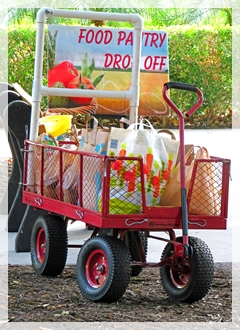
food pantry - feed the hungryYesterday, our nation celebrated Thanksgiving, a holiday that revolves around food and unites our nation across lines of culture, race, religion, and politics in a way little else can. Regardless of what football team they support, where they live or from where they came, whether liberal, conservative or somewhere in between, my Muslim, Hindu, Jewish, Christian, and unbelieving friends all celebrated around tables heavy laden with food. The menu and traditions varied—some had naan and others enjoyed cornbread or Parker House rolls. Some plates had ham alongside the turkey while others tofurkey and lentils or some of Grandma’s lasagna. Some cooks put pork sausage in their dressing and others kept kosher. There may have been glazed sweet potatoes and green beans at one house and mashed whites with gravy and corn casserole at another but, whatever was served, no one went away hungry and there were plenty of leftovers. Unfortunately, not everyone’s plate was piled with food and not everyone complained of feeling stuffed.

When I grew up, I was told there were starving children in Armenia so I should clean my plate. I once gave the smart-aleck retort that what I didn’t eat couldn’t be sent to those kids so what difference did it make! That was, of course, the wrong response and, most definitely, the wrong attitude. It wasn’t so much about cleaning my plate; my parents were trying to teach me appreciation and gratitude for the bounty at our table. They wanted me to understand that not everyone was so blessed. Unlike me, many children knew the real meaning of hunger.

The UN defines “food security” as always having physical, social and economic access to enough safe and nutritious food to meet one’s dietary needs for a productive and healthy life. Although there is more than enough food in the world to feed everyone, they estimate that some 815 million people in our world are “food insecure.” In our nation alone, some 41 million people (13 million of whom are children) are considered food insecure. It’s not just the Armenians or whoever else our parents mentioned that are hungry; it’s our neighbors!No one anywhere should go hungry but it’s disgraceful that anyone in our wealthy nation should be without reliable access to a sufficient quantity of affordable and nutritious food.

As Christians, we must respond to food insecurity with compassion and action—prayer, advocacy, volunteering, and donating. When we pray, “Give us this day our daily bread,” let’s remember the bread with which we are blessed is meant to be shared. When Jesus shared a few loaves and fish, He managed to feed thousands; consider how many we could feed if we shared our resources! As you write up your Christmas gift list, perhaps you will include a Christian relief organization and help combat poverty and hunger. If you’re wondering what to get your pastor or child’s teacher, rather than a tie or mug, what about a flock of chicks, geese or ducks (only $20) from someplace like Heifer International? Your donation will provide both food and a source of income for a hungry family. These next few weeks, you’ll be making several trips to the grocery store. Every time you shop, consider taking advantage of the BOGO specials and giving that free item (better yet both of them) to the local food pantry. There are more than enough resources in our world so that everyone can eat well but we each must do our part.

Yesterday, we looked at our bountiful Thanksgiving feast and asked ourselves, “What will I eat?” Please remember that someone not that far from you may have said, “Is there anything for me to eat?”

For I was hungry, and you fed me. I was thirsty, and you gave me a drink. I was a stranger, and you invited me into your home. I was naked, and you gave me clothing. I was sick, and you cared for me. I was in prison, and you visited me. … I tell you the truth, when you did it to one of the least of these my brothers and sisters, you were doing it to me! [Matthew 25:35-36,40 (NLT)]

Copyright ©2017 jsjdevotions. All rights reserved.

MARA

Monarch butterfly - queen anne's laceBut she said, “Don’t call me Naomi; call me Bitter. The Strong One has dealt me a bitter blow. I left here full of life, and God has brought me back with nothing but the clothes on my back. Why would you call me Naomi? God certainly doesn’t. The Strong One ruined me.” [Ruth 1:20-21 (MSG)]

The final lesson of learning to be independent – widowhood…is the hardest lesson of all. [Anne Morrow Lindberg]

When we first meet her in the book of Ruth, the widowed Naomi does not seem the sort of unpleasant meddlesome mother-in-law about whom jokes are made; she is much loved and respected by her daughters-in-law. After great tragedy strikes their family, Naomi’s widowed daughter-in-law Ruth chooses to leave home, return with her to Israel, and adopt the God of the Israelites. Naomi must have been a very special woman to have a daughter-in-law so determined to stay at her side. By the time the widows arrive in Bethlehem, however, we see another side to the older woman. “Don’t call me Naomi,” she says, telling people to call her Mara, meaning bitter. For Naomi and Ruth, circumstances improve when Ruth meets and marries Boaz and presents her mother-in-law with a grandchild. Unfortunately, not every widow has a Boaz to act as her redeemer and provide a happy ending to the story.

I have a group of widowed friends who, if comparing tragic sob stories with Naomi, could put hers to shame. They lost as much or more and have endured as many hardships and challenges as did Naomi. Nevertheless, in spite of having their lives turned upside down by their losses, none of them would call themselves bitter. While they have their moments of complaint, sorrow and loneliness, their faith strengthens them and allows them to face their new reality with an eagerness and joy that does not depend on outer circumstances. Their grief hasn’t left them bitter; if anything, it has made them better. They radiate a sense of peace, purpose and zest for life because their redeemer isn’t a relative who has chosen to take care of them; their Redeemer is Jesus Christ!

I can’t pretend to know what it’s like to lose a spouse but I imagine it’s like being ripped in half. Someday, either my husband or I will face the grief and uncertainty that comes with widowhood. When the “we” of our lives becomes just “me,” loneliness, anger and resentment can easily follow. We can become bitter or allow our faith to fill us with hope. Death may take away a spouse, but Jesus will take that spouse away from death! I pray that, in our grief, we will be strengthened by our faith in God’s purpose and receive the consolation offered by our Comforter, the Holy Spirit.

Most loving God, you know the pain and sorrow of death; mercifully hear our prayer for those who mourn the death of their beloved. The nights are lonely and the days are too long. Comfort them and bring an end to the days of tears. Bless them and bring an end to their days of sorrow. Renew them with the joy of life and bring to an end their days of mourning. Let the bond of love which you have for your people be the foundation of their hope that love never ends and that precious moments with our beloved are forever held dear in our hearts. Amen. [Vienna Cobb Anderson]

The Friend, the Holy Spirit whom the Father will send at my request, will make everything plain to you. He will remind you of all the things I have told you. I’m leaving you well and whole. That’s my parting gift to you. Peace. I don’t leave you the way you’re used to being left—feeling abandoned, bereft. So don’t be upset. Don’t be distraught. [John 14:26-17 (MSG)]

You’re blessed when you feel you’ve lost what is most dear to you. Only then can you be embraced by the One most dear to you. [Matthew 5:4 (MSG)]

Copyright ©2017 jsjdevotions. All rights reserved.

OUR FATHER

Mute swan - cygnetsPray like this: Our Father in heaven…” [Matthew 6:9a (NLT)]

Throughout Scripture, God is called by several ancient names that reflect His character: El Shaddai (God Almighty), El Olam (The Everlasting God), El Elyon (The Most High God), and El Roi, (The God Who Sees). He is Yahweh-Jireh (The Lord Will Provide), Yahweh-Rapha (The Lord Who Heals), and Yahweh-Roh (Our Shepherd). We also find references to God as both a Rock and a King. Yet, with all these ways to address God, when Jesus taught us how to pray, He chose to address God with the words “Our Father.”

As I pondered calling on our Father in prayer, I recalled an episode that occurred more than twenty-five years ago when two of our children attended college together. They went camping with a group of friends and enjoyed beers around the campfire. In the wee hours of the morning, the group was awakened by a police officer who breathalyzed them all. Unfortunately, the results indicated they’d been drinking and, since all were all under 21, each received a ticket for “illegal possession of alcohol by consumption” (a Class C misdemeanor). My children’s friends were amazed when they immediately called their dad, admitted their mistake, and asked his advice. My daughter’s response to her friends’ shock at their quick call was simple: “If I can’t call my father, who can I call?”

Our children called their father not because he paid their tuition and provided for them or even because he has a law degree. Even knowing he would expect them to face the consequences of their foolishness, they called on their father because he loves them! He’s their daddy and they are his children and they knew that, in spite of his disappointment in them, he would lovingly forgive and wisely counsel them.

“Our Father,” said Jesus. We can address God as Creator, Most High, Shepherd, Rock, Healer or any of a dozen other impersonal ways but it’s like calling on someone great and powerful; we know of Him but we don’t know Him. Prayer isn’t like scheduling an appointment to present a petition before a foreign king; it is an intimate conversation with someone we love who also loves us. It’s like my children coming to their daddy, confessing their error, and asking for his guidance. We appeal to God in love, not in fear of His anger or even awe of His power. God adopted us when we accepted Christ—we are His children, His heirs, and we can come boldly before Him with our prayers. That our unchanging, sovereign, all-knowing, all-powerful, ever-present, infinite God desires a relationship with us and wants us to address Him as “Our Father” is a privilege and an honor—let us never take it lightly.

For all who are led by the Spirit of God are children of God. So you have not received a spirit that makes you fearful slaves. Instead, you received God’s Spirit when he adopted you as his own children. Now we call him, “Abba, Father.” For his Spirit joins with our spirit to affirm that we are God’s children. [Romans 8:14-16 (NLT)]

May God our Father and the Lord Jesus Christ give you grace and peace. [Romans 1:7b (NLT)]

Copyright ©2017 jsjdevotions. All rights reserved.