
When we bless the cup at the Lord’s Table, aren’t we sharing in the blood of Christ? And when we break the bread, aren’t we sharing in the body of Christ? And though we are many, we all eat from one loaf of bread, showing that we are one body. [1 Corinthians 10:16-17 (NLT)]
 Sometimes our Florida church celebrates Communion at the beach. The church provides fried chicken and everyone brings a dish to pass. After enjoying dinner and fellowship with our church family, we congregate around the gazebo, pray, hear a brief sermon, and partake of the Lord’s Supper. Some Sundays, there also may be a Baptism in the ocean. We stand on the beach as the sun sets in the west and welcome a new Christian into the body of Christ. These sunset meals are a celebration of God’s grace, Jesus’s love, and the power of the Holy Spirit.
Whenever we have our sunset celebrations, I think of what it must have been like for the early church. Because most of the early Christians were Jews, initially they gathered in the temple and synagogues for worship. Unable to celebrate the Lord’s Supper or baptize in a Jewish house of worship, this arrangement was unsatisfactory. Without a church building or a formal baptistery, people were brought to wherever there was water for Baptism and, on Sundays, the Christians gathered in homes for a 1st century potluck. The partaking of the bread and wine was usually celebrated as part of the meal, called an agape or love feast. To show their union in Jesus, people were to set aside their differences in status, wealth, ethnicity, and education and any quarrels were to be settled before partaking in the meal. Their worship was close and intimate. When we celebrate with our church at the beach, I feel that same sense of fellowship. We are an odd assortment of people, of diverse backgrounds and various ages, and from all walks of life but we are family—united by our belief in Jesus. Celebrating the sacraments in such a way is a profoundly meaningful experience.
Of course, the early church wasn’t perfect and problems arose. Paul took the Corinthians to task for dissension among their members and for not settling their differences. Worse, some of the Corinthians were selfish with the food or got drunk during the meal; not everyone cared or shared. Their gluttony and disregard for the needs of others didn’t demonstrate the unity and love that were to characterize the early church. With no alcohol at our church potlucks, no one ever gets drunk but some people in the front of the line have been known to take far more than their share, making it slim pickings for those at the end. I have a sneaky suspicion that not everyone comes together with all of their differences settled either. In actuality, we probably aren’t a whole lot different from our Corinthian forefathers.
By the beginning of the 2nd century, Christ’s followers had moved out of the synagogues, the Christian church found its own way to worship, and the Lord’s Supper was no longer celebrated as part of a meal. Although a few denominations and house churches still celebrate agape meals with communion, most of us celebrate the Lord’s Supper in a more formal setting than a potluck at someone’s house or a park. Nevertheless, we should always remember its beginnings. That first Lord’s Supper was an actual meal that fed both body and soul. Apart from Judas, the participants were a family of believers, a band of brothers, united in their love for one another and for Jesus. The Lord’s Supper began as a Passover feast celebrating God’s redemption of His people from slavery to Pharaoh and it continues as a celebration of the redemption of His children from slavery to sin. Moreover, we should never come to His table without settling our differences with one another.
But every Lord’s day . . . gather yourselves together and break bread, and give thanksgiving after having confessed your transgressions, that your sacrifice may be pure. But let no one that is at variance with his fellow come together with you, until they be reconciled, that your sacrifice may not be profaned. [Didache 14 (c.90 AD)].
 Recently, the news has been filled with stories about powerful men who have misused their influence to prey on others. Unfortunately, abuse of power is nothing new. Consider our Biblical hero King David. While strolling on his roof late one afternoon, he looked down on the city below and spotted a beautiful woman taking her ritual bath. Even though he knew she was married, David sent for her. With at least six wives already, he wasn’t lacking for female companionship. Nevertheless, he wanted the beautiful Bathsheba. The Bible tells us the two had sex, she got pregnant, and David killed her husband to conceal their adultery. The Bible, however, tells us nothing of Bathsheba. We know she didn’t ask David to invade her privacy and, obedient to her king, she went to his palace. How could she refuse and to whom could she complain? Whether David managed to seduce her with his charm or forced himself on her doesn’t matter. He was her king and she had no choice. He wrongly took advantage of his power when he sent his men to get her, had sex with her, and manipulated events so that her husband was killed in battle.
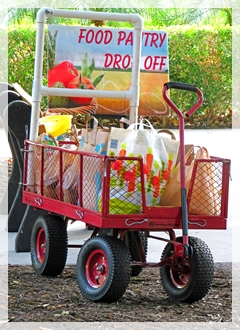 Yesterday, our nation celebrated Thanksgiving, a holiday that revolves around food and unites our nation across lines of culture, race, religion, and politics in a way little else can. Regardless of what football team they support, where they live or from where they came, whether liberal, conservative or somewhere in between, my Muslim, Hindu, Jewish, Christian, and unbelieving friends all celebrated around tables heavy laden with food. The menu and traditions varied—some had naan and others enjoyed cornbread or Parker House rolls. Some plates had ham alongside the turkey while others tofurkey and lentils or some of Grandma’s lasagna. Some cooks put pork sausage in their dressing and others kept kosher. There may have been glazed sweet potatoes and green beans at one house and mashed whites with gravy and corn casserole at another but, whatever was served, no one went away hungry and there were plenty of leftovers. Unfortunately, not everyone’s plate was piled with food and not everyone complained of feeling stuffed.
 But she said, “Don’t call me Naomi; call me Bitter. The Strong One has dealt me a bitter blow. I left here full of life, and God has brought me back with nothing but the clothes on my back. Why would you call me Naomi? God certainly doesn’t. The Strong One ruined me.” [Ruth 1:20-21 (MSG)]
 Pray like this: Our Father in heaven…” [Matthew 6:9a (NLT)]
 One week after Hurricane Irma, our Florida church met where they usually do in the city park. As the service began, an irate city official arrived. Afraid of unsafe conditions and liability issues, he insisted that the service be stopped immediately. While the senior pastor continued the service, our associate pastor tried to calm him down. He started by asking the bureaucrat how he was doing. The overwrought man’s response was a recitation of all of the challenges he’d dealt with in a city without power, working sewers or safe water. “No,” our pastor said, “I know the city is a mess, how are you doing?” He went on to ask about the man’s family, his house, and whether he was in need of anything. Instead of seeing him as a problem to be solved, our Pastor saw him as a person under a great deal of stress. As the two men talked and shared their personal hurricane stories, the official calmed. He finally took a good look at the park and decided the service could continue. This didn’t happen because our pastor won an argument; it happened because he saw the city employee as a person with problems of his own and showed that he (and our church) cared.
