
Make the most of your chances to tell others the Good News. Be wise in all your contacts with them. Let your conversation be gracious as well as sensible, for then you will have the right answer for everyone. [Colossians 4:5-6 (TLB)]
 When Meg and John walked into the church narthex, Meg was visibly disturbed. “I just can’t believe they said that. How can they call themselves Christians?” she asked her husband. Seeing Meg’s obvious distress, the pastor who’d been greeting at the door went over to talk. The two had been at a small group study before service when, after class, another couple nonchalantly dismissed the virgin birth as fiction and, as they walked out the door, added that the resurrection was as much a fabrication as the virgin birth.
The virgin birth is a doctrine plainly stated in the Apostle’s Creed—a creed that is regularly recited at that church. Christianity holds that Jesus had no earthly father and was not the product of intercourse. How it happened, we don’t know and certainly can’t understand. The resurrection of Christ is also affirmed in the Apostle’s Creed. For the most part even non-believers won’t argue the crucifixion, death and burial of Jesus nor will they dispute that his tomb was empty on the third day. They simply can’t accept how the tomb came to be that way. Just because we can’t understand how something happened, however, doesn’t mean that it didn’t occur!
This devotion, however, isn’t about defending the virgin birth and the resurrection. It’s about Meg and John. “I don’t think that group is right for us,” she said. “Let’s find another group; we’re not going back there again.” Her husband, however, emphatically disagreed: “Oh, yes we are! We’re not going to let this go unanswered.” Meg and John have a valuable opportunity to share the gospel and one that I hope they use wisely.
This devotion is also about that other questioning couple and I think back to nearly fifty years ago when a young woman, from a Buddhist background, was about to join our church. Having grown up in a Buddhist home with a family altar, she was struggling with a way to reconcile praying to her ancestors (something she had always done) with her new Christian beliefs. While there is no place for ancestor worship in Christianity, our pastor’s answer was gentle and loving. Rather than condemning her for her past beliefs and practices, he encouraged her to grow in her new ones. His words were encouraging and accepting—not of ancestor worship—but of her.
Meg and John’s experience is a reminder that not everyone we meet at church, Bible study, or small group is a firm believer. The fact they are there, however, is a step in the right direction! We must do our best to keep them there by being sympathetic, compassionate, humble, loving, gracious, patient, and willing to listen. If people can’t freely question doctrine, express their disbelief, or ask for further explanation in church, where should they go? Remember, even Thomas had doubts! Rather than telling them what we think and why we think it, perhaps we should start by asking them what they think and why they think it. Let’s meet them wherever they happen to be, walk with them into a deeper understanding of the gospel, and pray with and for them.
 A pastor friend shared a story about a woman at a previous church who had an odd habit. Whenever the pastor announced a change of some kind, more often than not, she would say to him, “I’m so thankful. I’ve been praying you would decide to do that.” When curiosity overcame him, he asked “Instead of using God as a middle man, why don’t you just tell me what you’re thinking or want changed?” Revealing that she was a preacher’s kid, the woman told of the officious interference, meddling, criticism and complaint her father had endured during his ministry. In fact, the often unchristian fault-finding behavior of his parishioners nearly turned her away from the church. She vowed that, unless asked, she’d never tell a pastor what she thought he should do. Instead, she’d simply pray about it and, “if it is God’s will, then He will reveal it to the pastor.” Apparently, as she discerned, God makes an excellent “middle man!”
 It was the first night of a new small group study and, as we gathered our books to leave, one woman said she’d have to read more about the author since he sounded like a Calvinist. Believing that everyone has the God-given ability to choose God’s grace, she didn’t want to participate in the class if the book’s author believed that, in the past, God chose some among mankind for His own and that that Christ died only for those elect.
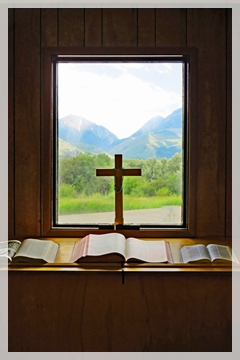 Before the incarnation of Christ, God dwelt first in the tabernacle and then in the temple. The innermost room of the temple was called the “Most Holy Place” and it was in this inner room that God’s glory was said to dwell. This was where the Ark of the Covenant was kept and where the high priest came with a sacrifice to atone for his and the nation’s sins every year. With the incarnation of Jesus, God no longer dwelt in the temple but in the flesh of His son and, for a brief time, God actually walked among His people. Yet, when Jesus lived as a man, only a few people at a time could be in His presence. With His death, there is no yearly atonement ritual because Jesus atoned for our sins once and for all. Moreover, because of His resurrection, ascension, and the presence of the Holy Spirit, it is possible for countless people, everywhere, to be in His presence at the same time. Once we become believers, the Holy Spirit moves into our hearts and each one of us, as members of Christ’s church, become part of His body and the temple of God.
 Watching a friend’s video of her grandbaby’s first steps, I thought back to my children’s first faltering steps. They teetered and tottered, often fell, got up, and fell again. Eventually, the wobbly legs of my eldest became the confident legs that take him down mountain slopes on a snowboard, the awkward steps of my daughter became the graceful ones of a dancer in toe shoes, and the child who took forever to walk now runs marathons. It took time and maturity, however, before they could carry themselves with such strength and assurance.
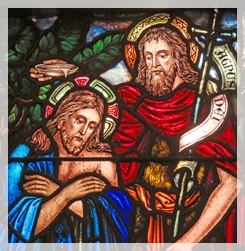 Although I don’t remember my Baptism as an infant, I do have a picture that tells me I wore a long white dress and a bonnet. Another picture tells me that I wore a shorter white dress, a hat instead of a bonnet and my first pair of nylon stockings and heels at my Confirmation thirteen years later. That, however, is about all I remember of making a public reaffirmation of my faith and recommitting to the baptismal promises made for me when I was a baby. Although I knew a lot about Jesus at the time, I’m not sure that I truly knew Him. I know Him now and, in a much simpler ceremony, I recently reaffirmed my Baptism in a way I will never forget.
 Devotions of the Heart