
They replied, “When you sit on your glorious throne, we want to sit in places of honor next to you, one on your right and the other on your left.” … When the ten other disciples heard what James and John had asked, they were indignant. So Jesus called them together and said, “You know that the rulers in this world lord it over their people, and officials flaunt their authority over those under them. [Mark 10:37, 41-42 (NLT)]
 The day’s gospel was from Mark 10 and, as the sermon began, the pastor shared having spent three hours earlier that week in a tiresome meeting on evangelism. The speakers had been lauded for the high number of “first public professions of faith” in their parishes. As the meeting went on, the pastor furtively checked his phone to see if memory had served him right. Indeed, his church far exceeded the numbers of the keynote speakers. Part of him (the bad part), like James and John, wanted to boast and be honored but the other part reminded him that ministry is about people and not numbers. He ate a little humble pie and said nothing. As often happens in long meetings, his mind wandered and he thought back to an encounter some twenty-eight years ago when he first came to the parish.
In 1991, both the church and our nation had much less liberal views about alternative lifestyles and homosexuality. An era of homophobia, there often were economic, social, and even physical repercussions to coming out. AIDS was the leading cause of death among men 25 to 44 and, in an attempt to raise AIDS awareness, the Red Ribbon Project had just launched.
That year, Wayne, an elderly retired minister in the parish approached the pastor. “This homosexual thing,” he said, “I just don’t comprehend it and I can’t condone it. But,” he added, “all people are God’s children and are of sacred worth.” Wayne then spoke of the many gay men dying in the area. In those early years, most families abandoned their gay AIDS infected sons and brothers. Fearing contagion, AIDS patients were touched only by hands in rubber gloves and, because of surgical masks, they saw only the eyes of those who attended them. Facing death and without a support system, they felt alone, unloved, and worthless. Reiterating that he neither understood nor approved of homosexuality, Wayne added that he couldn’t stand by and do nothing. He asked permission to serve AIDS patients in the local hospitals. “I don’t want them to die without feeling the touch of a warm hand, seeing a smile, or knowing that they have value. I can’t let them die alone or without telling them that Jesus loves them.” The pastor immediately agreed to Wayne’s ministry of love because being a servant is what Jesus was and what He told us to be.
As the pastor thought back to Wayne’s selfless and loving service, he understood why his church’s growth numbers are exemplary. It wasn’t evangelism techniques, community events, baseball team sponsorship, or advertising; it was that the church and its members serve as Christ’s hands and feet. Through service, they both tell and show people that Jesus loves them.
When the pastor wanted to brag about his numbers, he realized he was being like James and John when they wanted their place of honor in God’s kingdom or the other disciples who were indignant at the thought they might not be honored as well. When he thought back to Wayne, however, he thought of Jesus’ words: “For even the Son of Man came not to be served but to serve others…” As Christ followers, we don’t need to understand or condone, we just need to serve our brothers and sisters (and all are our brothers and sisters).
One of the principal rules of religion is to lose no occasion of serving God. And, since he is invisible to our eyes, we are to serve him in our neighbour; which he receives as if done to himself in person, standing visibly before us. [John Wesley]
 When Meg and John walked into the church narthex, Meg was visibly disturbed. “I just can’t believe they said that. How can they call themselves Christians?” she asked her husband. Seeing Meg’s obvious distress, the pastor who’d been greeting at the door went over to talk. The two had been at a small group study before service when, after class, another couple nonchalantly dismissed the virgin birth as fiction and, as they walked out the door, added that the resurrection was as much a fabrication as the virgin birth.
 A pastor friend shared a story about a woman at a previous church who had an odd habit. Whenever the pastor announced a change of some kind, more often than not, she would say to him, “I’m so thankful. I’ve been praying you would decide to do that.” When curiosity overcame him, he asked “Instead of using God as a middle man, why don’t you just tell me what you’re thinking or want changed?” Revealing that she was a preacher’s kid, the woman told of the officious interference, meddling, criticism and complaint her father had endured during his ministry. In fact, the often unchristian fault-finding behavior of his parishioners nearly turned her away from the church. She vowed that, unless asked, she’d never tell a pastor what she thought he should do. Instead, she’d simply pray about it and, “if it is God’s will, then He will reveal it to the pastor.” Apparently, as she discerned, God makes an excellent “middle man!”
 It was the first night of a new small group study and, as we gathered our books to leave, one woman said she’d have to read more about the author since he sounded like a Calvinist. Believing that everyone has the God-given ability to choose God’s grace, she didn’t want to participate in the class if the book’s author believed that, in the past, God chose some among mankind for His own and that that Christ died only for those elect.
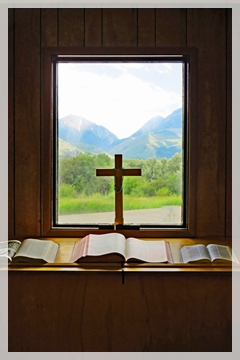 Before the incarnation of Christ, God dwelt first in the tabernacle and then in the temple. The innermost room of the temple was called the “Most Holy Place” and it was in this inner room that God’s glory was said to dwell. This was where the Ark of the Covenant was kept and where the high priest came with a sacrifice to atone for his and the nation’s sins every year. With the incarnation of Jesus, God no longer dwelt in the temple but in the flesh of His son and, for a brief time, God actually walked among His people. Yet, when Jesus lived as a man, only a few people at a time could be in His presence. With His death, there is no yearly atonement ritual because Jesus atoned for our sins once and for all. Moreover, because of His resurrection, ascension, and the presence of the Holy Spirit, it is possible for countless people, everywhere, to be in His presence at the same time. Once we become believers, the Holy Spirit moves into our hearts and each one of us, as members of Christ’s church, become part of His body and the temple of God.
 Watching a friend’s video of her grandbaby’s first steps, I thought back to my children’s first faltering steps. They teetered and tottered, often fell, got up, and fell again. Eventually, the wobbly legs of my eldest became the confident legs that take him down mountain slopes on a snowboard, the awkward steps of my daughter became the graceful ones of a dancer in toe shoes, and the child who took forever to walk now runs marathons. It took time and maturity, however, before they could carry themselves with such strength and assurance.
