I’M FINE

And we are confident that he hears us whenever we ask for anything that pleases him. And since we know he hears us when we make our requests, we also know that he will give us what we ask for. [1 John 5:14-15 (NLT)]

snowy egretsWhen asked about her boys, a friend used to answer, “They’re doing their own thing.” Years later, I learned “their own thing” meant they were breaking her mama’s heart with their addictions and run-ins with the law. Because she kept her pain concealed, she carried the weight of that burden alone for many years. We often hear similar answers when we ask someone how they’re doing— brusque responses like, “I’m fine,” “It’s taken care of,” or “We don’t need a thing.” Maybe everything really is hunky dory but those answers are often used when life has gone seriously awry and things are anything but fine. Those vague but terse responses are conversation stoppers. Even best friends, who suspect something is amiss, won’t pry and the subject is politely changed.

We wrap ourselves up in a nice package on the outside when inside we’re a mess. We allow people into the vestibule of our lives but won’t let them in to see the messy kitchen or dirty floor. We refuse to expose our vulnerabilities and then we wonder where our friends are when we need them. No one knows we need them if we refuse to allow them into our lives. The same goes for God. “Where are you God?” we complain without being willing to admit life’s a mess and we need Him.

Think of the paralyzed man whose friends took him to see Jesus in Capernaum. What if he’d told his friends he was just fine and didn’t need a thing? While his friends went off to see Jesus, he would have remained paralyzed at home and there would be one less miraculous healing. What if the blind man in Bethsaida or the centurion’s servant had said they were fine? Scratch two more healings!

As for Job’s friends—he could have rebuffed them at the door, telling them, “I’m fine; this is just a little setback.” Instead, he allowed them inside to see his scabs, sores and misery. Even with his friends’ erroneous theology, Job must have found comfort when they remained at his side. Perhaps their discussions even strengthened his faith in God.

We tell people we’re okay when we’re not and we often tell God the same thing. We’re so used to replying, “I’m fine,” when a stranger says, “How are you?” that we forget our friends and God actually care about the answer. Most of the time, when people inquire about our lives or ask how they can help, they sincerely want to know. If they’re not really interested, their response to our answer likely will be, “Sorry, I’m busy!” Even though God knows everything about us and all that we need, He tells us to ask Him. He knows we’re not fine, but do we? Fortunately, with God, we can be confident that He’ll never tell us He’s too busy!

Refusing to ask for help when you need it is refusing someone the chance to be helpful. [Ric Ocasek]

You haven’t done this before. Ask, using my name, and you will receive, and you will have abundant joy. [John 16:24 (NLT)]

Keep on asking, and you will receive what you ask for. Keep on seeking, and you will find. Keep on knocking, and the door will be opened to you. For everyone who asks, receives. Everyone who seeks, finds. And to everyone who knocks, the door will be opened. [Matthew 7:7-8 (NLT)]

Copyright ©2017 jsjdevotions. All rights reserved


COMPASSION FATIGUE

Then he went on alone into the wilderness, traveling all day. He sat down under a solitary broom tree and prayed that he might die. “I have had enough, Lord,” he said. “Take my life, for I am no better than my ancestors who have already died.” [1 Kings 19:4 (NLT)]

hibiscusMost of us think of sloth as laziness: a dislike of work or any physical exertion. Having watched the local zoo’s sloth in action (or, rather, inaction), I think the sluggish animal is appropriately named. Spiritual sloth, however, is far different than being a couch potato. Originally, the sin of sloth was two sins: sadness and acedia. Compiled by Evagrius of Ponticus, a 4th century monk, these two “capitals sins” were part of a list of eight he believed to the greatest threats to devout monasticism.
We know what sadness is and it’s important to remember that the sadness which Evagrius found problematic for his monks was not clinical depression; it was that despondency or gloom that easily came upon a monk living an ascetic life of prayer, fasting and labor in the middle of the Egyptian desert in the 4th century. It was unhappiness with one’s present situation and the melancholy that comes from longing for something different. It was distress at one’s circumstances and the inability to give thanks in all things. In this troubled world, we certainly don’t have to be monks to suffer that kind of sadness.

Acedia comes from the Greek and means without care or concern. Rather than laziness, it is apathy or a fatigue of mind and soul. A spiritual boredom or weariness, acedia results in listless prayers, study or service. In the midday heat, the monks were tempted to let their minds wander during study and prayers and then fall asleep causing Evagrius to call acedia the “noonday demon.” Seeing the correlation between sadness and acedia, in the late 6th century, Pope Gregory combined the two sins into sloth .

A few mornings ago, I fell victim to compassion fatigue and began to understand spiritual sloth. The previous night’s discussion in Bible study had been disheartening. We’d talked of the recent hurricanes (with yet another one on the horizon), Mexico’s earthquakes, Puerto Rico’s devastation, Korea’s threat, the horrendous carnage in Las Vegas, a polarized nation, and the unrest in the Middle East. As I added that night’s heartbreaking prayer requests to my already burgeoning and depressing list, I grew numb with grief. “What’s the point? I wondered as I listed a two-year old just diagnosed with metastasized stomach cancer, a woman who may lose her feet because of nursing home neglect, and a friend’s suicidal son. “What difference can I make? Why bother?” I cried. At that point, my heart was so weary with grief that I no longer wanted to care or pray. I probably felt as Elijah did when, while fleeing Jezebel, he sat down under that broom tree and said he wanted to die. That’s spiritual sloth and it’s not just monks and Old Testament prophets that can be afflicted with it. The enemy wants us all to become so downhearted and world-weary that we fall into spiritual inactivity or sloth.

Elijah was cured of his spiritual sloth by food, rest, and a talk with the Lord. Although I didn’t eat, I was nourished by Scripture. I didn’t sleep but I rested in the words I read and then, like Elijah, I had a prayerful chat with God. God whispered to Elijah and gave him new strength. He whispered to me and refreshed me with his words of love, comfort, reassurance and hope.

I cried out, “I am slipping!” but your unfailing love, O Lord, supported me. When doubts filled my mind, your comfort gave me renewed hope and cheer. [Psalm 94:18-19 (NLT)]

And now, dear brothers and sisters, one final thing. Fix your thoughts on what is true, and honorable, and right, and pure, and lovely, and admirable. Think about things that are excellent and worthy of praise. [Philippians 4:8 (NLT)]

Copyright ©2017 jsjdevotions. All rights reserved.

ROOTS

And now, just as you accepted Christ Jesus as your Lord, you must continue to follow him. Let your roots grow down into him, and let your lives be built on him. Then your faith will grow strong in the truth you were taught, and you will overflow with thankfulness. [Colossians 2:6-7 (NLT)]

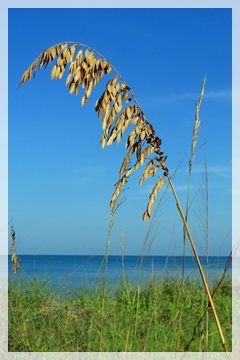
sea oatsIt’s not just light poles that were destroyed by Hurricane Irma’s winds; many trees also met their end at her hands. As I looked at the upended roots of a once mighty oak, I thought of one of Aesop’s fables about an oak in a storm. A proud oak stood by a stream, and like this one, had survived several storms in its many years. One day, a hurricane the likes of Irma arrived and the great oak fell with a thunderous crash. As the water rose, it was carried down to the sea. When the oak eventually came to rest along the shore, it looked up at the sea oats that were waving in the now gentle sea breeze, “How did you manage to weather such a terrible storm?” it asked. “I’m a great oak and even I didn’t have strength enough to battle the wind.”

The sea oats replied, “That was your problem. You were too proud to bend and yield a little and so the wind knocked you over. I’m just an insubstantial sea oats plant but, knowing my weakness, I didn’t resist as the wind gusted. The harder it blew, the more I humbled myself and the lower I bent. So, here I am, still enjoying the beach. Aesop’s moral is that it is better to bend than to break. “Perhaps there a message here,” I thought and, yet, I wasn’t sure it was just about pride and humility.

The Apostle Paul was very clear about standing firm in the face of trials and temptation. He told the early church to stand firm and not to waver; he wanted them to be oaks and not sea oats. When facing one of life’s hurricanes, however, it’s pretty hard not to wobble, quiver and quake wildly. If we stand firm, will we be knocked down and end up a piece of drift wood or ground up into mulch? If that mighty oak couldn’t weather the storm, how can we?

The Apostle also said that growing roots in Jesus is what will keep us strong. That fallen oak’s upended roots were taller than me and yet they didn’t do the oak much good when Irma arrived. The roots of which Paul speaks are deep roots that grown down into our Lord. It is strong deep roots that will serve to anchor a tree in the ground. I’m not an arborist, but I could easily see that there was nothing deep about that oak’s roots (or the roots of the many other uprooted oaks throughout our community).

In Jesus’ parable about soil, he told of seed scattered on good soil that grew, seed strewn on a path that was eaten by the birds, seed that was crowded out by the thorns, and seed that fell on rocky soil. Those plants in rockyy soil grew quickly but, since their roots weren’t deep, they withered in the hot sun. If He’d been in a tropical climate like Florida’s, Jesus could have used sand and hurricanes instead of rocks and sun in His analogy. Good nutritious soil is necessary for a plant’s success and Florida’s soil is shallow and mostly sand. The many fallen oaks’ roots, while wide, were shallow and certainly not the kind of roots of which Jesus and Paul spoke.

Aesop’s fable was about pride and humility but the many uprooted oaks in town tell me something more. Granted, there may be times we need to bend a little, as do the sea oats, but we must never bend if that means compromising our faith. I think of Daniel, Shadrach, Meshach, and Abednego. Their roots were so deep that they were willing to die before they bent down to worship a false god or failed to worship the true one. While a miracle saved them, there was no miracle for Stephen, a man whose deep roots in Christ gave him strength enough to stand and testify before the Jewish high council knowing he’d die because of it. These men were willing to be sacrificed and broken before bending to the prevailing wind.

Given a choice, I would rather stand strong, like an oak with deep roots, than fall because of the wind. Nevertheless, if the wind is blowing in the wrong direction, like Stephen and other Christian martyrs, I would rather be broken and fall than bend and survive as do the sea oats.

I pray from his glorious, unlimited resources he will empower you with inner strength through his Spirit. Then Christ will make his home in your hearts as you trust in him. Your roots will grow down into God’s love and keep you strong. [Ephesians 3:16-17 (NLT]

Copyright ©2017 jsjdevotions. All rights reserved.

THE BLESSING

As they were eating, Jesus took some bread and blessed it. Then he broke it in pieces and gave it to the disciples, saying, “Take this and eat it, for this is my body.” And he took a cup of wine and gave thanks to God for it. He gave it to them and said, “Each of you drink from it, for this is my blood, which confirms the covenant between God and his people. It is poured out as a sacrifice to forgive the sins of many. [Matthew 26:26-28 (NLT)]

columbineThe celebration of the Eucharist or Holy Communion has been central to our Christian worship since the early church. If asked the meaning of the word eucharist, most of us would probably respond that it is the Christian sacrament that commemorates the Last Supper with bread and wine. While it has come to mean that and often refers to the consecrated elements, especially the bread, the word eucharist originally meant something else entirely. Coming from the Greek words eukharistos, meaning grateful, and kharizesthai, meaning to offer graciously, it is a translation of the Hebrew word berekah which means a blessing or benediction. Acknowledging God as the source of all good things, a berekah would be similar to the grace or table blessing we offer before or after a meal.
When Jesus spoke the traditional Passover meal berakahot that night in the upper room, he gave them new meaning when he added the words, “this is my body” and “this is my blood.” In thanks, He raised the bread just as his body soon would be raised on the cross. He took the matzah that symbolized the suffering of Israel, thanked God for it, and broke it, knowing that his body would be broken in less than a day. As He passed it to the disciples, the bread that once symbolized Israel’s suffering became the bread that would symbolize His. The disciples may have thought he was simply offering a blessing for the Passover bread but Jesus was offering thanks for the body which soon would be defeated by thorns, whip, nails and cross. He then thanked God as he poured out the wine that symbolized Israel’s redemption from Egypt and passed it around. The disciples may have thought he was giving thanks for Israel’s redemption from Egypt but Jesus knew it was for their redemption from sin. For something to be redeemed, however, a price must be paid and Jesus knew that price would be his blood. While pouring out the wine, He knew his blood would soon pour from his body and yet he still gave thanks. Knowing full well the torment he would suffer, He graciously offered himself for us and gave thanks.

Last week, when the Words of Institution were spoken before Communion and the bread and wine were consecrated, I realized I hadn’t fully appreciated the circumstances in which those words originally were spoken. Jesus knew He’d be betrayed, disappointed and denied within hours. He knew the agony that would soon occur. Jesus knew he would be broken and bleed. He knew the real sacrifice was not the lamb on which they’d supped; He was the sacrificial Lamb of God and yet He acknowledged God as the source of all blessings and thanked Him! Blessed be the Lord; let us give thanks!

Blessed are You, Lord our God, King of the Universe, who brings bread from the earth. … Blessed are You, Lord our God, King of the Universe, who creates the fruit of the vine. [Jewish prayers over bread and wine] 

The next day John saw Jesus coming toward him and said, “Look! The Lamb of God who takes away the sin of the world! [John 1:29 (NLT)]

Copyright ©2017 jsjdevotions. All rights reserved.

WHAT LEGACY?

But God said to him, “You fool! You will die this very night. Then who will get everything you worked for?” Yes, a person is a fool to store up earthly wealth but not have a rich relationship with God. [Luke 12: 20-21 (NLT)]

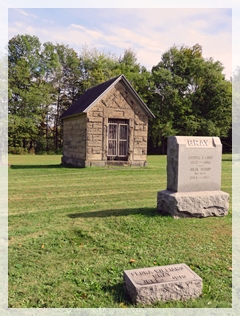
Trumbull Cemetery - OhioWhen touring a nearby resort town, a beautiful old mansion was pointed out. It was once owned by a man who made so much money on his invention of the sanitary milk bottle cap that he retired at the age of 26. For 93 years, the Chicago White Sox played at a ball field named for the team’s founder. In 2003, the field was renamed US Cellular Park and then, in 2016, it became the Guaranteed Rate Field. When I went to Northwestern University, the football venue was named for a former Evanston mayor. In 1997, the stadium was renamed to honor the family of a generous donor to the school’s athletic facilities. A friend’s daughter is attending a school named for a German immigrant who opened a Chicago butcher shop in 1883. Who were these men?

If you’ve not been on a Lake Geneva boat tour, you’ve never heard O.N. Tevander. Although one can still find pictures of his bottle capping machine, he doesn’t even rate a mention in Wikipedia. Do today’s baseball fans know that Charles Comiskey was a key person in the formation of the American League and founder of the Chicago White Sox? Do the Northwestern Wildcats know anything of William Dyche, class of 1882, and that his name was to remain on any NU stadium for perpetuity? In another twenty years, will they have any idea that Patrick Ryan founded Aon Corporation and once served on the university’s Board of Trustees? By then, it’s possible that another large check will have been written and the stadium will have yet another name. When you hear the name Oscar Mayer, do you think of an immigrant butcher from Bavaria or of a large corporation (now owned by Kraft), hot dogs and the wiener song?

Even if we amass great wealth, make generous donations, or achieve some modicum of fame, chances are that most of us will be forgotten in a few generations. Our last name might remain on a corporate letterhead or, if wealthy enough, we could have a building or stadium named after us (at least for a while). Our headstone may rest in a cemetery, we might be listed in a genealogy chart, or an old letter or picture of us may reside in a box of memorabilia stored in someone’s attic. Nevertheless, we will be long gone and, for the most part, forgotten. For William Dyche, perpetuity lasted only 71 years! How long will it last for us? Even if a great grandchild has our china, a piece of our jewelry or carries our name, our essence will have vanished. We will be little more than a short family story or a faceless name.

Jesus told a parable about the rich man whose land was so productive that he ran out of room to store his crops. Rather than share his excess, he just built bigger barns so he could relax and enjoy his wealth for years to come. Unfortunately for him, he died that very night. A simple parable, it points out the temporal nature of life.

Financial planners often ask their clients, “What will be your legacy?” The rich man in the parable left a legacy of filled barns for someone else to enjoy. Sadly, he forgot the most important thing—his soul. Sometimes we’re so busy thinking about our legacy here on earth that, like the man in the parable, we also forget about our souls. Whether or not we are remembered in this world isn’t really important. The real question is whether or not God will welcome us into His kingdom in the next.

Don’t store up treasures here on earth, where moths eat them and rust destroys them, and where thieves break in and steal. Store your treasures in heaven, where moths and rust cannot destroy, and thieves do not break in and steal. Wherever your treasure is, there the desires of your heart will also be. [Matthew 6:19-21 (NLT)]

Copyright ©2017 jsjdevotions. All rights reserved.

MASTER WEAVERS

And we know that God causes everything to work together for the good of those who love God and are called according to his purpose for them. [Romans 8:28 (NLT)]

spider websIt rained last night. During our early morning walk, we looked out over the prairie and saw hundreds of sparkling spider webs. As the morning sun caught the water droplets on the silk, the master weavers’ work glistened in the mist. Although we take that trail several times a week, it was the first time this season we saw those arachnidan works of art. The spiders didn’t start spinning just the previous night; their webs have been there all summer but weather and light conditions kept us from seeing them. In fact, had we chosen to walk the loop in the other direction, we never would have seen them at all!

God, like his eight legged creations, is always busy weaving the strands of our lives. Much of the time, however, as with the spider webs, we don’t see or understand what He’s doing. “Where is God in all of this?” we ask. It is usually in hindsight that we recognize His presence—the way He moved, guided, protected, instructed, disciplined or provided for us. Nevertheless, whether or not we see His hand in our circumstances, we know that He, like the spiders, is ever-present and busy weaving.

I find those beautiful webs reassuring. They show me that God will give us beautiful gifts when we least expect them but that we must be willing to look for them in the most unlikely places. The webs remind me that we don’t need to see God to know that He is always there and always working. Moreover, God reveals himself in a variety of ways. While an angel or burning bush is dramatic and impressive, let’s remember that Elijah did not find God in the mighty wind, earthquake or fire. He found God in a gentle whisper. As for me, spiders’ webs on a misty morning are one of the ways God reassures me of His presence and His amazing plan; they are God’s gentle whisper of reassurance from the Master Weaver!

Our lives are but fine weavings
That God and we prepare
Each life becomes a fabric planned
And fashioned in His care.
We may not always see just how
The weavings intertwine,
But we must trust the Master’s hand
And follow His design,
For He can view the pattern
Upon the upper side,
While we must look from underneath
And trust in Him to guide.
Sometimes a strand of sorrow
Is added to His plan,
And though it is difficult for us,
We still must understand
That it is He who fills the shuttle,
It is He who knows what is best,
So we must weave in patience
And leave to Him the rest.
Not till the loom is silent
And the shuttles cease to fly
Shall God unroll the canvas
And explain the reason why
The dark threads are as needed
In the Weaver’s skillful hand
As the threads of gold and silver
In the pattern He has planned. [Author unknown]

Just as you cannot understand the path of the wind or the mystery of a tiny baby growing in its mother’s womb, so you cannot understand the activity of God, who does all things. [Ecclesiastes 11:5 (NLT)]

Copyright ©2017 jsjdevotions. All rights reserved.