
Jesus, full of the Holy Spirit, left the Jordan and was led by the Spirit into the wilderness, where for forty days he was tempted by the devil. He ate nothing during those days, and at the end of them he was hungry.… When the devil had finished all this tempting, he left him until an opportune time. [Luke 4:1-2,13 (NIV)]
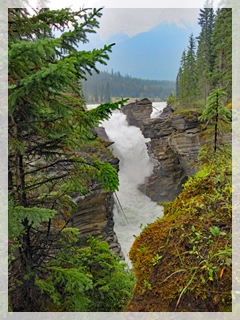 As I viewed the picturesque waterfall, the tremendous amount of water pouring over the rock, and the deep gorge formed by the glacial river, I thought of H. Jackson Brown’s quote: “In the confrontation between the stream and the rock, the stream always wins, not through strength but by perseverance.” Thinking it a good start for a devotion about patience and determination, I looked forward to writing it when I got home. Having been out of town thirty out of the last seventy days, however, I’ve been playing “catch-up” since returning from Canada. Domestic chores, family obligations, paper work, commitments, appointments, assorted health issues, and then my mother-in-law’s hospitalization have eaten away at me and I’m physically and emotionally exhausted. Today, during prayers, it occurred to me that something else is as persistent (and effective) as that rushing water—Satan! While the enemy enjoys throwing major disasters our way, as he did with Job, he also likes to peck at us like a troublesome woodpecker or whittle away at us as water does to rock. Through persistence, water defeats rock; like that persistent water, the enemy is determined to defeat us.
Satan came to Jesus when he was weakest—alone, tired and hungry after forty days of fasting in the wilderness. He does the same with us. It doesn’t take much for him to start his work. Even a small amount of worry, exhaustion, illness, busyness, discouragement, fear, delay, discontent, frustration, adversity, anger, anxiety, or pain makes us vulnerable to the enemy’s attacks. Add enough of them together for a long enough time and what seemed rock solid may break down or collapse.
The Apostle Peter likened Satan to a prowling lion and we should be wary of his attacks. If he can’t devour us in one assault, however, he’ll take a nibble out of our souls whenever an opportunity arises. Enough little nibbles can erode our spirit the same way water erodes rock. This morning, I realized that Satan was making inroads; it was time to shine up my armor of God and go on the offense. Instead of spending less time in Bible study and prayer, I needed to spend more (especially in the praise and thanksgiving departments)! While it may have taken five million years for water to carve the Grand Canyon, it wouldn’t take the enemy that long to leave a large chasm in my heart.
Almighty Father, Creator of all, thank you for the blessings of this and every day. Strengthen us so that we can resist the enemy’s attacks. Give us wisdom to understand your word and grace that we may live in obedience to it. May our faith increase daily so that we can do your work and fulfill your purpose for us; through Jesus Christ our Lord. Amen.
 All they did was sin even more, rebel in the desert against the High God. They tried to get their own way with God, clamored for favors, for special attention. They whined like spoiled children, “Why can’t God give us a decent meal in this desert? Sure, he struck the rock and the water flowed, creeks cascaded from the rock. But how about some fresh-baked bread? How about a nice cut of meat?” [Psalm 78:17-20 (MSG)]
 Not all of us have the benefit of eighty years’ experience as did Moses when God called on him. Take David, for example, he was just a young shepherd boy when called on to become both warrior and king. Peter and John were fishermen; nothing in their backgrounds prepared them for their roles as Apostles and founders of a church. Mary was just a girl, in the town of Nazareth, engaged to be married to a local carpenter. What preparation did she have to become the mother of God? Gideon was a farmer, hiding from the Midianites in a wine press while threshing wheat, when God called to him. In fact, Gideon protested that, as the most insignificant member of the weakest clan, he couldn’t be the one to rescue Israel.
 After it was returned by the Philistines, the Ark of God had been neglected in Kiriath-jearim for twenty years. Fresh from victories over the Philistines, David decided to bring the Ark back to its rightful home in Jerusalem. It certainly seemed like a good idea at the time. Unfortunately, ignoring the law’s clear instructions that the Ark could only rest on poles and carried on the shoulders of Levites, David had it placed on a cart pulled by oxen. The oxen stumbled, the cart tipped, and Uzzah reached out to steady it. Under Hebrew law, touching the sacred Ark was a capital offense and Uzzah was immediately struck dead. The Ark should never have been on a cart and it was David’s disobedience and carelessness that caused the man’s death. Nevertheless, David’s reaction was to get mad at God.
 Ezekiel proclaimed God’s message to the Jewish exiles in Babylon. As the Lord’s prophet, he was commissioned to deliver words of both judgment and hope. Some of the exiles recognized him as a prophet but more did not. Although they found Ezekiel’s message entertaining, they had no intention of putting his words into practice. There’s a lesson here for today’s churches: pews filled with people there only for the music, amusement, food, or activities mean nothing if God’s word is not planted in people’s hearts.
 After their recent visit to the oncologist, a friend asked me to pray for her father. His cancer is terminal and she asked me to pray that he will come to know God. He’s been sitting on the fence for quite some time and his time for fence sitting is rapidly running out. As I added him to my prayer list, I wondered, “Can we pray someone to God?”
