A FRAGRANT OFFERING

Offer the other lamb in the evening, along with the same offerings of flour and wine as in the morning. It will be a pleasing aroma, a special gift presented to the Lord. [Exodus 29:41 (NLT)]

But the internal organs and the legs must first be washed with water. Then the priest will burn the entire sacrifice on the altar as a burnt offering. It is a special gift, a pleasing aroma to the Lord. [Leviticus 1:9 (NLT)]

GARDENIAThe gardenias were blooming. The aroma of those beautiful flowers filled the air as I walked that morning and I paused in my walk just to inhale and relish the pleasant scent.

In the Old Testament, the Hebrews were instructed to offer sacrificial burnt offerings on their altars as gifts to God, making a “pleasing aroma to the Lord.” As a vegetarian, I found it difficult to picture how the odor of burned meat could be considered pleasant. That morning, however, I finally understood the verse’s meaning. It wasn’t the sacrifice of meat that smelled good to God; it was the prayers that accompanied the burnt offerings that made the pleasing aroma.

As I breathed in the scent of the flowers, I wondered, “Is this how God feels when He hears our prayers?” I want my prayers to be as fragrant and pleasing to God as the gardenias were to me. Perhaps gardenia isn’t your favorite scent; maybe it’s the aroma of fresh baked ginger cookies or, in my husband’s case, fresh cooked bacon. Either way, let your prayers be as pleasing to God as your favorite aromas are to you! By the way, I have a sneaky suspicion that praise and thanksgiving smell best to Him; whiny complaints probably smell a bit like burnt toast!

O Lord, please accept my prayers as a sacrifice of praise and thanksgiving. May you always find them sweet smelling.

Accept my prayer as incense offered to you, and my upraised hands as an evening offering. [Psalm 141:2 (NLT)]

And when he took the scroll, the four living beings and the twenty-four elders fell down before the Lamb. Each one had a harp, and they held gold bowls filled with incense, which are the prayers of God’s people. [Revelation 5:8 (NLT)]

Copyright ©2017 jsjdevotions. All rights reserved.

RERUNS

The Lord said to Moses, “I’m going to send you food from heaven like rain. Each day the people should go out and gather only what they need for that day. In this way I will test them to see whether or not they will follow my instructions. But on the sixth day when they prepare what they bring home, it should be twice as much as they gather on other days.”  Exodus 16:4-5 (GW)

red bellied woodpeckerMy husband and I joke that our marriage survived because we agreed that whoever filed for divorce had to take sole custody of the children! Knowing that it took two of us to deal with the three of them, we stayed married. Now that the children are grown,  we remain together because whoever files must relinquish all grandparenting rights. Since neither one of us is willing to forfeit time with the delightful grands, we continue to remain together. All joking aside, we’ll soon be commemorating a half century of marriage.

For the next ten days, we will be in California, celebrating our fiftieth anniversary with our children and grands. Four families from four states will be there and it wasn’t easy finding several days when everyone could take time away from work, school, friends, sports and other obligations to get together. In fact, because of everyone’s busy schedules, we’re celebrating six weeks early. As I thought about how my children, their spouses and children had to make certain sacrifices and adjust their lives so we could gather as one family, I thought about my responsibilities. Not only do I owe my family my full attention, but I also want to enjoy every possible minute with them. Nevertheless, I also want to honor my commitment to this devotional blog. Knowing I can’t do justice to both, I took it to God in prayer and that still small voice whispered in my ear, “Summer reruns.”

This website has been a journey of faith for me. For several years, I’ve trusted God to provide my words on a regular basis. Like manna from heaven, the Holy Spirit has inspired my daily messages; I have no complaint since He’s given me well over 1,300 posts. With the Israelites’ manna, God wanted the people to trust His daily provision so any manna stored from one day to the next got worms and spoiled. For me, reusing any devotions seemed a bit like storing manna and showed a lack of faith in God’s provision. I then recalled that God allowed two days’ worth of manna to be gathered on the sixth day, so that the seventh day, the Sabbath, was truly a day of rest. Being mindful that the days with our loved ones are numbered and only God knows how many remain, the next ten days are going to be an extended Sabbath for my family and me. There may be some more reruns later this summer when my husband and I go for a “just the two of us” trip to the Canadian Rockies to complete our anniversary celebration.

God speaks to my heart as I write and I hope and pray my writing speaks to yours. Nevertheless, just as Scripture may speak to me in different ways on different days, my words may speak to you in different ways on different days, as well. Instead of gathering extra manna for the Sabbath, I gathered up some devotions from three years ago, did a little updating where necessary, and re-scheduled them. I pray you enjoy the summer reruns. Blessings, j

If anyone doesn’t take care of his own relatives, especially his immediate family, he has denied the Christian faith and is worse than an unbeliever. [1 Timothy 5:8 (GW)]

I’m giving you a new commandment: Love each other in the same way that I have loved you. Everyone will know that you are my disciples because of your love for each other. [John 13:34-35 (GW)]

Copyright ©2017 jsjdevotions. All rights reserved.

CEASE FIRE

Then Solomon said, “Don’t kill the child! Give it to the first woman—she is its real mother.” [1 Kings 3:27 (GNT)]

mallard - baby duckingsImmediately after finishing yesterday’s devotion about conflict and prayer, I received a call from a friend whose 11-year old granddaughter, Anna, has osteosarcoma (bone cancer). Having undergone chemotherapy for the past two months, she is scheduled for surgery this week. In the best case scenario, her knee and part of her femur will be removed and replaced by a metal prostheses; the worst case scenario involves complete amputation of the leg. In either case, more chemo and at least six to twelve months of physical therapy will follow.

As distressed as this grandfather is by his grand’s cancer, he is even more upset by her parents’ behavior. Divorced several years ago, they decided upon an “every other week” type of joint custody. Although this often sounds like a win-win solution, court battles about custody issues have continued since the divorce. Rather than a good compromise, their custody agreement is more like an, “If I can’t have her all of the time, neither can you!” sort of thing. Their story reminds me of the two women claiming to be the mother of the same infant who came to King Solomon to settle their dispute. As the women argued, King Solomon called for his sword and ordered that the child be cut in half so that each one could have a part of him. “No!” screamed one mother who said to give him to the other woman so that he could live. “Go ahead,” said the other woman since that way neither mother would have the baby. Solomon immediately knew the identity of the real mother—the woman who was willing to give up her own flesh and blood so that he could live. Real parents are willing to sacrifice their happiness for the sake of their children, even if that means losing them. Now, with a seriously ill youngster, instead of putting aside their differences and forming a united wall of protection around their daughter, Anna’s parents brought their dispute not just into the court but also into the hospital. Because tempers flared and things got so contentious, only that week’s custodial parent can be with the girl in hospital.

Yesterday, I wrote about turning to Scripture and prayer as a way of handling disputes. In this case, although counselling and the courts haven’t worked, Scripture and prayer haven’t been tried. It is in God’s word and prayer that these parents would find true wisdom, strength and the directions to sacrifice, forgive, and love in the way that the mother in Solomon’s court did. I know both of Anna’s parents love her but they are unwilling to put aside their anger, resentment, and selfish desires for the sake of their child. Instead of being sliced in half by a sword, an eleven year old girl is being torn apart by two adults who are more interested in winning every dispute than they are in finding a way to live in peace and bring healing to their daughter. So invested in winning, they can’t see the real loser in their hateful war. Unfortunately, while their situation is extreme, Anna is not the only child of divorce being used as a pawn in her parents’ game of revenge.

Father in Heaven, forgive us when we look to our needs and desires instead of to you. Watch over and strengthen, not just Anna, but all children caught in the middle of their parents’ battles. May we all learn to call to you in prayer, turn to your word for wisdom, be willing to sacrifice our desires for the good of others, and continually act with forgiveness and love.

Above everything, love one another earnestly, because love covers over many sins. [1 Peter 4:8 (GNT)]

Ask God to bless those who persecute you—yes, ask him to bless, not to curse. … If someone has done you wrong, do not repay him with a wrong. Try to do what everyone considers to be good. Do everything possible on your part to live in peace with everybody. … Do not let evil defeat you; instead, conquer evil with good. [Romans 12:14,17-18,21 (GNT)]

Copyright ©2017 jsjdevotions. All rights reserved.

HUMBLING

The Lord detests the proud; they will surely be punished. … Pride goes before destruction, and haughtiness before a fall. First pride, then the crash—the bigger the ego, the harder the fall. [Proverbs 16:5,18 (NLT)]
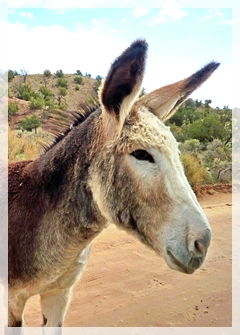
donkeyWhile reading C.S. Lewis’ The Horse and His Boy, I couldn’t help but think of the proud Babylonian King Nebuchadnezzar. He was so full of himself that he erected a 90-foot golden statue and then demanded that people fall down and worship it as a sign of loyalty to him. When interpreting one of the king’s dreams, Daniel told Nebuchadnezzar that he would be driven from human society and only regain his kingdom when the king learned that heaven, not man, rules. The king was warned to change his evil behavior. In spite of the caution and even though he’d seen the power of the Israelites’ one true God when Shadrach, Meshach, and Abednego survived the fiery furnace, Nebuchadnezzar didn’t change his ways. While looking down from his rooftop and surveying the wonders of Babylon, he expressed pride in his accomplishments and congratulated himself on his mighty power. Before the words were even out of his mouth, a voice from heaven pronounced judgment upon him. The king developed what is known as boanthropy, a psychological disorder in which one becomes delusional and thinks he or she is a cow. The high and mighty king was driven from society and lived and ate like an animal for the next seven years.

In The Horse and His Boy, instead of a king, the reader meets the pompous Prince Rabadash, the tale’s villain. Fancying himself a great warrior, he set off to seek revenge on a Narnian queen who spurned his advances. After being defeated in battle, the captured prince was told to forget his pride and anger and accept the mercy offered by Narnia’s kings. Even though he replied with an arrogant tirade, another chance to change his evil ways was offered to the proud prince. While responding with even more invective, Rabadash’s last words came out as braying. Unlike Nebuchadnezzar, who only thought he was an animal, the prince actually became one—a donkey.

Both true and fictional stories can help us understand God and life. After all, even Jesus made up stories with his parables. It is no mere coincidence that Rabadash’s fate resembles that of Nebuchadnezzar. C.S. Lewis considered pride to be the “great sin”—the sin that leads us to what he called “the complete anti-God state of mind” and the sin that leads us to all other sins. Pride causes us to look down on things and people (as it did with both Nebuchadnezzar and Rabadash) instead of looking up to God. It was only when the humbled king looked up at heaven that he returned to sanity and only when thousands had looked down at the four-legged prince that he regained his body.

Envy is private, lust and anger can be concealed, and selfishness and greed can be disguised as the virtues of prudence and fortitude. Things like pride, arrogance, contempt and conceit, however, are rather obvious and there is a sense of poetic justice to both men’s public humiliation. By the time they returned to their normal states, their subjects had witnessed them either acting like a cow or looking like a donkey. Behind the prince’s back while alive (and openly once dead), he was known as Prince Rabadash the Ridiculous. Although the Bible makes no mention of it, I can only imagine that the people of Babylon must have snickered when they saw the once powerful and proud king grazing in the fields, his hair long and matted and his untrimmed nails looking like claws.

God hates it when we’re proud and yet we all suffer from pride. Although Jesus took our punishment for that sin (and every other one), we often find ourselves recipients of some of God’s divine discipline when we err and stray. As for pride, God seems to have fitting and often public ways of knocking us down a peg or two when necessary. If we don’t keep ourselves humble, we can be pretty sure that God will do it for us. Like Nebuchadnezzar, we may find ourselves ostracized from society or, like Rabadash, looking like an awful lot like an ass.

Every Christian has a choice between being humble or being humbled. [Charles Spurgeon]

As the Scriptures say, “God opposes the proud but gives grace to the humble.” So humble yourselves before God. Resist the devil, and he will flee from you. Come close to God, and God will come close to you. Wash your hands, you sinners; purify your hearts, for your loyalty is divided between God and the world. … Humble yourselves before the Lord, and he will lift you up in honor. [James 4:6b-8,10 (NLT)]

Copyright ©2017 jsjdevotions. All rights reserved.

WOULD I? COULD I?

God blesses those who are persecuted for doing right, for the Kingdom of Heaven is theirs. [Matthew 5:10 (NLT)]

As they stoned him, Stephen prayed, “Lord Jesus, receive my spirit.” He fell to his knees, shouting, “Lord, don’t charge them with this sin!” And with that, he died. [Acts 7:59-60 (NLT)]

old world wisconsinHis testimony enraged the Jewish high council and he was taken from the city and stoned to death. Stephen was the first of the Christian martyrs but clearly not the last. We’ve all been horror-stricken by the recent news from Egypt where ISIS thugs attacked Coptic Christians on their way to a remote monastery. According to witnesses, the men were told their lives would be spared if they recited the shahada, the Islamic declaration of faith. When they refused to do so, they were gunned down. Since December, more than 100 Coptic Christians have died in Egypt in four different attacks. On Palm Sunday, two of their churches were bombed leaving forty-four dead. It’s not easy being a Christian in Egypt.

Apparently, it’s not that easy in India, either. Last winter, Bartu Urawn and his wife were forced to stand all night in a freezing pond. When they refused to renounce their Christian faith after being immersed in the frigid water for seventeen hours, they were beaten. Although his wife survived, Urawn died as a result of the torture. A decade ago, Christianity was embraced by ten families in this remote Indian village. Unfortunately, in the years that followed, seven of those families caved into threats and returned to their indigenous tribal religion. The Urawns, however, remained faithful to Jesus.

After watching the news of the Egyptian attack last night, my husband asked how I would respond in a similar situation. I wondered. Would I choose to be a martyr? I’d like to think I would. Like the Urawns, could I endure hours of torture and still stay true to Christ? I’d like to think I could. What if, rather than saving my life, renouncing Christ meant I could keep my children from suffering torture or death? Now it’s getting harder to know the answer. Could I watch them suffer? How could I live with myself in either scenario? Perhaps I’d find an excuse for verbally abandoning Jesus by telling myself that they were just empty words from my mouth and my heart didn’t mean them. I’m not so sure God would see it that way and it doesn’t much sound like something Jesus would do. These are not easy questions and, hopefully, I’ll never be forced to ask them. Nevertheless, the uncertainty of my answers indicates the level of my faith and it’s nowhere near as strong as I thought it was. Jesus told us to pick up our crosses and follow him; let us never forget that the cross was an instrument of torture and He was walking to Calvary. We have been called to share in His suffering and persecution should not deter us.

Living here in the United States, we’re not likely to be threatened with torture or death for our Christian faith. We don’t risk our lives by reading the Bible or gathering in worship and prayer. Perhaps, rather than wondering if we would stand up to ISIS soldiers or an angry mob of non-believers, we should ask ourselves how well we stand up to the world in which we live. Although we may never have to choose between Jesus and our physical survival (or that of our loved ones), there are plenty of opportunities every day to forsake Him in far more subtle ways. If we’re not walking in His footsteps and led by His Holy Spirit, we’re denying Him. There’s more than one way to lose one’s soul.

 I will not deny Christ…I will continue to believe until my last breath. [Bartu Urawn]

Then Jesus said to his disciples, “If any of you wants to be my follower, you must give up your own way, take up your cross, and follow me. If you try to hang on to your life, you will lose it. But if you give up your life for my sake, you will save it. And what do you benefit if you gain the whole world but lose your own soul? Is anything worth more than your soul? [Matthew 16:24-26 (NLT)]

Copyright ©2017 jsjdevotions. All rights reserved.

HIS LAST LECTURE

I have told you these things so that you won’t abandon your faith. … I have told you all this so that you may have peace in me. Here on earth you will have many trials and sorrows. But take heart, because I have overcome the world. [John 16:1,33 (NLT)]

Blue JayThe “Last Lecture,” a tradition at many universities, is given by a professor as if it is the last one delivered in the speaker’s lifetime. Hoping to inspire the audience to become better versions of themselves, the lecturer usually reflects on his life’s journey and shares his hard-earned wisdom. New meaning was given to this tradition in 2007 when Randy Pausch, a professor at Carnegie Mellon University, gave what truly was his last lecture. Terminally ill with pancreatic cancer, he was dead less than a year after giving it.

In chapters 14 through 17, the Gospel of John records another last lecture. Having only a few hours left with the disciples and less than twenty-four hours to live, Jesus delivered it. As far as last lectures go, Jesus’ is no match for that of Randy Pausch. The professor addressed his prognosis of less than six months to live within the first minute. His audience knew they were hearing the words of a dying man but the disciples didn’t. Pausch explicitly stated what issues he wouldn’t tackle (cancer, his family, or spirituality and religion) and then clearly addressed his topic of achieving childhood dreams. There was no ambiguity in his speech and no one was confused when his lecture was over. Jesus’ words, however, must have seemed confusing to the disciples. He said their joy would overflow and then warned them they’d be persecuted; He said He was leaving but would still remain. If the disciples had known they were listening to a last lecture, they may have listened more carefully, asked more questions, and stayed awake in the garden that night.

Although Jesus told them not to let their hearts be troubled, there would have been fewer troubled hearts if the disciples had truly understood that He’d rise again. Jesus knew how the story would end but they didn’t! Yet, it wouldn’t have taken much faith or trust if they’d known what Sunday morning would bring. How could Jesus distill three years’ worth of teaching into one speech? What could He say that would keep them strong while He hung on the cross and then lay in a tomb for three days? Jesus told them just enough to hold them over until His return, sort of like tossing them life jackets but leaving them in the stormy sea. They had enough to stay afloat but needed to have faith that a rescue ship would arrive.

There are similarities in the two lectures. In spite of its title, Pausch’s speech wasn’t about achieving dreams; like Jesus’ lecture, it was about how to lead our lives—about love, teamwork, perseverance, faith and trust. The second similarity is that Pausch’s lecture wasn’t just for his audience; like that of Jesus, it was for his children. Knowing His words would not end with the eleven men in the room,  Jesus concluded with a prayer for future believers. Those words were for His children, the generations of new believers that would come to Him through the ages.

What we learn from Jesus’ last lecture is simple: we don’t have to know the future to have faith in God but we do have to have faith in God to face the future with untroubled hearts.

Now I am coming to you. I told them many things while I was with them in this world so they would be filled with my joy. I have given them your word. … I am praying not only for these disciples but also for all who will ever believe in me through their message. I pray that they will all be one, just as you and I are one—as you are in me, Father, and I am in you. [John 17:13-14, 20-21 (NLT)]

Copyright ©2017 jsjdevotions. All rights reserved.