MARY, DID YOU KNOW?

“Don’t be afraid, Mary,” the angel told her, “for you have found favor with God!  You will conceive and give birth to a son, and you will name him Jesus. He will be very great and will be called the Son of the Most High. The Lord God will give him the throne of his ancestor David. And he will reign over Israel forever; his Kingdom will never end!” [Luke 1:30-33 (NLT)]Virgin Mary

A poor teenage girl, a virgin, found herself pregnant. When she first felt life in her womb, did she know that she’d give birth in a stable, that her child’s life would be in danger, or that they’d have to flee to Egypt? When she held Him to her breast, did she know that her infant son was the long awaited Messiah and what that would mean? As she taught Him to walk, wiped his nose, and bandaged his cuts, did she know that, rather than residing on an earthly throne, He’d sit at the right hand of God? As she proudly heard Him recite the Torah, did she know that He’d turn water into wine or raise the dead? When He triumphantly entered Jerusalem, did she know that soon she’d stand and watch as He suffered a criminal’s death upon a cross? As she sobbed in John’s arms, did she know her baby boy would rise again in three days? Could she have known that 2,000 years later nearly a third of the world’s population (2.3 billion people) would be His followers? Mary, did you have any idea of what the future would bring?

Mary, did you know that your Baby Boy would one day walk on water?
Mary, did you know that your Baby Boy would save our sons and daughters?
Did you know that your Baby Boy has come to make you new?
This Child that you delivered will soon deliver you.
Mary, did you know that your Baby Boy will give sight to a blind man?
Mary, did you know that your Baby Boy will calm the storm with His hand?
Did you know that your Baby Boy has walked where angels trod?
When you kiss your little Baby you kissed the face of God?
Mary, did you know that your Baby Boy is Lord of all creation?
Mary, did you know that your Baby Boy would one day rule the nations?
Did you know that your Baby Boy is heaven’s perfect Lamb?
The sleeping Child you’re holding is the Great, I Am.
[Mary Did You Know?  (Mark Lowry)]

They hurried to the village and found Mary and Joseph. And there was the baby, lying in the manger. After seeing him, the shepherds told everyone what had happened and what the angel had said to them about this child. All who heard the shepherds’ story were astonished, but Mary kept all these things in her heart and thought about them often. [Luke 2:16-19 (NLT)]

Copyright ©2017 jsjdevotions. All rights reserved.

DISAPPOINTMENT

We are pressed on every side by troubles, but we are not crushed. We are perplexed, but not driven to despair. We are hunted down, but never abandoned by God. We get knocked down, but we are not destroyed. [2 Corinthians 4:8-9 (NLT)]

OrchidPeople disappoint. Consider Moses’ disappointment when, fresh off Mt. Sinai after a 40 day meeting with God, he returned to find the Israelites worshipping a golden calf. Can you imagine David’s disappointment when Saul, the man he’d comforted with his songs, plotted his death? Picture Nathan’s disappointment in David when he confronted him about his adultery with Bathsheba. Think of Joseph’s disappointment in the brothers he thought loved him as they callously sold him into slavery. Consider Jesus’ disappointment in the denying Peter, the betraying Judas, and His sleeping disciples. For that matter, consider the disappointment of the disciples as they saw their hope for the end of Rome’s tyranny die a criminal’s death on the cross.

People let us down. I remember back to 1974, when the Watergate cover-up began to unravel. My in-laws were deeply disappointed and saddened when the president they’d supported resigned in disgrace. Today, that sort of public betrayal doesn’t surprise us. Every day we learn of another betrayal of the public’s trust, abuse of power or lack of integrity. Manipulation, deception, and falsehoods are daily events. Nevertheless, when they’re done by someone we actually know—someone in whom we believed—we’re shocked and hurt. Recently, I’ve learned that people I thought I knew—people I trusted and respected—are not worthy of that trust or respect. That some others, knowing of their duplicity, have chosen to tolerate or gloss over it adds to my disappointment. Yes, people can let us down.

When efforts at rectification and reconciliation failed, my initial response was anger and indignation. That’s when the one most hurt by this betrayal of trust reminded me that I must always lead with love. Resolution is not possible, anger and retaliation are wrong, so forgiveness, prayer and grief are all that remain. With a forgiving heart, I will pray for both the betrayers and betrayed and grieve for what has been lost. Then, putting this disappointment behind me and trusting in God’s guidance, I will move forward into tomorrow.

It’s been said, “People will let us down but God never will.” Indeed, people let down Moses, David, Nathan, Joseph, and Jesus and they will continue to disappoint us. Jesus, however, never let down the disciples. Their hopes were briefly dashed when He was laid in a borrowed tomb but, with His resurrection three days later, they saw the end of sin’s tyranny and the beginning of life eternal. God will never let us down. As I lay my disappointment before Him in prayer, I know He will take my sad heart and restore it with strength, confidence, faith, and love. He will never disappoint!

We can rejoice, too, when we run into problems and trials, for we know that they help us develop endurance. And endurance develops strength of character, and character strengthens our confident hope of salvation. And this hope will not lead to disappointment. For we know how dearly God loves us, because he has given us the Holy Spirit to fill our hearts with his love. [Romans 5:3-5 (NLT)]

Copyright ©2017 jsjdevotions. All rights reserved.

BREAKING BREAD TOGETHER

When we bless the cup at the Lord’s Table, aren’t we sharing in the blood of Christ? And when we break the bread, aren’t we sharing in the body of Christ? And though we are many, we all eat from one loaf of bread, showing that we are one body. [1 Corinthians 10:16-17 (NLT)]

communion cupSometimes our Florida church celebrates Communion at the beach. The church provides fried chicken and everyone brings a dish to pass. After enjoying dinner and fellowship with our church family, we congregate around the gazebo, pray, hear a brief sermon, and partake of the Lord’s Supper. Some Sundays, there also may be a Baptism in the ocean. We stand on the beach as the sun sets in the west and welcome a new Christian into the body of Christ. These sunset meals are a celebration of God’s grace, Jesus’s love, and the power of the Holy Spirit.

Whenever we have our sunset celebrations, I think of what it must have been like for the early church. Because most of the early Christians were Jews, initially they gathered in the temple and synagogues for worship. Unable to celebrate the Lord’s Supper or baptize in a Jewish house of worship, this arrangement was unsatisfactory. Without a church building or a formal baptistery, people were brought to wherever there was water for Baptism and, on Sundays, the Christians gathered in homes for a 1st century potluck. The partaking of the bread and wine was usually celebrated as part of the meal, called an agape or love feast. To show their union in Jesus, people were to set aside their differences in status, wealth, ethnicity, and education and any quarrels were to be settled before partaking in the meal. Their worship was close and intimate. When we celebrate with our church at the beach, I feel that same sense of fellowship. We are an odd assortment of people, of diverse backgrounds and various ages, and from all walks of life but we are family—united by our belief in Jesus. Celebrating the sacraments in such a way is a profoundly meaningful experience.

Of course, the early church wasn’t perfect and problems arose. Paul took the Corinthians to task for dissension among their members and for not settling their differences. Worse, some of the Corinthians were selfish with the food or got drunk during the meal; not everyone cared or shared. Their gluttony and disregard for the needs of others didn’t demonstrate the unity and love that were to characterize the early church. With no alcohol at our church potlucks, no one ever gets drunk but some people in the front of the line have been known to take far more than their share, making it slim pickings for those at the end. I have a sneaky suspicion that not everyone comes together with all of their differences settled either. In actuality, we probably aren’t a whole lot different from our Corinthian forefathers.

By the beginning of the 2nd century, Christ’s followers had moved out of the synagogues, the Christian church found its own way to worship, and the Lord’s Supper was no longer celebrated as part of a meal. Although a few denominations and house churches still celebrate agape meals with communion, most of us celebrate the Lord’s Supper in a more formal setting than a potluck at someone’s house or a park. Nevertheless, we should always remember its beginnings. That first Lord’s Supper was an actual meal that fed both body and soul.  Apart from Judas, the participants were a family of believers, a band of brothers, united in their love for one another and for Jesus. The Lord’s Supper began as a Passover feast celebrating God’s redemption of His people from slavery to Pharaoh and it continues as a celebration of the redemption of His children from slavery to sin. Moreover, we should never come to His table without settling our differences with one another.

But every Lord’s day . . . gather yourselves together and break bread, and give thanksgiving after having confessed your transgressions, that your sacrifice may be pure. But let no one that is at variance with his fellow come together with you, until they be reconciled, that your sacrifice may not be profaned. [Didache 14 (c.90 AD)].

If someone says, “I love God,” but hates a fellow believer, that person is a liar; for if we don’t love people we can see, how can we love God, whom we cannot see? And he has given us this command: Those who love God must also love their fellow believers. [1 John 4:20-21 (NLT)]

Copyright ©2017 jsjdevotions. All rights reserved.

AUDACIOUS PRAYERS

And without faith it is impossible to please him. For whoever would draw near to God must believe that he exists and that he rewards those who seek him. [Hebrews 11:6 (RSV)]

Steamboat Ski - COIt was a dreary winter day when the entire congregation exited the church into a weed-filled field. Like the Israelites, we were armed with horns, only ours were those silly blowout noisemakers seen at children’s birthday parties. Silently, we marched until we’d circled the muddy patch of ground seven times. Anyone observing us from the highway surely thought us foolish as we raised those noisemakers to our lips, blew hard and then cheered. Unlike the Israelites who marched around Jericho so God would knock down walls, we marched around that field to show our faith that God would erect walls for us!

That was a little more than five years ago in the Colorado mountain town where we spent our winters. Armed only with big prayers and bold faith, that church built a 15,000 square-foot Family Life Center. At its dedication last September, the congregation was again given noisemakers; when the service ended, the horns sounded as they celebrated God’s love, grace, and amazing provision.

Erecting that building wasn’t an easy task—blueprints were drawn and redrawn, delay after delay occurred, the red tape seemed never ending, and everything was more complicated and often more expensive than expected. The church never lost faith in the project nor did they cut back on serving God’s people. They faithfully continued their discipleship, benevolence, education, community outreach and missions work while raising additional funds for their expansion. This ski and ranch town is not a wealthy one and many are employed only seasonally. Nevertheless, they generously stepped out in faith, shared their resources, made sacrifices, and trusted God to provide. The pastor is fond of reminding his flock that God honors audacious prayers because audacious prayers honor God. The Family Life Center is a testament to that statement—when the people dared to dream and pray big, instead of walls falling, they were raised!

Picture the audacity of the bleeding woman who was so sure Jesus could heal her that she pushed her way through the crowd just to touch the hem of His robe. Imagine the audacity of Joshua asking God to stop the sun and moon from moving until the Israelites had defeated their enemies. When Elijah prayed for both drought and rain, he made some audacious predictions to Ahab. Like the bleeding woman and Joshua, he would have looked a fool if God had not answered those prayers. God came through for them all because their big bold prayers honored an even bigger God.

We insult our amazing Father with trivial prayers; they’re like asking famed chef Gordon Ramsey to make only a peanut butter sandwich. Inconsequential prayers imply we’re not sure He really can do anything that great. Courageous faith means bold audacious prayers and stepping out for God’s kingdom. Because they prayed, believed, and acted on their belief, that mountain church saw our awesome God provide in miraculous ways. He can do far more than we can imagine or ask and we must never doubt His power. Perhaps God will say, “No!” but, if we never ask, He can’t say, “Yes!” God honors audacious prayers because audacious prayers honor Him!

Then the disciples came to Jesus privately and said, “Why could we not cast it [a demon] out?” He said to them, “Because of your little faith. For truly, I say to you, if you have faith as a grain of mustard seed, you will say to this mountain, ‘Move from here to there,’ and it will move; and nothing will be impossible to you.” [Matthew 17:19-20 (RSV)]

Copyright ©2017 jsjdevotions. All rights reserved.

POWER

But Jesus called them together and said, “You know that the rulers in this world lord it over their people, and officials flaunt their authority over those under them. But among you it will be different. Whoever wants to be a leader among you must be your servant, and whoever wants to be first among you must become your slave.  [Matthew 20:25-27 (NLT)]

red-shoudered hawkRecently, the news has been filled with stories about powerful men who have misused their influence to prey on others. Unfortunately, abuse of power is nothing new. Consider our Biblical hero King David. While strolling on his roof late one afternoon, he looked down on the city below and spotted a beautiful woman taking her ritual bath. Even though he knew she was married, David sent for her. With at least six wives already, he wasn’t lacking for female companionship. Nevertheless, he wanted the beautiful Bathsheba. The Bible tells us the two had sex, she got pregnant, and David killed her husband to conceal their adultery. The Bible, however, tells us nothing of Bathsheba. We know she didn’t ask David to invade her privacy and, obedient to her king, she went to his palace. How could she refuse and to whom could she complain? Whether David managed to seduce her with his charm or forced himself on her doesn’t matter. He was her king and she had no choice. He wrongly took advantage of his power when he sent his men to get her, had sex with her, and manipulated events so that her husband was killed in battle.
This is not a male-bashing devotion; it is a reminder to us all that power and authority of any kind is a privilege. We are told to be good stewards of our wealth and use it wisely. When we are blessed with positions of authority or power, we should use that wisely, as well. If we’re not millionaires, CEOs, politicians, producers, or celebrities, we might think we have little or no power, but we do. We have the power to make someone else’s day good or bad and we have the power to affect their future. We can badger or intimidate co-workers, baby sitters, interns, clerks, sales people, bus drivers, assistants, neighbors, care givers, maintenance people, spouses and even children. It’s not just sexual abuse; there are many other ways to abuse, demean, mistreat, manipulate, or exploit people. Bullies aren’t found just on the playground; I’ve seen them berate wait staff, receptionists, and students. Threats aren’t made just by bosses; I’ve seen them made by irate customers. Politicians aren’t the only ones with clout; many of us have the ability to put in a good (or bad) word that can change someone’s future. We can make or break someone’s reputation with a few keystrokes. Having the upper hand never gives us the right to hit with it and having the power to do something doesn’t necessarily mean we should.

Abuse of power has consequences; conceived in adultery, David and Bathsheba’s child died and we’ve recently seen numerous successful careers crash. We may not make the tabloids when we shortchange the sitter, take out our anger on the secretary, or threaten someone out of spite. Nevertheless, there will be consequences for us as well—if not in this world, then in the next. In the parable of the talents, Jesus tells us that we’ll be held accountable for the way we use our gifts. We tend to think of those gifts as money, time and skills. They also include knowledge, relationships, privilege, power and authority and we should use all of them with love and compassion. Moreover, when we use our influence or authority to mistreat those less powerful, let us remember that we are mistreating the most powerful one of all!

And the King will say, “I tell you the truth, when you did it to one of the least of these my brothers and sisters, you were doing it to me!” [Matthew 25:40 (NLT)]

Copyright ©2017 jsjdevotions. All rights reserved.

FOOD INSECURITY

The crowds asked, “What should we do?” John replied, “If you have two shirts, give one to the poor. If you have food, share it with those who are hungry.” [Luke 3:10-11 (NLT)]

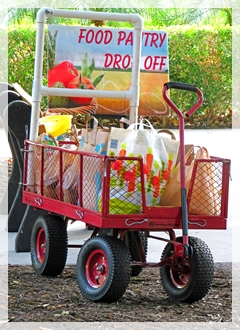
food pantry - feed the hungryYesterday, our nation celebrated Thanksgiving, a holiday that revolves around food and unites our nation across lines of culture, race, religion, and politics in a way little else can. Regardless of what football team they support, where they live or from where they came, whether liberal, conservative or somewhere in between, my Muslim, Hindu, Jewish, Christian, and unbelieving friends all celebrated around tables heavy laden with food. The menu and traditions varied—some had naan and others enjoyed cornbread or Parker House rolls. Some plates had ham alongside the turkey while others tofurkey and lentils or some of Grandma’s lasagna. Some cooks put pork sausage in their dressing and others kept kosher. There may have been glazed sweet potatoes and green beans at one house and mashed whites with gravy and corn casserole at another but, whatever was served, no one went away hungry and there were plenty of leftovers. Unfortunately, not everyone’s plate was piled with food and not everyone complained of feeling stuffed.

When I grew up, I was told there were starving children in Armenia so I should clean my plate. I once gave the smart-aleck retort that what I didn’t eat couldn’t be sent to those kids so what difference did it make! That was, of course, the wrong response and, most definitely, the wrong attitude. It wasn’t so much about cleaning my plate; my parents were trying to teach me appreciation and gratitude for the bounty at our table. They wanted me to understand that not everyone was so blessed. Unlike me, many children knew the real meaning of hunger.

The UN defines “food security” as always having physical, social and economic access to enough safe and nutritious food to meet one’s dietary needs for a productive and healthy life. Although there is more than enough food in the world to feed everyone, they estimate that some 815 million people in our world are “food insecure.” In our nation alone, some 41 million people (13 million of whom are children) are considered food insecure. It’s not just the Armenians or whoever else our parents mentioned that are hungry; it’s our neighbors!No one anywhere should go hungry but it’s disgraceful that anyone in our wealthy nation should be without reliable access to a sufficient quantity of affordable and nutritious food.

As Christians, we must respond to food insecurity with compassion and action—prayer, advocacy, volunteering, and donating. When we pray, “Give us this day our daily bread,” let’s remember the bread with which we are blessed is meant to be shared. When Jesus shared a few loaves and fish, He managed to feed thousands; consider how many we could feed if we shared our resources! As you write up your Christmas gift list, perhaps you will include a Christian relief organization and help combat poverty and hunger. If you’re wondering what to get your pastor or child’s teacher, rather than a tie or mug, what about a flock of chicks, geese or ducks (only $20) from someplace like Heifer International? Your donation will provide both food and a source of income for a hungry family. These next few weeks, you’ll be making several trips to the grocery store. Every time you shop, consider taking advantage of the BOGO specials and giving that free item (better yet both of them) to the local food pantry. There are more than enough resources in our world so that everyone can eat well but we each must do our part.

Yesterday, we looked at our bountiful Thanksgiving feast and asked ourselves, “What will I eat?” Please remember that someone not that far from you may have said, “Is there anything for me to eat?”

For I was hungry, and you fed me. I was thirsty, and you gave me a drink. I was a stranger, and you invited me into your home. I was naked, and you gave me clothing. I was sick, and you cared for me. I was in prison, and you visited me. … I tell you the truth, when you did it to one of the least of these my brothers and sisters, you were doing it to me! [Matthew 25:35-36,40 (NLT)]

Copyright ©2017 jsjdevotions. All rights reserved.