
As they were eating, Jesus took some bread and blessed it. Then he broke it in pieces and gave it to the disciples, saying, “Take this and eat it, for this is my body.” And he took a cup of wine and gave thanks to God for it. He gave it to them and said, “Each of you drink from it, for this is my blood, which confirms the covenant between God and his people. It is poured out as a sacrifice to forgive the sins of many. [Matthew 26:26-28 (NLT)]
 The celebration of the Eucharist or Holy Communion has been central to our Christian worship since the early church. If asked the meaning of the word eucharist, most of us would probably respond that it is the Christian sacrament that commemorates the Last Supper with bread and wine. While it has come to mean that and often refers to the consecrated elements, especially the bread, the word eucharist originally meant something else entirely. Coming from the Greek words eukharistos, meaning grateful, and kharizesthai, meaning to offer graciously, it is a translation of the Hebrew word berekah which means a blessing or benediction. Acknowledging God as the source of all good things, a berekah would be similar to the grace or table blessing we offer before or after a meal.
When Jesus spoke the traditional Passover meal berakahot that night in the upper room, he gave them new meaning when he added the words, “this is my body” and “this is my blood.” In thanks, He raised the bread just as his body soon would be raised on the cross. He took the matzah that symbolized the suffering of Israel, thanked God for it, and broke it, knowing that his body would be broken in less than a day. As He passed it to the disciples, the bread that once symbolized Israel’s suffering became the bread that would symbolize His. The disciples may have thought he was simply offering a blessing for the Passover bread but Jesus was offering thanks for the body which soon would be defeated by thorns, whip, nails and cross. He then thanked God as he poured out the wine that symbolized Israel’s redemption from Egypt and passed it around. The disciples may have thought he was giving thanks for Israel’s redemption from Egypt but Jesus knew it was for their redemption from sin. For something to be redeemed, however, a price must be paid and Jesus knew that price would be his blood. While pouring out the wine, He knew his blood would soon pour from his body and yet he still gave thanks. Knowing full well the torment he would suffer, He graciously offered himself for us and gave thanks.
Last week, when the Words of Institution were spoken before Communion and the bread and wine were consecrated, I realized I hadn’t fully appreciated the circumstances in which those words originally were spoken. Jesus knew He’d be betrayed, disappointed and denied within hours. He knew the agony that would soon occur. Jesus knew he would be broken and bleed. He knew the real sacrifice was not the lamb on which they’d supped; He was the sacrificial Lamb of God and yet He acknowledged God as the source of all blessings and thanked Him! Blessed be the Lord; let us give thanks!
Blessed are You, Lord our God, King of the Universe, who brings bread from the earth. … Blessed are You, Lord our God, King of the Universe, who creates the fruit of the vine. [Jewish prayers over bread and wine]
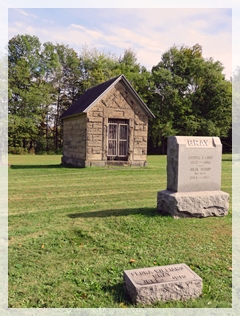 When touring a nearby resort town, a beautiful old mansion was pointed out. It was once owned by a man who made so much money on his invention of the sanitary milk bottle cap that he retired at the age of 26. For 93 years, the Chicago White Sox played at a ball field named for the team’s founder. In 2003, the field was renamed US Cellular Park and then, in 2016, it became the Guaranteed Rate Field. When I went to Northwestern University, the football venue was named for a former Evanston mayor. In 1997, the stadium was renamed to honor the family of a generous donor to the school’s athletic facilities. A friend’s daughter is attending a school named for a German immigrant who opened a Chicago butcher shop in 1883. Who were these men?
 His cautionary words to the disciples are difficult to understand. How can Jesus, who told us to love our enemies and do good to them, tell us to hate our families? Do we have to despise our relatives if we want to be his disciples? Fortunately, after getting the disciples’ attention with that unusual statement, Jesus followed with a parable about a man who undertook a project without counting the cost and then couldn’t finish what he began. Hating our family is just a hyperbole; it’s a way of saying that anyone who follows Christ must love Him more than anything else. Christ is to be first and foremost in our hearts and minds. In comparison to our love for Jesus, we are to love them less (or “hate” them). To be His disciple, Jesus demands total commitment; we must be willing to give up everything for Him, even if that means the things and people we love. Sadly, when we choose Christ over loved ones, they might perceive our love of Jesus as a betrayal and may even hate us for that choice.
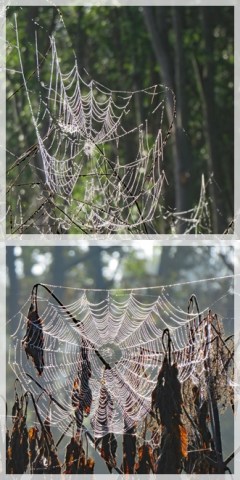 It rained last night. During our early morning walk, we looked out over the prairie and saw hundreds of sparkling spider webs. As the morning sun caught the water droplets on the silk, the master weavers’ work glistened in the mist. Although we take that trail several times a week, it was the first time this season we saw those arachnidan works of art. The spiders didn’t start spinning just the previous night; their webs have been there all summer but weather and light conditions kept us from seeing them. In fact, had we chosen to walk the loop in the other direction, we never would have seen them at all!
 As I viewed the picturesque waterfall, the tremendous amount of water pouring over the rock, and the deep gorge formed by the glacial river, I thought of H. Jackson Brown’s quote: “In the confrontation between the stream and the rock, the stream always wins, not through strength but by perseverance.” Thinking it a good start for a devotion about patience and determination, I looked forward to writing it when I got home. Having been out of town thirty out of the last seventy days, however, I’ve been playing “catch-up” since returning from Canada. Domestic chores, family obligations, paper work, commitments, appointments, assorted health issues, and then my mother-in-law’s hospitalization have eaten away at me and I’m physically and emotionally exhausted. Today, during prayers, it occurred to me that something else is as persistent (and effective) as that rushing water—Satan! While the enemy enjoys throwing major disasters our way, as he did with Job, he also likes to peck at us like a troublesome woodpecker or whittle away at us as water does to rock. Through persistence, water defeats rock; like that persistent water, the enemy is determined to defeat us.
 Devotions of the Heart