
Again and again the Lord had sent his prophets and seers to warn both Israel and Judah: “Turn from all your evil ways. Obey my commands and decrees—the entire law that I commanded your ancestors to obey, and that I gave you through my servants the prophets.” But the Israelites would not listen. They were as stubborn as their ancestors who had refused to believe in the Lord their God. [2 Kings 17:13-14 (NLT)]
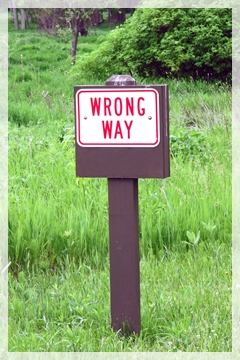 We were at the symphony watching Alfred Hitchcock’s Psycho while the orchestra played Bernard Herrman’s chilling soundtrack. When Janet Leigh’s character, Marion Crane, stepped into the shower, a man in the audience yelled, ”Don’t do it!” Since most of us saw the movie decades ago, we didn’t want her to take that fatal shower either. In spite of the warning, however, she did. Since Marion was at the Bates Motel because she’d embezzled $40,000 from her boss, perhaps that man should have yelled, “Don’t do it!” much sooner.
That’s sort of what it was like when rereading the books of Kings and Chronicles recently. I knew they would end badly for both Israel and Judah but there was nothing I could do about it. I didn’t want to read their sad history again any more than I wanted to see Marion Crane die in the shower a second time. But, just as I made it through the gruesome movie murder, I made it through the disheartening saga of God’s chosen people.
No one warned Marion about Norman Bates but the people of Judah and Israel got plenty of warnings from God. The prophets Amos and Hosea told the northern kingdom they’d be taken captive by the Assyrians and both kingdoms were warned of their tragic ends by Micah. Joel and Isaiah warned Judah to turn from their idolatry and sins. Habakkuk warned them that the Babylonians would be used as an instrument of judgment and Zephaniah and Jeremiah predicted the destruction of Jerusalem. God’s chosen people couldn’t claim they weren’t warned. In fact, the warnings are found as far back as Deuteronomy when God made clear the cost of disobedience.
Scripture warns us to repent, resist the enemy, be morally alert and obedient, and not to be misled by false teachers. It warns of persecution and the dangers of lust, drifting away, prejudice, hypocrisy, and God’s impending judgment. Romans 6:23 puts it bluntly: “For the wages of sin is death, but the free gift of God is eternal life through Christ Jesus our Lord.” Like the people of Israel and Judah, we can’t say we weren’t warned.
 It was every parent’s nightmare; while the Dad was changing the toddler’s diaper, his four-year old daughter wandered away and disappeared in the zoo! We saw him as he was frantically asking people, “Did you see a little girl in a pink bike helmet?” As he went racing down the path toward the alligators and lions, we went toward the lemurs and play area. Fortunately that pink helmet made her easy to spot as she stood watching the black bears lumber through their enclosure. As we walked her back to her father, I said a prayer of thanksgiving that she would be returning home safely that day.
 In his gospel, Matthew writes of wise men from eastern lands who saw a ”star in the East.” This actually was a Greek term used in astrology at the time, en te Anatole, which meant “at the rising.” Now known as a heliacal rising, it describes a planet that rises above the eastern horizon shortly before dawn. Just moments after its appearance, it disappears in the sun’s glare. Better reflecting this astrological meaning, many Bibles translate the wise men seeing the star “as it rose.” While we’re not exactly sure what happened in the sky that drew the Magi to Judea, today’s astronomers have a pretty good idea.
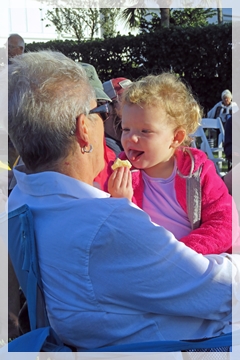 As we sang carols at the beach Christmas Eve, Sarah’s grand sat on her lap while finishing off a holiday cookie. By the time the little one was done with the cookie and cuddling her gram, Sarah’s shirt was a wrinkled mess of frosting, crumbs and cookie drool. I couldn’t help but think of the gospel story of parents bringing their children to Jesus for a blessing. Even in the first century, I imagine little children meant grubby hands, sticky fingers, and runny noses. From what we know of Jesus, though, I picture him welcoming those children onto His lap along with all of the mess that came with them. Perhaps some even left drool on his robe.
 In honor of that first Christmas, the one without decorations, piles of gaily wrapped presents or a feast, let’s try to keep it simple today and tomorrow. It’s not too late to change our plans and readjust our expectations. I’m sure Joseph and Mary didn’t plan on birthing in a stable, but their Christmas was a blessed one even though life didn’t go as they’d intended. Accept in advance that some things are certain to go wrong: guests won’t arrive on time, a gift will disappoint, food will burn, a drink will spill, toys will break, tears will be shed, directions will get thrown away, someone’s feelings will be hurt, and we’ll miss those who are absent. That’s as much a part of this holiday as church, carols, family, prayers, candy canes, laughter, a Christmas tree, and pine-scented candles.
