MYOB

If you are insulted for the name of Christ, you are blessed, because the Spirit of glory and of God rests upon you. But let none of you suffer as a murderer or a thief or an evildoer or as a meddler. [1 Peter 4:14-15 (ESV)]
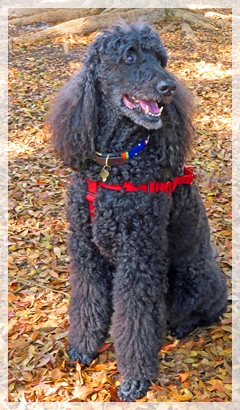
standard poodleThe store was called “Ms. Bossy Boots” and the sign in the window said, “I’m not bossy, I’m just helpful.” Having just had an encounter with a precocious youngster who’d been wearing some very bossy boots, I laughed. After advising me that I needed to put televisions in all my bedrooms, she informed me we couldn’t sell our house because she didn’t want new neighbors! She announced her disapproval of the appetizers, questioned the dinner menu, told me jam should be served with the bread, and criticized the vegetables. Following dinner, I was advised that any remaining cookies should be packed up for her. In a younger child, her behavior might have been slightly excusable. At her age, however, it was demanding and ill-mannered. Over-indulged by her mother and grandparents, she has not learned that it is the meek who will inherit the earth.

Most of us don’t behave like impertinent children but that doesn’t mean we aren’t meddlesome or bossy; we’re just more subtle than that cheeky little girl. When we put on our bossy boots, we excuse ourselves by saying we’re being helpful, interested, or supportive. If anyone had the right to interfere, it was Jesus but He refused to intervene when asked to settle a dispute about an inheritance. Because rabbis often resolved disagreements, it wasn’t such an odd request. Nevertheless, our Lord, knowing what constituted His business and what didn’t, refused to get involved. He did, however, take that opportunity to teach about greed.

We were told, “Mind your own business,” when we tattled in school and, “Keep your eyes on your own paper!” when taking tests. Keeping our mouths shut and our eyes on our own business remains good advice today. Far too often, our “helpfulness” is really just an excuse to be bossy or stick our noses into somebody else’s affairs. Soon we’re just a word away from engaging in gossip and self-righteousness while telling others how much we are doing, solving or repairing and how well we are doing it. The Apostle Peter lumps meddlers in with thieves, murderers and other criminals and Proverbs likens meddling to grabbing a dog by the ears. Whether we call it helping, tweaking, or enlightening, it’s wise to remember that just a few inches away from a dog’s ears are some pretty sharp teeth. Eventually, meddling will turn around and bite us!

Whoever meddles in a quarrel not his own is like one who takes a passing dog by the ears. [Proverbs 26:17 (ESV)]

And to aspire to live quietly, and to mind your own affairs, and to work with your hands, as we instructed you, [1 Thessalonians 4:11 (ESV)]

Copyright ©2017 jsjdevotions. All rights reserved.

GOD’S BANKERS

wild geraniumThere are always going to be poor and needy people among you. So I command you: Always be generous, open purse and hands, give to your neighbors in trouble, your poor and hurting neighbors. [Deuteronomy 15:11 (MSG)]

The Hebrew word for what we call “charity” is tzedakah; its nature, however, is far different than acts of benevolence or generosity. Rather than being a magnanimous act by someone more fortunate, tzedakah is considered an act of justice and righteousness. It is remedying a wrong, doing what is right and just, and fulfilling a duty; in short, it is giving the poor what they deserve.

In writing about charity, Rabbi Yanki Tauber tells of a wealthy man who often supported his rabbi’s charitable activities. One day a letter requesting a large sum for a good cause arrived. At the time, money was a little tight and making a donation was inconvenient so the rich man ignored the request. Shortly after that, his businesses began to fail and the wealthy entrepreneur lost his entire fortune.

The distraught fellow went to the synagogue and berated the holy man for not warning him that he’d suffer if he ignored the rabbi’s plea. “I would have given you the money had I known what punishment I would suffer!” he said. The rabbi calmly responded that the loss of money wasn’t a punishment. “Nothing that was yours has been taken from you,” he explained, adding that God had allotted a certain amount of resources to the rabbi in his work. Since the time he spent in prayer, studying, teaching, counseling and helping others left him no time to manage finances or property, the rabbi’s resources had been placed in the trust of several people who acted as “bankers” for that wealth. In turn, those bankers recognized the value of the rabbi’s work and supported it. When the once rich man failed to carry out his banking duty, the money was simply transferred to another, more responsible, “banker.”

God loves all of His children but that does not mean that He allots equal portions of blessings or sorrows to each of them. Some are healthier, wealthier, smarter, more talented or more attractive than others. Some people seem to escape misfortune while others seem to encounter storms at every turn. Because of an accident of birth, we may live comfortable lives in a wealthy nation or suffer in poverty in a corrupt or war-torn land. Some people have power and are easily heard while others are powerless and often ignored. That we are not given equal portions, however, does not mean that we are not equally deserving. If we have been blessed with wealth, education, influence or opportunities, we should think of ourselves as God’s bankers. We’re just holding on to other people’s resources and it is our job to distribute those resources to their rightful owners. Like our Jewish brothers and sisters, Christians should be dispensers of tzedakah. Unlike them, however, we don’t do it to buy our way into heaven (which it won’t). We do it because God tells us it is the right thing to do!

God does not need your good works, but our neighbor does. [Martin Luther]

This is how we’ve come to understand and experience love: Christ sacrificed his life for us. This is why we ought to live sacrificially for our fellow believers, and not just be out for ourselves. If you see some brother or sister in need and have the means to do something about it but turn a cold shoulder and do nothing, what happens to God’s love? It disappears. And you made it disappear. [1 John 3:16-17 (MSG)]

Then the King will say, “I’m telling the solemn truth: Whenever you did one of these things to someone overlooked or ignored, that was me—you did it to me.” [Matthew 25:40 (MSG)]

Copyright ©2017 jsjdevotions. All rights reserved.

ROOTS

And now, just as you accepted Christ Jesus as your Lord, you must continue to follow him. Let your roots grow down into him, and let your lives be built on him. Then your faith will grow strong in the truth you were taught, and you will overflow with thankfulness. [Colossians 2:6-7 (NLT)]

sea oatsIt’s not just light poles that were destroyed by Hurricane Irma’s winds; many trees also met their end at her hands. As I looked at the upended roots of a once mighty oak, I thought of one of Aesop’s fables about an oak in a storm. A proud oak stood by a stream, and like this one, had survived several storms in its many years. One day, a hurricane the likes of Irma arrived and the great oak fell with a thunderous crash. As the water rose, it was carried down to the sea. When the oak eventually came to rest along the shore, it looked up at the sea oats that were waving in the now gentle sea breeze, “How did you manage to weather such a terrible storm?” it asked. “I’m a great oak and even I didn’t have strength enough to battle the wind.”

The sea oats replied, “That was your problem. You were too proud to bend and yield a little and so the wind knocked you over. I’m just an insubstantial sea oats plant but, knowing my weakness, I didn’t resist as the wind gusted. The harder it blew, the more I humbled myself and the lower I bent. So, here I am, still enjoying the beach. Aesop’s moral is that it is better to bend than to break. “Perhaps there a message here,” I thought and, yet, I wasn’t sure it was just about pride and humility.

The Apostle Paul was very clear about standing firm in the face of trials and temptation. He told the early church to stand firm and not to waver; he wanted them to be oaks and not sea oats. When facing one of life’s hurricanes, however, it’s pretty hard not to wobble, quiver and quake wildly. If we stand firm, will we be knocked down and end up a piece of drift wood or ground up into mulch? If that mighty oak couldn’t weather the storm, how can we?

The Apostle also said that growing roots in Jesus is what will keep us strong. That fallen oak’s upended roots were taller than me and yet they didn’t do the oak much good when Irma arrived. The roots of which Paul speaks are deep roots that grown down into our Lord. It is strong deep roots that will serve to anchor a tree in the ground. I’m not an arborist, but I could easily see that there was nothing deep about that oak’s roots (or the roots of the many other uprooted oaks throughout our community).

In Jesus’ parable about soil, he told of seed scattered on good soil that grew, seed strewn on a path that was eaten by the birds, seed that was crowded out by the thorns, and seed that fell on rocky soil. Those plants in rockyy soil grew quickly but, since their roots weren’t deep, they withered in the hot sun. If He’d been in a tropical climate like Florida’s, Jesus could have used sand and hurricanes instead of rocks and sun in His analogy. Good nutritious soil is necessary for a plant’s success and Florida’s soil is shallow and mostly sand. The many fallen oaks’ roots, while wide, were shallow and certainly not the kind of roots of which Jesus and Paul spoke.

Aesop’s fable was about pride and humility but the many uprooted oaks in town tell me something more. Granted, there may be times we need to bend a little, as do the sea oats, but we must never bend if that means compromising our faith. I think of Daniel, Shadrach, Meshach, and Abednego. Their roots were so deep that they were willing to die before they bent down to worship a false god or failed to worship the true one. While a miracle saved them, there was no miracle for Stephen, a man whose deep roots in Christ gave him strength enough to stand and testify before the Jewish high council knowing he’d die because of it. These men were willing to be sacrificed and broken before bending to the prevailing wind.

Given a choice, I would rather stand strong, like an oak with deep roots, than fall because of the wind. Nevertheless, if the wind is blowing in the wrong direction, like Stephen and other Christian martyrs, I would rather be broken and fall than bend and survive as do the sea oats.

I pray from his glorious, unlimited resources he will empower you with inner strength through his Spirit. Then Christ will make his home in your hearts as you trust in him. Your roots will grow down into God’s love and keep you strong. [Ephesians 3:16-17 (NLT]

Copyright ©2017 jsjdevotions. All rights reserved.

DOWN BUT NOT OUT

No one lights a lamp and then hides it or puts it under a basket. Instead, a lamp is placed on a stand, where its light can be seen by all who enter the house. Your eye is like a lamp that provides light for your body. When your eye is healthy, your whole body is filled with light. But when it is unhealthy, your body is filled with darkness. Make sure that the light you think you have is not actually darkness. If you are filled with light, with no dark corners, then your whole life will be radiant, as though a floodlight were filling you with light. [Luke 11:34-36 (NLT)]

broken lightTo avoid the southwest Florida heat, I waited until dusk to take my walk. Thanks to Hurricane Irma, most of the street lamps in my neighborhood don’t work. For a light to function, electrical energy has to be converted into light energy and both a source of electricity and a working connection are needed. For many of the lights, the connection was broken when blowing debris shattered their bulbs. For others, Irma’s 150 mph winds broke the connection when it blew off their tops, wrapped their poles around trees, or knocked them to the ground. Without a connection to their source of power, those street lights are useless—they’re just a tangle of wires and a pile of glass, plastic and metal. Even though they don’t work, people have been cautioned to remember that their exposed wires are live. It’s not the electricity that is missing; it’s the connection that is inoperative. Two poles, however, were down but not out. Even though they’d been flattened by the storm, neither wires nor bulb had broken. In spite of the storm’s violence, they remained connected and were beacons in the night’s darkness.


When the storms of life batter us and knock us down, like those street lamps, we can lose our connection, not to electricity, but to God. Our minds may get so caught up in anger, worry, fear, depression, or self-pity that we become separated from our true source of power—Jesus. He told us to let our lights shine but we can’t shine if we’re not connected to Him. When our lives go dark, we should remember that God hasn’t gone anywhere—like the electricity, He’s still there. We’re the ones who are broken. Unfortunately, no Florida Power & Light truck is going to arrive and reconnect us to God.

Reconnecting is a choice we have to make. Reconnecting is trusting God and ceding to His will. It is prayer and reading the Bible; it is praise, thanksgiving and worship. Reconnecting is turning to God and choosing joy over misery, light over darkness, love over hate, forgiveness over rancor, peace over anger and service over selfishness. Fortunately, we’re not alone in this. We may not have FP&L but we have something more powerful (and far more dependable)—the Holy Spirit! If we allow Him, He will reconnect us to the light of the world. We may be down, but we don’t ever have to go out! By His power, our lights can continue to shine.

Remember this. When people choose to withdraw far from a fire, the fire continues to give warmth, but they grow cold. When people choose to withdraw far from light, the light continues to be bright in itself but they are in darkness. This is also the case when people withdraw from God. [Augustine]

And now I will send the Holy Spirit, just as my Father promised. But stay here in the city until the Holy Spirit comes and fills you with power from heaven. [Luke 24:49 (NLT)]

Jesus spoke to the people once more and said, “I am the light of the world. If you follow me, you won’t have to walk in darkness, because you will have the light that leads to life.” [John 8:12 (NLT)]

Copyright ©2017 jsjdevotions. All rights reserved.

THE HOLY GOALIE

And that about wraps it up. God is strong, and he wants you strong. So take everything the Master has set out for you, well-made weapons of the best materials. And put them to use so you will be able to stand up to everything the Devil throws your way. This is no afternoon athletic contest that we’ll walk away from and forget about in a couple of hours. This is for keeps, a life-or-death fight to the finish against the Devil and all his angels. [Ephesians 6:10-12 (MSG)]

Several weeks ago, there was a story on the morning news about a youth hockey camp. When the sportscaster mentioned having a “holy goalie” in attendance, I stopped to listen. As it turns out, this was not a typical athletic camp but a faith-based one—one that combined sports and God. The aforementioned holy goalie was a Catholic bishop from downstate who loves hockey almost as much as he does Jesus!

Even the best goalie can’t make a save all of the time. Top hockey goalies Martin Brodeur, with 691 wins, and Patrick Roy, with 551 wins, manage to make saves only a little more than 90% of the time. Considering the age and vocation of the “holy goalie,” I doubt that his percentage of saves is anywhere that good. Wouldn’t it be nice to have a real Holy Goalie—someone who could keep the opposition—the enemy—from defeating us? We do, in fact, have a Holy Goalie and He has more defense moves than the priest, Brodeur and Roy combined. Our Holy Goalie isn’t an all-star athlete or even a presiding bishop; He is the Holy Spirit.

Of course, much of a goalie’s success or failure in stopping opposing goals has to do with his team and whether or not the players have played a good defensive game. Even with a truly Holy Goalie, like any good team, we must do our part. Before facing the opponents, hockey players suit up in a host of protective gear: shin guards, elbow pads, heavily cushioned hockey pants, shoulder pads and chest protector, protective gloves, “jock,” helmet, neck guard, mouth guard, and maybe even a face mask. Hockey is fast-moving, intense, rough and sometimes brutal; then again, so is life. We may not get body checked into the boards but circumstances can knock us down just as easily and the enemy can leave us just as bloody as a puck to the nose. Rather than padded clothing, when we suit up for the game of life, we must put on the armor of God to be protected by His truth, righteousness, peace, salvation, faith and word. In hockey, players can change “on the fly” but no one steps in for us in real life. We’ve got to keep going, playing our best, until the whistle blows. That’s where our Holy Goalie differs from a mortal one. He doesn’t just defend us when the enemy gets close to the goal; He acts as cheering section, general manager, coach, trainer, and team physician. Our Holy Goalie, like hockey’s referees and linesmen, also tells us when we’ve crossed the line, violated any rules or been guilty of unChristianlike conduct. While we have no need for a Zamboni driver, the Holy Goalie’s guidance can smooth the way for us better than any Zamboni. Thank you, God, for our Holy Goalie—your Holy Spirit!

Breath in me, O Holy Spirit, that my thoughts may all be holy. Act in me, O Holy Spirit, that my work, too, may be holy. Draw my heart, O Holy Spirit, that I love but what is holy. Strengthen me, O Holy Spirit, to defend all that is holy. Guard me, then, O Holy Spirit, that I always may be holy. [St. Augustine]

Don’t grieve God. Don’t break his heart. His Holy Spirit, moving and breathing in you, is the most intimate part of your life, making you fit for himself. Don’t take such a gift for granted. [Ephesians 4:30 (MSG)]

Copyright ©2017 jsjdevotions. All rights reserved.

MIX IT UP

And we know that God causes everything to work together for the good of those who love God and are called according to his purpose for them. [Romans 8:28 (NLT)]

hummingbird moth - sphinx mothThe men from the church were enjoying their monthly breakfast at their favorite diner. The new minister, Pastor Tim, decided to join them. Wanting to get to know the men better, he asked who would like to offer grace before the meal. John, a retired farmer from Iowa volunteered. After taking off his cap, he stood and said loudly, “Lord, I sure do hate buttermilk!” The old farmer then added, “And, Lord, I don’t care much for lard.” Pastor Tim wasn’t sure how to react but decided to see where this prayer was leading. Then John continued with, “Tell the truth, white flour doesn’t taste like much either and baking powder sure is bitter.” Pastor Tim started to stand up and take over saying grace when, in his booming voice, John added, “But, Lord, when you mix them all together and bake them, I truly do love those fresh biscuits! Thank you, Heavenly Father, for the biscuits, gravy, eggs, and bacon with which we are blessed this fine morning. Amen.”

Of course, this is just a bit of humorous and anonymous Internet fiction but it makes a good point. Lots of events will occur in our lifetimes that we’re not going to like very much. We won’t understand what God means by such difficult circumstances nor are we able to see how anything good can come out of such unpleasant, sometimes tragic, events. Even when things seem chaotic and inexplicable, we must remember that God is in control and He knows what He is doing. Just as John had to trust the biscuit baker, we must trust God for the end result. By themselves, challenges and difficulties can leave a bad taste in our mouths. After God is done mixing them all together, however, they can turn into something quite wonderful (and much better) than fresh buttermilk biscuits!

Now all glory to God, who is able, through his mighty power at work within us, to accomplish infinitely more than we might ask or think. Glory to him in the church and in Christ Jesus through all generations forever and ever! Amen [Ephesians 3:20-21 (NLT)]

Copyright ©2017 jsjdevotions. All rights reserved.