MISTAKES HAPPEN

But if we confess our sins to him, he is faithful and just to forgive us our sins and to cleanse us from all wickedness. [1 John 1:9 (NLT)]

golden mantled ground squirrel - YellowstoneIt was late Saturday night when one of our pastors glanced at the next day’s church program and saw that Sunday’s sermon was titled “Epithet.” Since he wasn’t speaking about insults on social media but about the way we’ll be remembered when we’re gone, it should have read “Epitaph.” After spending the next hour trying to figure out a way to tie epithets into epitaphs, he realized it made more sense to own up to his spelling error, which he did at all three services.

Life gives us an abundance of opportunities to make mistakes and, sometimes, it seems as if we never miss one! We mishear, misinterpret, misjudge, misread, misspeak, misspell, misunderstand and, yes, we sin. We take wrong turns, say the wrong things, and believe the wrong person. Sometimes, that wrong person is an over-confident self. Overly confident, the pastor didn’t proofread, the builders of the Titanic didn’t provide enough life boats, and Napoleon thought he could successfully invade Russia in the winter.

Like the pastor, as much as we hate to do it, we need to own our mistakes and admit our responsibility for them. Sometimes, we can make the best of them, in which case they cease being mistakes. For example, while 3M’s Patty Sherman was trying to develop a rubber that wouldn’t deteriorate when exposed to jet fuel fumes, she made a mistake and spilled a few drops of one failed test batch on her shoe. Later, seeing that those spots were clean while the rest of her shoe had gotten stained and dirty, she made the most of that mistake with a product we call Scotchguard!

Sometimes, we can fix our mistakes. When KFC discovered their motto “Finger-lickin’ good!” became “Eat your fingers off!” in Chinese, they quickly corrected their clumsy translation. Sometimes, though, we just plow on ahead in the face of our errors. The Leaning Tower of Pisa started to lean five years after construction began but, rather than admit and correct the problem, building continued for another for 192 years. They kept compensating by making the uphill side shorter but, because mistakes don’t correct themselves, the tower kept leaning.

Like that learning tower, many of our mistakes are ones with which we must live. Hopefully, we learn from our errors as I imagine NASA did when they accidentally taped over their video of the moon landing. Rather than dwelling on our mistakes, we have to move out of the land of “what if” into the land of “what is.” This, however, is where we encounter the hardest part of making a mistake: forgiving ourselves.

Consider the mistakes of Judas and Peter: Judas sold Jesus for thirty pieces of silver and Peter denied Him three times. Realizing Jesus would die for his betrayal, could Judas have been trying to undo his mistake by giving back the blood money? Filled with remorse and unable to change what had been done, he killed himself. I can’t help but wonder what would have happened if only Judas had waited three days. I know Jesus would have forgiven Him. Think of the testimony Judas could have given if he’d forgiven himself and waited as did Peter. Like Judas, Peter betrayed Jesus but, unlike him, he forgave himself, lived with his mistake, and was in the room when Jesus appeared! Think of the powerful testimony Peter did give!

We have a choice about even our most grievous mistakes. Like Peter, we can live with them, forgive ourselves, accept God’s forgiveness, and move on with our lives in service to Him. Or, like Judas, we can hold on to them and refuse to forgive ourselves. Our guilt may not take our lives but it will take our peace, joy, self-confidence, hope, and even our faith in a forgiving God. We’re told we must forgive to be forgiven; it would seem that command means forgiving ourselves as much as it means forgiving others. Let our guilt be washed away!

Finally, I confessed all my sins to you and stopped trying to hide my guilt. I said to myself, “I will confess my rebellion to the Lord.” And you forgave me! All my guilt is gone. [Psalm 32:5 (NLT)]

And since we have a great High Priest who rules over God’s house, let us go right into the presence of God with sincere hearts fully trusting him. For our guilty consciences have been sprinkled with Christ’s blood to make us clean, and our bodies have been washed with pure water. [Hebrews 10:21-22 (NLT)]

Copyright ©2019 jsjdevotions. All rights reserved.


SACRIFICES

And so, dear brothers and sisters, I plead with you to give your bodies to God because of all he has done for you. Let them be a living and holy sacrifice—the kind he will find acceptable. This is truly the way to worship him. [Romans 12:1-2 (NLT)]

monarch butterfly - butterfly weedIf you ever visited the Mayan ruins near Cancun, Mexico, chances are you saw the remains of a stone ball court with sloping walls. Nowhere near as impressive as the Mayan pyramids, I didn’t even take a picture when I saw one. Two stone rings hang about 20 feet up the walls. A ball game called pok-ta-pok was played there. As in volleyball, players passed a solid rubber ball around by hitting it with various parts of their bodies. Unlike volleyball, however, they could not touch the ball with their hands. The goal was to get the ball through one of the rings.

This game was a reenactment of the Mayan creation story and had ritual significance. When prisoners of war were forced to play the game, it became a prelude to their sacrifice by decapitation, heart removal, or disembowelment. Since blood was considered nourishment for the gods, the sacrifice of a living creature was a powerful one and the sacrifice of a human was the most powerful.

When we hear the word sacrifice, we tend to picture something as brutal and gruesome as the Mayans, satanic cults, King Manasseh sacrificing his son to Molech, or even Abraham placing his son on an altar and bringing a knife to his throat. We think of sacrifice as suffering terrible loss: the destruction or surrender of something precious to us. Having a negative connotation, we tend to see sacrifice as unpleasant, involuntary, or punishing.

There was, however, another scenario to that Mayan ball game. In some cases, it was the winners who were sacrificed. Teams willingly played in the hopes of winning and being sacrificed to the gods. This sacrifice was a privilege that gave great honor to the player and his family. Although the game’s losers lived, they were disgraced and may have become slaves. While it still seems barbaric to us, rather than a giving up of something, that sacrifice was seen as a gain.

God clearly prohibited human sacrifice when he gave the law to the Israelites, yet Paul tells the Romans to be living sacrifices! This is neither a forced sacrifice nor one of punishment; we are not defeated warriors being sacrificed in shame. This is an enthusiastic sacrifice, like that of the Mayan warriors who chose to compete in that sacrificial game. Like them, we are victors but, unlike them, ours is not a one-time sacrifice resulting in death but rather a constant placement of our lives at God’s disposal. It is a joyful and willing sacrifice of worship—a consecration of our lives to Him.

Sunday, we sang these words from Frances Havergal’s hymn: “Take my life and let it be consecrated, Lord, to Thee.” As we sang, we offered Him our time, hands, feet, voices, lips, money, intellect, will, heart, and love. That is what it means to be a living sacrifice to God. Four years after writing her hymn, Havergal responded to her own words, “Take my silver and my gold,” by giving away all of her jewelry (nearly fifty items) to a missionary society. About this sacrifice, she wrote a friend of her “extreme delight” and said, “I don’t think I ever packed a box with such pleasure.” Her words, actions, and joyful attitude are an example of what it means to be a living and holy sacrifice,

Take my love, my Lord, I pour at thy feet its treasure store.
Take myself and I will be ever, only, all for Thee.
[Frances R. Havergal (1874)]

Give yourselves completely to God, for you were dead, but now you have new life. So use your whole body as an instrument to do what is right for the glory of God. [Romans 6:13b (NLT)]

Copyright ©2019 jsjdevotions. All rights reserved

DON’T DO IT!

Again and again the Lord had sent his prophets and seers to warn both Israel and Judah: “Turn from all your evil ways. Obey my commands and decrees—the entire law that I commanded your ancestors to obey, and that I gave you through my servants the prophets.” But the Israelites would not listen. They were as stubborn as their ancestors who had refused to believe in the Lord their God. [2 Kings 17:13-14 (NLT)]

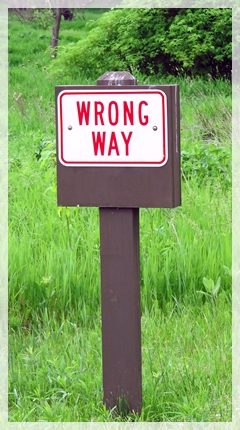
wrong wayWe were at the symphony watching Alfred Hitchcock’s Psycho while the orchestra played Bernard Herrman’s chilling soundtrack. When Janet Leigh’s character, Marion Crane, stepped into the shower, a man in the audience yelled, ”Don’t do it!” Since most of us saw the movie decades ago, we didn’t want her to take that fatal shower either. In spite of the warning, however, she did. Since Marion was at the Bates Motel because she’d embezzled $40,000 from her boss, perhaps that man should have yelled, “Don’t do it!” much sooner.

That’s sort of what it was like when rereading the books of Kings and Chronicles recently. I knew they would end badly for both Israel and Judah but there was nothing I could do about it. I didn’t want to read their sad history again any more than I wanted to see Marion Crane die in the shower a second time. But, just as I made it through the gruesome movie murder, I made it through the disheartening saga of God’s chosen people.

No one warned Marion about Norman Bates but the people of Judah and Israel got plenty of warnings from God. The prophets Amos and Hosea told the northern kingdom they’d be taken captive by the Assyrians and both kingdoms were warned of their tragic ends by Micah. Joel and Isaiah warned Judah to turn from their idolatry and sins. Habakkuk warned them that the Babylonians would be used as an instrument of judgment and Zephaniah and Jeremiah predicted the destruction of Jerusalem. God’s chosen people couldn’t claim they weren’t warned. In fact, the warnings are found as far back as Deuteronomy when God made clear the cost of disobedience.

Scripture warns us to repent, resist the enemy, be morally alert and obedient, and not to be misled by false teachers. It warns of persecution and the dangers of lust, drifting away, prejudice, hypocrisy, and God’s impending judgment. Romans 6:23 puts it bluntly: “For the wages of sin is death, but the free gift of God is eternal life through Christ Jesus our Lord.” Like the people of Israel and Judah, we can’t say we weren’t warned.

Be careful that you do not refuse to listen to the One who is speaking. For if the people of Israel did not escape when they refused to listen to Moses, the earthly messenger, we will certainly not escape if we reject the One who speaks to us from heaven! [Hebrews 12:25 (NLT)]

Copyright ©2019 jsjdevotions. All rights reserved.

PROTECT THEM, LORD

I love you, Lord; you are my strength. The Lord is my rock, my fortress, and my savior; my God is my rock, in whom I find protection. He is my shield, the power that saves me, and my place of safety. I called on the Lord, who is worthy of praise, and he saved me from my enemies. [Psalm 18:1-3 (NLT)]

grandchildIt was every parent’s nightmare; while the Dad was changing the toddler’s diaper, his four-year old daughter wandered away and disappeared in the zoo! We saw him as he was frantically asking people, “Did you see a little girl in a pink bike helmet?” As he went racing down the path toward the alligators and lions, we went toward the lemurs and play area. Fortunately that pink helmet made her easy to spot as she stood watching the black bears lumber through their enclosure. As we walked her back to her father, I said a prayer of thanksgiving that she would be returning home safely that day.

I thought of that anxious father the next day when reading Pearls Before Swine, a comic drawn by Stephan Pastis. Goat is extending sympathy to Pig for his grandma’s death when Pig carries him off. In the next few frames, Pig carts off his friends Duck and Cat. Next, we see all of Pig’s friends stuffed in a box under a sign saying, “SAFE PLACE WHERE I CAN KEEP AN EYE ON EVERYONE I LOVE SO NOTHING BAD CAN HAPPEN TO THEM.” The label on the box read, “Bad things stay away!” In the last frame, when Goat tries to explain that it doesn’t work that way, Pig just responds, “Don’t distract me. I’m standing guard.” Like Pig, I wish I could keep bad things from happening to those I love but I know I can’t. When my grands visit, determined that nothing bad is going to happen to them on my watch, I’m on high alert (and probably over protective). Of course, if parents and grandparents could, we’d erect a wall of protection around our loved ones to shield them, not just from death, but from heartache, injury, disappointment, and pain.

It would be a miracle if the worst that happens to that little girl is getting lost at the zoo and, while her pink bike helmet may protect her when she falls off her trike, it’s of little use elsewhere! We live in a fallen world: a world with disease, defiance, pain, sorrow, falseness, mistakes, greed, betrayal, loss, violence, malice, and death. Chances are that our children and grands will go further astray than just to the bears’ enclosure at the local zoo. Unlike Pig, we can’t stuff those we love in a box and stand guard over them night and day. Instead, we teach, encourage, warn, guide, lead, love, discipline, forgive, pray, equip them, and let them go. Although we provide them with God’s armor, we can’t make them accept or wear it.

We protect our gates, are cautious of what we allow into our homes, and stay alert to the dangers around us but what about when our loved ones leave home to lead their own lives? Many of the Psalms speak of God being a shield but that seems more figurative than literal. Although Shadrach, Mesach, and Abednego exited that fiery furnace unscathed, others weren’t that fortunate. Consider the fates of Stephen, the prophet Zechariah, John the Baptist, Jeremiah, Paul, and James! Sadly, there is no fool-proof way to protect our loved ones from Columbines or Sandy Hooks any more than we can from disappointment, grief, cancer, mental illness, rejection, failure, or death.

I used to ask God to be with my children and grands until I realized how silly my request was; He’s with them always! I now ask God to guard them from evil by making His presence known to them and His voice heard by them. As I pray God’s blessing of protection over my loved ones, I give them to Him, trusting that He will bring them safely home, if not in this world, then in the next!

But let all who take refuge in you rejoice; let them sing joyful praises forever. Spread your protection over them, that all who love your name may be filled with joy. For you bless the godly, O Lord; you surround them with your shield of love. [Psalm 5:11-12 (NLT)]

Copyright ©2020 jsjdevotions. All rights reserved.

LET’S PRAY

I urge you, first of all, to pray for all people. Ask God to help them; intercede on their behalf, and give thanks for them. [1 Timothy 2:1 (NLT)]

snowy egretsThe eight of us were brainstorming a difficult and heartbreaking situation facing a family we know. We had plenty of ideas about getting them the assistance and guidance they needed but we could only direct them to the resources. They were the ones who needed to take action. Unfortunately, people often want the easy way out of their problems and desire money rather than counsel. Money, however, is usually only a stop gap measure and it frequently enables a bad situation to continue or get worse. The problem we were discussing required change, compromise, work and sacrifice far more than money. These people had to take action and, truth be told, I’m not so sure they wanted to step forward and act.

Those of us sitting around the table that day are people of action. Asking “What can I do? How can I help?” we wanted to roll up our sleeves, get to work, and make things right. This was one of those times, however, when there was nothing more we could do and no way we could make things right. There always will be hurts that we can’t heal, needs that we can’t satisfy, situations we can’t fix, and wrongs that we can’t make right. Sadly, this was one of them.

I learned something important that day, something even more important than understanding when it is time to step back from someone else’s problem. Our discussion had reached a dead end and we started repeating ourselves. At that point, we had a choice. We could beat a dead horse and keep talking which probably would have turned our constructive discussion into gossip and censure. On the other hand, we could stop and pray. Fortunately, understanding we were helpless onlookers and seeing we were dangerously close to becoming judge and jury, someone suggested prayer! Knowing we can’t fix everything but that we can love and pray for everyone, we prayed and handed the situation to God.

The thing I learned that day? While I’ve always believed in the power of prayer, I hadn’t realized the power of just saying, “Let’s pray!” Pausing for prayer changed the entire tenor of the discussion. The next time I’m in one of those conversations that starts to go downhill into the territory of gossip, disapproval, or scorn, I know to say, “Let’s pray!” Prayer can change more than situations and other people; it can change the people doing the praying!

If you claim to be religious but don’t control your tongue, you are fooling yourself, and your religion is worthless. [James 1:26 (NLT)]

Since God chose you to be the holy people he loves, you must clothe yourselves with tenderhearted mercy, kindness, humility, gentleness, and patience. Make allowance for each other’s faults, and forgive anyone who offends you. Remember, the Lord forgave you, so you must forgive others. Above all, clothe yourselves with love, which binds us all together in perfect harmony. And let the peace that comes from Christ rule in your hearts. For as members of one body you are called to live in peace. And always be thankful. [Colossians 3:12-15 (NLT)]

Copyright ©2019 jsjdevotions. All rights reserved.

THE REASON FOR MORE THAN A SEASON

Because God’s children are human beings—made of flesh and blood—the Son also became flesh and blood. For only as a human being could he die, and only by dying could he break the power of the devil, who had the power of death. Only in this way could he set free all who have lived their lives as slaves to the fear of dying. [Hebrews 2:14-15 (NLT)]

The Holy Family - Willow TreeAlthough Epiphany celebrates the magi’s visit to the Christ child, for many people it simply marks the official end to the holiday season. It’s the day the tree goes down, lights are removed, and nativity scenes get stowed for another year. British tradition holds that if you haven’t removed the holiday décor by January 6, you must leave it in place all year long to avoid misfortune. I don’t know about misfortune but, in our community, you’ll face a fine if holiday lights or decorations remain after this week!

This year, my five-year old grand helped me take down the tree and put away the Christmas decorations. Along with the ornaments, candle holders, stockings, and two Santas, we put away four nativity sets. As the little guy placed the Christ child in one of the boxes, he asked me why I had so many figures of baby Jesus. I reminded him that Jesus (not Santa) is the reason for the season and that we always want to keep Christ in Christmas.

After everything Christmas was packed up and put away, I realized a small resin figurine of the Holy Family remained on a shelf in the living room. The crates in the garage were filled to the brim and, just as on that first Christmas, there was no room anywhere for Mary, Joseph and the newborn King. Rather than having them spend the next eleven months in a high cabinet with assorted vases, I decided to keep them on my desk.

That figurine will serve as a reminder of how God deliberately chose to humble Himself: to be born of woman and live as a mortal man. That was God Himself who entered our world through a birth canal amidst blood and amniotic fluid. The baby who nursed at Mary’s breast and peed, pooped, spit up and drooled was God! He who created man was so helpless He couldn’t even roll over for the first few months of His life and had to learn to crawl and walk. The God who gave mankind the gift of speech had to learn to speak, the One who invented numbers had to learn to count, and He who spoke the law to Moses had to learn how to read His own words! The God who spoke light into existence had to light a candle at night and our omnipresent God had to walk to get from one place to another. The God who never gets tired, thirsty or hungry became a man who did. Jesus humbled Himself by living as a man and endured everything mankind does: blisters, bruises, colds, waiting, toothaches, bug bites, stubbed toes, hangnails, exhaustion, sunburn, skinned knees, and probably diarrhea. He even endured temptation but, unlike us, He remained sinless!

Sometimes, it’s easy to forget the human part of Jesus: that our infinite God chose to live in a finite world with all of its limitations. That figurine will remain on my desk this year as a reminder that our invincible and invulnerable God freely chose to live as a man so that He could die as a man in my place. Fully man and fully God at the same time, Jesus is more than just the reason for the Christmas season; He is the reason for our salvation. Christ belongs in far more than Christmas; He belongs in everything we think, say and do.

Therefore, it was necessary for him to be made in every respect like us, his brothers and sisters, so that he could be our merciful and faithful High Priest before God. Then he could offer a sacrifice that would take away the sins of the people.  Since he himself has gone through suffering and testing, he is able to help us when we are being tested. [Hebrews 2:17-18 (NLT)]

Copyright ©2019 jsjdevotions. All rights reserved.