
 There are always going to be poor and needy people among you. So I command you: Always be generous, open purse and hands, give to your neighbors in trouble, your poor and hurting neighbors. [Deuteronomy 15:11 (MSG)]
The Hebrew word for what we call “charity” is tzedakah; its nature, however, is far different than acts of benevolence or generosity. Rather than being a magnanimous act by someone more fortunate, tzedakah is considered an act of justice and righteousness. It is remedying a wrong, doing what is right and just, and fulfilling a duty; in short, it is giving the poor what they deserve.
In writing about charity, Rabbi Yanki Tauber tells of a wealthy man who often supported his rabbi’s charitable activities. One day a letter requesting a large sum for a good cause arrived. At the time, money was a little tight and making a donation was inconvenient so the rich man ignored the request. Shortly after that, his businesses began to fail and the wealthy entrepreneur lost his entire fortune.
The distraught fellow went to the synagogue and berated the holy man for not warning him that he’d suffer if he ignored the rabbi’s plea. “I would have given you the money had I known what punishment I would suffer!” he said. The rabbi calmly responded that the loss of money wasn’t a punishment. “Nothing that was yours has been taken from you,” he explained, adding that God had allotted a certain amount of resources to the rabbi in his work. Since the time he spent in prayer, studying, teaching, counseling and helping others left him no time to manage finances or property, the rabbi’s resources had been placed in the trust of several people who acted as “bankers” for that wealth. In turn, those bankers recognized the value of the rabbi’s work and supported it. When the once rich man failed to carry out his banking duty, the money was simply transferred to another, more responsible, “banker.”
God loves all of His children but that does not mean that He allots equal portions of blessings or sorrows to each of them. Some are healthier, wealthier, smarter, more talented or more attractive than others. Some people seem to escape misfortune while others seem to encounter storms at every turn. Because of an accident of birth, we may live comfortable lives in a wealthy nation or suffer in poverty in a corrupt or war-torn land. Some people have power and are easily heard while others are powerless and often ignored. That we are not given equal portions, however, does not mean that we are not equally deserving. If we have been blessed with wealth, education, influence or opportunities, we should think of ourselves as God’s bankers. We’re just holding on to other people’s resources and it is our job to distribute those resources to their rightful owners. Like our Jewish brothers and sisters, Christians should be dispensers of tzedakah. Unlike them, however, we don’t do it to buy our way into heaven (which it won’t). We do it because God tells us it is the right thing to do!
God does not need your good works, but our neighbor does. [Martin Luther]
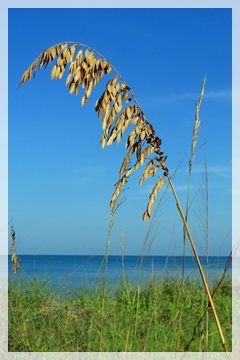 It’s not just light poles that were destroyed by Hurricane Irma’s winds; many trees also met their end at her hands. As I looked at the upended roots of a once mighty oak, I thought of one of Aesop’s fables about an oak in a storm. A proud oak stood by a stream, and like this one, had survived several storms in its many years. One day, a hurricane the likes of Irma arrived and the great oak fell with a thunderous crash. As the water rose, it was carried down to the sea. When the oak eventually came to rest along the shore, it looked up at the sea oats that were waving in the now gentle sea breeze, “How did you manage to weather such a terrible storm?” it asked. “I’m a great oak and even I didn’t have strength enough to battle the wind.”
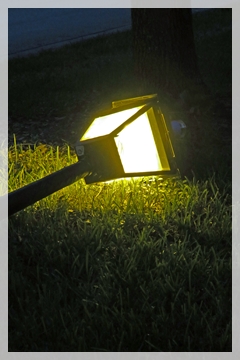 To avoid the southwest Florida heat, I waited until dusk to take my walk. Thanks to Hurricane Irma, most of the street lamps in my neighborhood don’t work. For a light to function, electrical energy has to be converted into light energy and both a source of electricity and a working connection are needed. For many of the lights, the connection was broken when blowing debris shattered their bulbs. For others, Irma’s 150 mph winds broke the connection when it blew off their tops, wrapped their poles around trees, or knocked them to the ground. Without a connection to their source of power, those street lights are useless—they’re just a tangle of wires and a pile of glass, plastic and metal. Even though they don’t work, people have been cautioned to remember that their exposed wires are live. It’s not the electricity that is missing; it’s the connection that is inoperative. Two poles, however, were down but not out. Even though they’d been flattened by the storm, neither wires nor bulb had broken. In spite of the storm’s violence, they remained connected and were beacons in the night’s darkness.
 The celebration of the Eucharist or Holy Communion has been central to our Christian worship since the early church. If asked the meaning of the word eucharist, most of us would probably respond that it is the Christian sacrament that commemorates the Last Supper with bread and wine. While it has come to mean that and often refers to the consecrated elements, especially the bread, the word eucharist originally meant something else entirely. Coming from the Greek words eukharistos, meaning grateful, and kharizesthai, meaning to offer graciously, it is a translation of the Hebrew word berekah which means a blessing or benediction. Acknowledging God as the source of all good things, a berekah would be similar to the grace or table blessing we offer before or after a meal.
 When touring a nearby resort town, a beautiful old mansion was pointed out. It was once owned by a man who made so much money on his invention of the sanitary milk bottle cap that he retired at the age of 26. For 93 years, the Chicago White Sox played at a ball field named for the team’s founder. In 2003, the field was renamed US Cellular Park and then, in 2016, it became the Guaranteed Rate Field. When I went to Northwestern University, the football venue was named for a former Evanston mayor. In 1997, the stadium was renamed to honor the family of a generous donor to the school’s athletic facilities. A friend’s daughter is attending a school named for a German immigrant who opened a Chicago butcher shop in 1883. Who were these men?
 Devotions of the Heart