
Make thankfulness your sacrifice to God, and keep the vows you made to the Most High. … But giving thanks is a sacrifice that truly honors me. If you keep to my path, I will reveal to you the salvation of God. [Psalm 50:14,23 (NLT)]
It’s one thing to be grateful. It’s another to give thanks. Gratitude is what you feel. Thanksgiving is what you do. [Tim Keller]
 Yesterday I happened upon a wood stork enjoying a fish breakfast. I was astonished as the stork swallowed the whole wriggling fish in one big gulp. “I’ll have to put that in my gratitude journal,” I thought as I walked on. Later, I spotted two woodpeckers hammering away at a tree and got up close and personal with a pond snail laying eggs. Two more for the journal, I thought. Did I put those little blessings in my journal last night? Shamefully, I forgot to write in it at all; worse, I totally forgot about them in my nightly prayers!
When I look back at the rest of yesterday, all sorts of wonderful little things happened for which I was grateful and yet failed to thank God. Without having one red light, I got to an appointment with time enough to take a short walk on the beach. I’m not self-centered enough to think God turned all those lights green just for me; nevertheless, my day went better because of it and it deserved thanks. I met a delightful young couple at cooking class. Did God put them there just for me? I don’t know, but I was thankful to have them as cooking partners for the afternoon. There was a beautiful cooling breeze and the sunset was magnificent. Did God arrange the weather to my wishes? I doubt it, but I should have told Him how much I appreciated it! I was remiss in acknowledging God’s presence or thanking him for the day’s numerous small blessings.
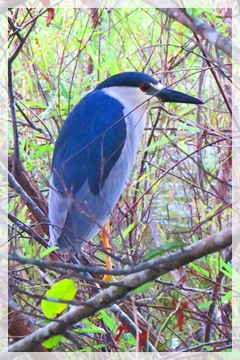
Today, I set out again and spotted a black-crowned night heron hiding in the bushes. While getting a photo, I thought, “I’ll have to put that in my gratitude journal.” This time, however, that small voice reminded me how lackadaisical I’ve gotten with my journal and asked me why I was waiting to thank the creator of all those beautiful moments. That gave me pause. If I’d been walking with someone else, I would have shared those sightings. Although I wasn’t walking with another person, I was walking with God. Why wasn’t I talking to Him? Why wasn’t I sharing my joy with the one who gave it to me? God was right beside me and He shouldn’t have to wait until I get around to thanking him or writing in my journal, especially since I’m not good about remembering to do so. Thanks should be speedy and sincere.
We thank God through our prayer. We don’t need church, a table blessing or a gratitude journal to do so. We certainly don’t need to wait until our regular prayer time to offer thanks and, most especially, we shouldn’t wait until November for Thanksgiving Day! Our whole day, every day, should consist of a prayer of thanksgiving. God is with us as we take our daily walk; let us remember to thank him for the joy we find along with way.
We need to discover all over again that worship is natural to the Christian, as it was to the godly Israelites who wrote the psalms, and that the habit of celebrating the greatness and graciousness of God yields an endless flow of thankfulness, joy, and zeal. [J.I. Packer]
 Yesterday, I wrote about making amends; today, I write about accepting them. In Jesus’ parable of the prodigal son, the young man realizes the error of his ways, returns to his father, admits his failure, and is forgiven. Although the son offers to act as a servant, his father doesn’t ask for amends or acts of penance; rather, he welcomes him back as an honored son. It’s a beautiful story about God’s redeeming grace and forgiveness. Like any good story, however, there’s conflict—the prodigal’s older brother. When he returns from working in the fields to the feast celebrating his brother’s return, he becomes angry and resentful. The parable concludes with the father’s explanation that the celebration is because, “He was lost, but now he is found!”
 I laughed at the picture of a large dog, with what looked to be a smile on his face, on his hind legs, holding a poop pan with one paw, a rake with the other, and scooping up a pile of dog dirt. The sign read: “Pets, people and parks – When you pick up your pile, everyone smiles.” Yes, we all smile when people clean up the mess left behind by their dogs. Unfortunately, it takes more than a pooper scooper to clean up the mess we leave behind when we sin.
 The thief comes only to steal and kill and destroy. I came that they may have life and have it abundantly. [John 10:10 (ESV)]
 “How do you get to Carnegie Hall?” asks the comedian. “Practice, practice, practice,” is his answer. “Nothing ever comes to one, that is worth having, except as a result of hard work,” said Booker T. Washington, a man who truly knew the value of hard work. Most of us, having been raised with a strong work ethic, would agree with Washington’s words. If we want something we must work for it. If we want to be musicians, we practice; if we want to get on the team, we train; if we want a scholarship, we study. Success comes through determination and lots of hard work. We’ve heard all the maxims; there’s no elevator to success so we have to take the stairs. We know there’s no such thing as a free lunch, we must work our way up the ladder, and we’ve got to pull ourselves up by our bootstraps. Success is never handed to you and it’s only in the dictionary that success comes before work.
 In his Small Catechism, Martin Luther instructs people to say the following prayer as soon they get out of bed: “God the Father, Son, and Holy Spirit watch over me. Amen.” When I watch my grands, it’s not just keeping the baby dry and fed, getting the toddler to use the potty and take his nap, getting the kids to school, preparing their lunch, or making sure that homework gets done. Watching over them is more than just supervising them and keeping them from destroying the house. It means protecting them—from dangerous objects, people, and activities. It’s keeping them from getting hurt or hurting anyone else. Sometimes it means stopping them in their tracks and other times it’s removing something from their reach. Watching them is wiping their tears, laughing at their jokes, and kissing their ouchies; yet, it is still more. It is leading by example, introducing them to new things, encouraging them and challenging them to become stronger and better. It is walking and talking with them and opening their eyes to the world around them. It is correcting, helping, comforting, loving, teaching and nurturing them.
 Devotions of the Heart