
 But whoever is building on this foundation must be very careful. For no one can lay any foundation other than the one we already have—Jesus Christ. [1 Corinthians3: 11 (NLT)]
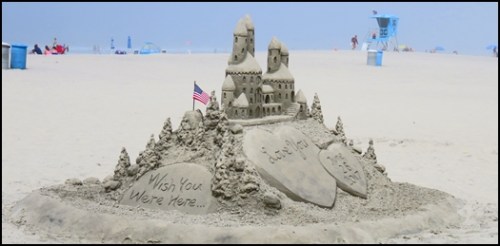
Last Sunday, while worshipping in the beach gazebo, my attention was drawn to a nearby tree. A pair of doves kept disappearing into the branches only to reappear a few moments later. Back and forth they went, building their new house one twig at a time. Like the doves, those of us in the gazebo are slowly building something—a new church. Rather than twigs or bricks, we’re building it with people—one person at a time.
After worship two Sundays ago, we saw a fellow sitting alone on a park bench strumming his guitar. My husband walked over to him, listened for a while, and, introduced himself. The men chatted and the guitarist, Jimmy, said he was in the park that morning for his NA meeting. My husband then invited him to bring his guitar and join us for worship the next week. Self-taught, Jimmy is not much of a musician and both his story and attire told me that, while he’s not exactly homeless, he lives on the fringe of society. Lord, forgive me, I wasn’t happy about that invitation nor was I especially thrilled Sunday when our new friend was there at the gazebo. I’m ashamed to admit that I was afraid Jimmy’s presence would offend others in attendance.
While watching those doves build their nest, however, the Holy Spirit did some much needed work on my heart and I saw how judgmental and self-righteous I’d been. The birds didn’t examine each twig to see if it was perfect or ask its history or lineage. They just kept bringing twigs into the tree. Wondering how to build a church, I’d forgotten about the cornerstone: the first stone set into a foundation, the stone that keeps the walls upright and strong. The church’s cornerstone is Jesus and the answer to how to build a church is simple: Do what Jesus would do.
Jesus brought healing to the sick, forgiveness to the condemned, hope to those in despair, faith to those who doubted, and love to the unloved. Jesus neither ignored nor tolerated sin but He welcomed all sorts and conditions of people. He didn’t ask Peter, John or James about their pasts before calling them and not everyone around Him was what could be called “respectable.” Criticized by the Pharisees for the company He kept, He welcomed tax collectors, prostitutes, the unclean, zealots, Gentiles and Samaritans. He gladly spent time with sinners who wanted to learn from him or put their faith in him. Jesus welcomed me and I’m no different than Jimmy—my tarnished past just hasn’t taken the heavy toll on me that it has on him. Moreover, I still have plenty of work to do on the sin of self-righteousness!
So, how do we build a church? We do it by living the truth of the gospel, connecting with one another, serving, and speaking and acting in love. Most of all, we build a church by seeking the lost and welcoming all who come! When I asked my husband why he invited Jimmy, he answered, “That’s what Jesus would have done!” and he was right. Sunday, after Communion, I wondered how long it’s been since Jimmy felt welcome and appreciated, took the Sacrament, or was reminded that God loved him enough to die for him. As we finished our service and gathered our things to leave, his NA group came in to use the gazebo. We offered them our remaining coffee and rolls and invited them all to join us for worship next week. “Hope to see you next Sunday,” I called to Jimmy and, this time, I meant it!
 Jesus replied, “The most important commandment is this: ‘Listen, O Israel! The Lord our God is the one and only Lord. And you must love the Lord your God with all your heart, all your soul, all your mind, and all your strength.’ The second is equally important: ‘Love your neighbor as yourself.’ No other commandment is greater than these.” [Mark 1:29-31 (NLT)]
 Jesus had returned to Capernaum and the word was out—the rabbi from Nazareth could heal. People were flocking to Him and the crowd followed Jesus right into the house where he was staying. Four friends of a paralyzed man carried him to see Jesus but the house was so full they couldn’t get through the door. Determined to get to Jesus, they carried the paralyzed man up the outside stairs to the rooftop and started to dig through the thatch. Picture the scene. The room is jam-packed when a disturbance is heard overhead. Dried mud and straw start to fall into the room, a head peaks through, more straw and dirt come spilling through the opening, a mat is dropped, and then four men lower their paralyzed friend down to the ground right at the feet of Jesus.
 Back in January, many people made resolutions to read the Bible. If you pledged to read the entire Bible this year, good for you. Like many who make that resolution, however, you may already have fallen behind schedule and are tempted to quit. Having tried to do it in a year, I feel your pain. After finally getting through Leviticus, Jeremiah nearly did me in with his doom and gloom. It’s not just the reading that takes time; it’s the understanding, the digesting, of what we’ve read that can slow us down. After all, there’s no point of reading it if we don’t understand it! I could read the words in a college astrophysics text but, if I didn’t understand them, I’d know no more about astrophysics on the last page than I did on the first. This year, I’m reading the Bible in chronological order and, in spite of my goal to do it in a year, it will probably take longer. For those who are discouraged or soon will be, I thought I’d rerun a previous devotion for you.
 Don’t be afraid, I’ve redeemed you. I’ve called your name. You’re mine. When you’re in over your head, I’ll be there with you. When you’re in rough waters, you will not go down. When you’re between a rock and a hard place, it won’t be a dead end—Because I am God, your personal God, The Holy of Israel, your Savior. [Isaiah 43:2-3a (MSG)]
 Listen, O heavens, and I will speak! Hear, O earth, the words that I say! Let my teaching fall on you like rain; let my speech settle like dew. Let my words fall like rain on tender grass, like gentle showers on young plants. I will proclaim the name of the Lord; how glorious is our God! [Deuteronomy 32:1-3 (NLT)]
 Devotions of the Heart