
 For I am the Lord, your healer. [Exodus 15:26b (RSV)]
In that hour he cured many of diseases and plagues and evil spirits, and on many that were blind he bestowed sight. And he answered them, “Go and tell John what you have seen and heard: the blind receive their sight, the lame walk, lepers are cleansed, and the deaf hear, the dead are raised up, the poor have good news preached to them. [Luke 7:21-22 (RSV)]
Here in southwest Florida it’s “season,” which means that flocks of snowbirds have arrived (and I don’t mean the kind with wings). While they boost the economy, locals groan at the busy traffic, the difficulty of getting into their favorite restaurants or hair salons, and the scarcity of parking places. One of the biggest problems is seeing a doctor! If we can find a doctor (or dentist) who is taking new patients (a challenge in itself) and takes our insurance, we’ll find a two month or longer wait before getting an appointment. Then, if we’re referred to a specialist, the whole routine begins again. As for urgent care clinics; unless the situation is life threatening, there is nothing urgent about the care one eventually receives. My best advice during season is not to get sick!
Our God truly is the Great Physician but, unlike the doctors in our town, He’ll take new patients. He won’t make us fill out detailed medical history forms; rather than past illnesses, He’s concerned about our wellness in the present and future. Insured or uninsured, Medicare or Medicaid, co-pay or no pay, it makes no difference; Jesus already paid our fee. God will never turn us away as incurable or hopeless because there are no lost causes in His office and He’ll never refer us to someone else because He specializes in whatever is ailing us. Best of all: no appointment is ever needed. God operates a walk-in clinic where the waiting room aways is empty and the doctor always is in!
At first, God being available 24/7 and taking His time during an appointment sounds like the concierge medicine that has become so popular in our area. God, however, doesn’t limit the number of patients in His practice nor does He require a hefty retainer fee before He gives you His number or listens to your complaint. God never takes a vacation and always has enough time and energy to deal with everyone who calls Him. Like a concierge physician, however, God is strong on preventative medicine: regular prayer, Bible study, Christian fellowship, and eating frequently at His table.
Of course, as with any physician, if we don’t recognize our sickness and the need for healing, we won’t call Him. We must have faith in our doctor’s wisdom and skill and follow his directions completely and we must do the same with our Great Physician. While He won’t be prescribing Lipitor, a flu shot, or more exercise, He’ll probably prescribe a healthy dose of repentance, forgiveness, love and prayer. Instead of giving us medical brochures about our condition, He’s already provided us with something better than the Merck Manual: Holy Scripture. As for any sort of long-term therapy—among other things, God is sure to recommend Christian community and service.
Our Great Physician hears our painful cries and heals our troubled souls. Thank you, God.
 Not that I was ever in need, for I have learned how to be content with whatever I have. [Philippians 4:11 (NLT)]
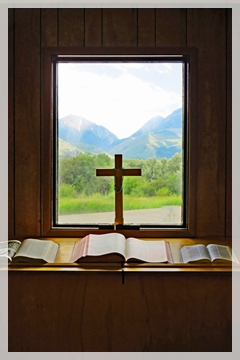 Before the incarnation of Christ, God dwelt first in the tabernacle and then in the temple. The innermost room of the temple was called the “Most Holy Place” and it was in this inner room that God’s glory was said to dwell. This was where the Ark of the Covenant was kept and where the high priest came with a sacrifice to atone for his and the nation’s sins every year. With the incarnation of Jesus, God no longer dwelt in the temple but in the flesh of His son and, for a brief time, God actually walked among His people. Yet, when Jesus lived as a man, only a few people at a time could be in His presence. With His death, there is no yearly atonement ritual because Jesus atoned for our sins once and for all. Moreover, because of His resurrection, ascension, and the presence of the Holy Spirit, it is possible for countless people, everywhere, to be in His presence at the same time. Once we become believers, the Holy Spirit moves into our hearts and each one of us, as members of Christ’s church, become part of His body and the temple of God.
 Some prophets weren’t bothered by the truth and were available for hire. Ahab, for example, had 400 prophets on his payroll acting as his “yes men.” When he asked Jehoshaphat to join him in a campaign against Aram, Jehoshaphat requested the advice of prophets so Ahab summoned his seers. Jehoshaphat, however, recognized them as pagans; when he asked for a true “prophet of the Lord,” Micaiah was summoned.
 In 539 BC, thousands of Medes and Persians were digging outside Babylon’s walls. Thinking they were futilely trying to undermine the city’s impregnable walls, Babylon’s King Belshazzar was unconcerned. While carousing with 1,000 of his nobles, he gave orders to bring out the gold and silver cups that Nebuchadnezzar had looted from Jerusalem’s temple 47 years earlier. The revelers were drinking to their false Babylonian gods with vessels dedicated to the one true God when a human hand appeared and started writing on the plaster wall. No longer so arrogant, the frightened Belshazzar called for his astrologers and diviners but, when the pagans were incapable of deciphering God’s message, Daniel was called to interpret the words.
 Someone was missing from yesterday’s story of Shadrach, Meshach, and Abednego and the fiery furnace: their good friend Daniel. When Nebuchadnezzar’s giant statue was erected on the plain of Dura, word was sent to all of his officials to assemble there for the statue’s dedication. We know Shadrach, Meshach, and Abednego were there because Daniel reported that they got tossed in a fiery furnace for refusing to bow to an idol. But what of Daniel? He’s the one who chronicled the event: the one who wrote that all of the high officers, officials, governors, advisers, treasurers, judges, magistrates, and provincial officials were present. Daniel gives no explanation for his absence at the dedication of the king’s golden statue.
 Devotions of the Heart