INVESTING TALENTS – Matthew 15:14-30 (Part 2)

God has given each of you a gift from his great variety of spiritual gifts. Use them well to serve one another. Do you have the gift of speaking? Then speak as though God himself were speaking through you. Do you have the gift of helping others? Do it with all the strength and energy that God supplies. Then everything you do will bring glory to God through Jesus Christ. All glory and power to him forever and ever! Amen. [1 Peter 4:10-11 (NLT)]

great egretYesterday, I wrote about Jesus’ Parable of the Three Servants, often called the Parable of the Talents. Although I used it as an example of excuse making, that’s not what the parable is about. This parable comes right after Jesus’ description of the end times and the Parable of the Ten Bridesmaids in which He urged readiness for the Day of the Lord. Immediately following this parable about the talents, Jesus spoke about the final judgment. The story of these three servants makes it clear that, when that last day comes, the master will settle accounts: faith will be rewarded and the righteous servants separated from the false ones.

In this parable, before going away on a trip, the master entrusts his money to his three servants according to their individual abilities; no one receives more or less than he is capable of handling. When the master (Jesus) returns, his servants (Christ-followers) give an accounting for how they fulfilled their responsibilities and used the talents. While we think of talents as natural abilities or skills, in Jesus’ time, a talent was a unit of measurement used to weigh out gold or silver. A talent was the largest quantity at the time and a talent of silver was about the equivalent of an average worker’s income for twenty years. The master in this parable entrusted each of his servants with a fortune. Rather than bags of silver, however, the talents entrusted to us by God include our wealth along with our time, natural abilities (talents), spiritual gifts, and bodies. This treasure entrusted to us is no more ours to keep than were the bags of silver given to the servants theirs. The treasure belongs to the master; his servants are but caretakers of His gifts.

Instead of entrusting us with His investment portfolio, Jesus entrusts us with His ministry and the furthering of His Kingdom. Scripture tells us exactly what He expects us to do with the treasure He’s given us: spread the gospel, love God, love others (including our enemies), forgive those who have wronged us, be hospitable to outsiders, and be an example for the world by feeding the hungry and caring for the poor, imprisoned, and sick. How we achieve His purpose will be different for each one of us because a different sack of talents has been entrusted to each one of us. Whether the sack is filled with gold, silver, copper or iron, we each have been given exactly the right amount of what God expects to use. In writing about this parable, D.L. Moody said, “Many thousands of watch springs can be made out of a pound of iron. See that you improve faithfully the talent God has given you.”

When the master commends the first two servants for the return on his investment, he doesn’t say, “Well done, my good and successful servant.” He says, “Well done my good and faithful servant.” The third servant, however, is punished but not because he failed to give the master a good return on his money; he’s punished because he didn’t even try. Rather than invest the money or put in a bank and get interest, he simply buried it. He isn’t punished for being unsuccessful; he’s punished for his lack of faith! The master didn’t expect him to double the investment as did the other servants, but he did expect him to do something with it! The faithless and lazy servant squandered the opportunity given to him; we must not do the same!

God does not demand that we be successful. He only asks that we be faithful in using the treasure He has entrusted to us. We honor God by using our talents to work to further His Kingdom; the success of our endeavors, however, is up to Him!

We are not called to be successful; we are called to be faithful. [Mother Teresa]

Work willingly at whatever you do, as though you were working for the Lord rather than for people. Remember that the Lord will give you an inheritance as your reward, and that the Master you are serving is Christ. [Colossians 3:23-24 (NLT)]

Copyright ©2021 jsjdevotions. All rights reserved.

EXCUSES – Matthew 15:14-30 (Part 1)

Don’t excuse yourself by saying, “Look, we didn’t know.” For God understands all hearts, and he sees you. He who guards your soul knows you knew. He will repay all people as their actions deserve. … People who conceal their sins will not prosper, but if they confess and turn from them, they will receive mercy. [Proverbs 24:12, 28:13 (NLT)]

Excuses—we all make them but I don’t think God much likes them.

giant swallowtail butterflyIn 1 Samuel 15, after Samuel confronts Saul for disobeying God’s clear commands regarding the Amalekites, Saul makes excuses—first by denying his sin, then by justifying his disobedience, and finally by blaming others. It is only after Samuel tells him the consequences of his sin—the loss of his kingship—that Saul reluctantly admits the truth. In contrast, we have Nathan confronting David regarding his sinful behavior with Bathsheba and Uriah. Immediately after the rebuke, David confesses. It would have been easy for David to blame Bathsheba for seducing him, Uriah for hampering his cover-up scheme, or Joab for his part in Uriah’s death, but he didn’t. Acknowledging his guilt, the repentant David confessed.

In Jesus’ Parable of the Three Servants (told in Matthew 15:14-30), the master entrusts each servant with a share of his wealth proportionate to their abilities. When the master returns, he asks them for an accounting. In my NLT Bible, the reports from the two servants who faithfully fulfilled their responsibilities take only sixteen words each. The third servant, the one who buried his master’s money, uses forty words to make excuses for his failings. In fact, by calling his master a harsh man, the servant tries to cast some of the blame back on him. Nothing in the parable, however, leads us to think the master was overly demanding, hard to please, or cruel. The negligent servant was just making excuses. I wonder what would have happened if he’d simply echoed David’s words to Nathan: “I have sinned against the Lord.” [2 Samuel 13:13]

One of the hardest things for us to do is admit our sins without making any excuses. We frequently deny, minimize, refuse responsibility, cast blame, defend our motives, justify our actions, or even rationalize that it couldn’t be wrong since everyone else does the same thing. Whether we call it a momentary lapse or an error of judgment, wrong is wrong and a sin is still a sin. A sincere confession takes only six words but most excuses take forty or more! Remember—when we honestly confess, it’s not as if we’re telling God anything He doesn’t know. We confess so that we know! It’s only when we honestly acknowledge our sins as sins that we can repent of them and get right with God.

In failing to confess, Lord, I would only hide you from myself, not myself from you. [Augustine]

If we claim we have no sin, we are only fooling ourselves and not living in the truth. But if we confess our sins to him, he is faithful and just to forgive us our sins and to cleanse us from all wickedness. If we claim we have not sinned, we are calling God a liar and showing that his word has no place in our hearts. [I John 1:8-10 (NLT)]

Copyright ©2021 jsjdevotions. All rights reserved.

THE LORD’S VICTORY

And he said to him, “Please, Lord, how can I save Israel? Behold, my clan is the weakest in Manasseh, and I am the least in my father’s house.” And the Lord said to him, “But I will be with you, and you shall strike the Midianites as one man.” [Judges 6:15-16 (NLT)]

Because the Midianites were raiding and plundering Israel, we meet Gideon hiding in a large vat. Rather than threshing wheat in the open air so the wind could blow away the chaff, he was cautiously working in the bottom of a secluded wine press when an angel of the Lord delivered a message to the timid man. Addressing Gideon as a mighty warrior, the unlikely hero demurred and claimed to be the least worthy of the weakest clan in the tribe of Manasseh.

After a fair amount of hesitation and questions, the reluctant warrior eventually gathered an army of 32,000 to battle the Midianites, a force of 153,000 men. With the odds against Gideon being four to one, I imagine he was wondering where to find more men when God told him that he had too many! He was instructed to send home all those who were afraid. After 22,000 men departed, God told Gideon there still were too many men. He was to separate them by the way they drank water from a stream—whether they cupped the water with their hands and lapped it up or knelt down to drink from the stream. Only the 300 warriors who drank from their hands were allowed to remain. With an overwhelming ratio of 450 Midianites to one Israelite, Gideon’s defeat seemed inevitable. Nevertheless, while Gideon may have been fearful, he never lost faith. Gideon’s few good men crushed the Midianites. The nomadic tribe never recovered and there was peace in the land for the next forty years.

We might wonder why God chose Gideon—the least of the least—and why He didn’t provide him with as large an army as possible to ensure an Israelite victory. The odds were bad enough when Gideon started with 32,000 men but, with only 300, victory seemed impossible. But that was God’s point! When the angel of the Lord entered Gideon’s life, the Israelites had been oppressed by the Midianites for seven years because they “did evil in the Lord’s sight.” [Judges 6:1] They’d worshipped pagan gods, built an altar to Baal, and erected an Asherah pole. Gideon’s first task, prior to leading the men into battle, had been to destroy those pagan symbols. When Baal did not retaliate, it became clear how worthless the false god was. But, did the people understand how powerful the Lord was?

God chose Gideon, the youngest son of the weakest clan, and only a handful of men because their victory against absolutely impossible odds made it abundantly clear to all that the victory didn’t belong to Gideon or his soldiers; it belonged only to God! Rather than looking at this story as an example of what just a few men (or women) can do, we should look at it as an example of what God can do just with a few! He is, after all, the hero in every story!

Selfish and proud creatures that we are, we tend to blame God when things go wrong but remove Him of any responsibility for our successes. In Gideon’s story, God eliminated any possibility that the Israelites’ strength, skill, or valor had anything to do with their triumph. Victory was the Lord’s! God was the hero of Gideon’s story; let Him continue to be acknowledged as the hero of ours, as well!

The horse is made ready for the day of battle, but the victory belongs to the Lord. [Proverbs 21:31 (ESV)]

Copyright ©2021 jsjdevotions. All rights reserved.

IT’S TERMINAL

Better to spend your time at funerals than at parties. After all, everyone dies—so the living should take this to heart. … A wise person thinks a lot about death, while a fool thinks only about having a good time. [Ecclesiastes 7:2,4 (NLT)]

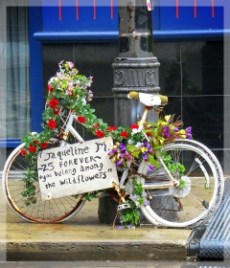
ghost bikeIt’s often said that there are no atheists in foxholes. This maxim traces its beginnings back to 1914 and World War 1 when an English newspaper quoted a chaplain at a memorial service for a fallen soldier: “Tell the Territorials and soldiers at home that they must know God before they come to the front if they would face what lies before them. We have no atheists in the trenches. Men are not ashamed to say that, though they never prayed before, they pray now with all their hearts.” When we joined our northern church, it was during the Viet Nam War. I remember a young man in our new member class who’d drawn a low number in the draft lottery. Expecting to be in combat within the year, he confessed wanting to “get right” with God before that time came. Apparently, even the threat of a foxhole is enough to cause some people to rethink their relationship with the Almighty.

Whenever we pass a roadside memorial or ghost bike like the one in today’s picture, I’m reminded of the precariousness of life. There’s a memorial at a corner near us for a young man who died there several years ago. Decorated seasonally by family and friends, it’s a poignant reminder of how unexpectedly a life can be extinguished and how much he is missed. Unlike the fellow in our church class, that young man, the victim of a drunk driver who ran a red light, didn’t have a low lottery number to warn him how near to death he was.

“A funeral provides an indispensable perspective on the universally terminal condition,” said the Reformation Study Bible notes for today’s verses from Ecclesiastes 7. Indeed, everyone is born with the incurable disease of death. I’m of an age where the many notes of condolence I’ve written these last few months make me think I should buy sympathy cards in bulk. These are dark thoughts for an early spring day, yet far too many of us choose to ignore our inevitable fate. Death is the one appointment that none of us will miss. While we have little control over the when of that day, we do have control over how we choose to prepare for the inevitable.

In both this world and the next, what happens after we die depends entirely on what we do now. Once laid out in the mortuary, it’s too late to write a will or accept Jesus. When we’re placed in a casket, we won’t be able to mend fences or make amends and we’ll have missed the opportunity to get right with God. By the time we’re on the other side of the sod or turned to ash in a crematorium, we can’t express our love and forgiveness or decide to accept God’s saving grace.

The problem with foxhole conversions, of course, is that once out of the trenches, they rarely last. Moreover, if we don’t make it out alive, by waiting until the very end to accept Jesus, we’ve missed out on the abundant Kingdom life He offers that begins while we’re here. Getting right with God long before we enter either foxhole or hospice care seems to be the wiser choice. The good news for the saved is that dying doesn’t mean departing from the land of the living. For those who know Jesus, death means departing from the land of the dying for the land of the living.

Depend upon it, your dying hour will be the best hour you have ever known! Your last moment will be your richest moment, better than the day of your birth will be the day of your death. It shall be the beginning of heaven, the rising of a sun that shall go no more down forever! [Charles Spurgeon]

And just as each person is destined to die once and after that comes judgment, so also Christ was offered once for all time as a sacrifice to take away the sins of many people. He will come again, not to deal with our sins, but to bring salvation to all who are eagerly waiting for him. [Hebrews 9:27-28 (NLT)]

Copyright ©2021 jsjdevotions. All rights reserved.

TUMBLEWEED AND COTTONWOODS

This is what the Lord says: “Cursed are those who put their trust in mere humans, who rely on human strength and turn their hearts away from the Lord. They are like stunted shrubs in the desert, with no hope for the future.” [Jeremiah 17:5-6 (NLT)]

Russian thistle - tumbleweed

Russian thistle – tumbleweed

Because Judah had trusted in false gods and foreign alliances rather than God, Jeremiah pronounced God’s judgment on the southern kingdom. After saying their sins were as if they’d been etched on their stony hearts with a diamond-pointed iron chisel, he compared them to a stunted shrub. That shrub may have been the tumble thistle, a common plant found in Israel’s grasslands. I’ve never been to Israel but I’ve seen a similar plant in the western states: the Russian thistle, commonly known as tumbleweed or wind witch. Both kinds of weeds begin with flowers on a spiny plant. As their seeds mature, the entire plant dries and breaks from its roots at the soil surface. Shaped like a ball and rootless, the wind blows and rolls these plant “skeletons” across the prairie.

In stark contrast to a stunted shrub, Jeremiah likened those who trust in the Lord to deep-rooted trees planted by the riverbank—trees untroubled by heat or drought. I’m reminded of our hardy American cottonwoods found near rivers, lakes, and irrigation ditches throughout the nation. The fastest growing trees in North America, cottonwoods can grow to over 100-feet tall, with a trunk diameter of 6-feet, and a leaf canopy over 75-feet wide. Instead of being blown by the wind like tumbleweed, the cottonwood’s size makes it an excellent windbreak. When we trust in ourselves and false gods, we’ll be blown every which way like a tumbleweed but, when we trust in God, we can withstand life’s headwinds like a cottonwood.

Growing on the water’s edge, cottonwoods typically survive adverse conditions and prairie fires. Few plants can survive the scorching heat, scant rainfall, relentless winds, blowing sand and poor soil of New Mexico’s White Sands National Monument but the deeply rooted Rio Grande cottonwood thrives there! When we trust in God and sink our roots deep in His word, like the cottonwood, we will flourish and have a full life, even in harsh conditions.

Dubbed “the pioneer tree,” the cottonwood was a welcome sight for settlers crossing the plains because it meant shade from the heat, fuel for a fire, and a source of water. Those same settlers considered tumbleweeds a menace. They leeched nutrients from the soil, crowded out forage grass and, being highly flammable when dry, could become flying fireballs and spread a grass fire. Just as pioneers found refuge in the cottonwood, those who trust in the Lord find refuge in Him. Those who trust only in man are as worthless as a noxious weed and as dangerous as burning tumbleweed.

When we put our trust in man, false gods, or empty ideologies, we’re no different than a tumbleweed: dry and rootless, rolling in whatever direction the wind is blowing, and with no hope for the future. When we trust in the Lord, we’re like the cottonwood: deeply rooted in His word, fed by His living water, and able to survive, even thrive, in the bleakest of situations.

But blessed are those who trust in the Lord and have made the Lord their hope and confidence. They are like trees planted along a riverbank, with roots that reach deep into the water. Such trees are not bothered by the heat or worried by long months of drought. Their leaves stay green, and they never stop producing fruit. [Jeremiah 17:7-8 (NLT)]

Copyright ©2021 jsjdevotions. All rights reserved.

THE HOLY TEMPLE (Cornerstone – part 3)

Therefore, this is what the Sovereign Lord says: “Look! I am placing a foundation stone in Jerusalem, a firm and tested stone. It is a precious cornerstone that is safe to build on. Whoever believes need never be shaken. [Isaiah 28:16 (NLT)]

Together, we are his house, built on the foundation of the apostles and the prophets. And the cornerstone is Christ Jesus himself. We are carefully joined together in him, becoming a holy temple for the Lord. Through him you Gentiles are also being made part of this dwelling where God lives by his Spirit. [Ephesians 2:20-22 (NLT)]

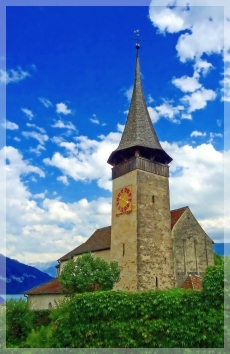
church of st. columba The cornerstone metaphor continues into the New Testament with both Paul and Peter referring to Jesus as the cornerstone of our faith. Nowadays, cornerstones are structurally unneeded and a growing number of commercial buildings no longer have them. Symbolic rather than functional, many serve as time capsules holding material relevant to the building and the year it was built. Because commercial buildings so frequently change hands, even the custom of inscribing the building’s name on a cornerstone is disappearing. The latest practice is a freestanding cornerstone/time capsule resting on a pedestal placed in a prominent part of the building. That way, a new stone can replace the old one every time the building’s owner changes.

While cornerstones may be superfluous to a modern structure, there is nothing superfluous about Jesus as our cornerstone. Moreover, He can’t be exchanged for a newer version or sold to the highest bidder. While buildings may change owners, our owner remains God and we are both His children and His servants. Our cornerstone does not serve as a time capsule of 1st century Judah; Jesus is our living stone and as relevant today as He was 2,000 years ago.

Both Paul and Peter carry the building metaphor further by calling us the stones in God’s temple. Unlike the temple in Jerusalem, this isn’t an earthly building with walls and a roof. Nevertheless, it has a cornerstone in Jesus. Since a cornerstone connects two different walls, the metaphor illustrates how Jesus connected both Gentiles and Jews into one cohesive church.

Peter likens us to living stones and Paul says we are built on the foundation of the apostles and prophets. Let that image sink in for a moment and consider those foundation stones: people like John the Baptist, Paul, Peter, and John. Others in that foundation are less famous but no less essential: people like Lydia, the cloth merchant who housed Paul; Tabitha (Dorcas), the generous seamstress who came back from the dead; the eloquent Apollos, one of the first Christian apologists; the devoted Mary Magdalene; Aquila and Priscilla, the tentmakers who opened their home to Paul; the generous Phoebe, a deacon at the church in Cenchreae; Silas, who sang with Paul when they were prisoners; and Paul’s fellow missionary, Barnabas. Through the centuries, others were added to the structure: defender of the Trinity, Athanasius; Martin Luther, the father of the Reformation; theologian and philosopher, Augustine of Hippo; the martyred Archbishop of Canterbury, Thomas Beckett; Bible translators John Wycliffe and Martin Tyndale; Pilgrim’s Progress author John Bunyan; reformer John Calvin; founder of Methodism, John Wesley; and the “Saint of Auschwitz,” Polish priest Maximilian Kolbe. Set beside these well-known Christians are people whose names we wouldn’t recognize; nevertheless, they too are the stones of the church. Think about it—people just like us are being set into this same edifice with the likes of apologist C.S. Lewis, humanitarian Mother Teresa, Olympian Eric Liddell, evangelist Billy Graham, and the “Prince of Preachers” Charles Spurgeon! We are living stones being mortared into place, shoulder to shoulder, with the apostles and prophets who went before us! We are the temple of God and its cornerstone is Jesus Christ!

You are coming to Christ, who is the living cornerstone of God’s temple. He was rejected by people, but he was chosen by God for great honor. And you are living stones that God is building into his spiritual temple. What’s more, you are his holy priests. Through the mediation of Jesus Christ, you offer spiritual sacrifices that please God. As the Scriptures say, “I am placing a cornerstone in Jerusalem, chosen for great honor, and anyone who trusts in him will never be disgraced.” [1 Peter 2:4-6 (NLT)]

Copyright ©2021 jsjdevotions. All rights reserved.