
Joyful are people of integrity, who follow the instructions of the Lord. Joyful are those who obey his laws and search for him with all their hearts. They do not compromise with evil, and they walk only in his paths. [Psalm 119:1-2 (NLT)]
 A few miles from our Illinois home, a giant ski jump towered over the treetops. Originally erected in 1905 by Carl Howelsen and a group of Norwegian skiers living in Chicago, it’s been rebuilt over the years and is still used today. In a curious coincidence, in 1913, the man who loved the mountains and deep snow found his way to the Colorado mountain town we once called our winter home. Although Howelsen returned to Norway in 1922, he left an indelible mark on the town by introducing it to recreational skiing and ski jumping. Not far from the hill named for him, stands a statue of the man known as Flying Norseman.
Howelsen never returned to Colorado, but I heard his son, Leif Hovelsen, speak at the dedication of that statue several years ago. It was then that I learned the legacy Howelsen left his son was even greater than the one he left our mountain town. When Leif was just a boy in 1930s Norway, Carl sent him on a delivery. Upon his return home, it was discovered that the boy had been short-changed. When his father insisted that he return and get the proper payment, the youngster balked. Not wanting to face the man who’d cheated him, the lad offered to make up the difference from his own savings. His father, however, insisted that he return to get the correct payment. It wasn’t about a few kroner, explained Carl. It was that every time we accept things like cheating, thievery, hate, depravity and deception, a little bit of our integrity erodes until none remains.
From Leif Hovelson’s life, it’s obvious that he took his father’s words to heart. Unable to accept the evils of Nazism during World War II, 19-year old Leif smuggled radio parts out of Oslo to members of the resistance fighting the Nazi occupation. Betrayed by a friend, he was captured by the Gestapo in 1943. As he was dragged from his home by soldiers, his mother’s parting words were, “Leif, never forget Jesus!” It seems that he never did!
Although he’d been placed in solitary confinement in a concentration camp, threatened with death, regularly interrogated, and tortured badly enough to lose much of his hearing, Hovelsen set his heart on reconciliation rather than revenge. After the war, he spent years in Germany working to help that country rebuild its moral and spiritual foundations. Choosing to love rather than hate, Hovelsen dedicated his life to Moral Re-Armament, an international movement with Christian roots and based around the “Four Absolutes:” absolute honesty, absolute unselfishness, absolute purity and absolute love. One of the core ideas of the movement was that changing the world begins with making changes in oneself. For Hovelsen, that change began when his father warned him of spiritual and moral erosion.
When I think of Carl Howelsen, I don’t think of the legacy he left to the sport of skiing and to the town that now boasts of 98 winter Olympic athletes. I remember the advice he gave his son and the impact it had on him.
Let us remember that, every time we accept that which is unacceptable, a little part of our soul wears away. While it takes water centuries to eat away at rock, it only takes one bad decision to start eroding our souls. We live in a world where immorality, prejudice, greed, selfishness, corruption, and dishonesty constantly assault us. If we are to be people of integrity, it is God’s standards, rather than the world’s, that must be our standards. Moreover, we can’t maintain the absolutes of honesty, unselfishness, purity, and love on our own; for that we need the power of the Holy Spirit.
Sow a thought, reap an act. Sow an act, reap a habit.
Sow a habit, reap a character. Sow a character, reap a destiny.
[Attributed to both Charles Reade and Ralph Waldo Emerson]
 In ancient times, when an iron tool became dull, another iron implement was used to give it a finer polish and sharper edge. It’s not just tools that can become dulled—so can minds and spirits. Good Christian friends who act as whetstones can make us accountable, keener, stronger, and more enthusiastic and valuable. Rather than allowing us to grow dull and settled in our comfort zones, they sharpen us with challenges that make us better disciples for Christ.
 Even though I’m not an angler, whenever I read about casting my cares, I picture using a fly rod and casting my concerns out into the river so the fast moving water can carry them away to God. When we lived in the mountains, one of our favorite walking trails ran alongside the Yampa River and we often paused to watch as the fishermen (and women) cast their lines into the water. Fly fishing is all about the art of casting and a bit like poetry in motion. It was fascinating to watch an angler flick the rod back and forth, gradually increasing the speed of the motion, before finally casting the line forward so the fly would land in the perfect spot. Masquerading as a water insect, the fly is made of things like fur, feathers, fabric and tinsel and secured to a hook. Rather than purchasing flies, many fishermen spend hours tying their own flies. Not wanting to lose either fly or fish in the river, anglers use at least five different knots to securely connect the reel to the backing, fly line, leader, and tippet before finally tying on the fly.
 These last few days, I’ve been discussing Paul’s instructions both to carry one another’s burdens and to carry our own loads. In between those two directives, we find a warning about the things that can prevent us from doing that: conceit and comparison.
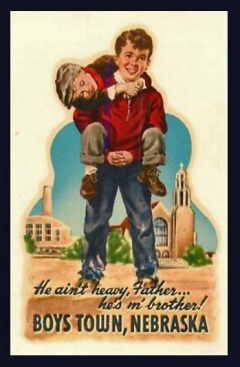 After saying we must carry each other’s burdens, the Apostle Paul seems to reverse himself three sentences later when he tells us we each must carry our own loads. It’s confusing; if we’re all supposed to carry our own loads, then nobody should need help carrying their burdens!
 Since we tend to think of burdens as demanding and often unwelcome duties or responsibilities, we’re certainly not anxious to take on a burden, especially one that actually belongs to someone else! Yet, that is exactly what we’re told we must do if we are going to fulfill Christ’s mandate. And what is that command? To love one another in the way God loves us.
 Devotions of the Heart