
When the Lord your God goes ahead of you and destroys the nations and you drive them out and live in their land, do not fall into the trap of following their customs and worshiping their gods. Do not inquire about their gods, saying, “How do these nations worship their gods? I want to follow their example.” You must not worship the Lord your God the way the other nations worship their gods, for they perform for their gods every detestable act that the Lord hates. [Deuteronomy 12:29-31 (NLT)]
 St. Valentine may (or may not) have been the Catholic bishop of Terni, a priest who helped persecuted Christians during the reign of Claudius II, one who suffered in Africa, one who secretly married couples when marriage was forbidden, or one who converted the family of a jailer named Asterius and restored sight to his blind daughter. It was a common name and whether there was only priest named Valentine who did all of these things or as many as three, supposedly he or they were beheaded by the Emperor Claudius II on February 14 around the end of the third century. The confusion about Valentine’s identity led the Roman Catholic Church to drop his saint day from their official calendar of feasts in 1969.
Today’s romantic traditions, however, have pagan roots. On February 14, the Romans celebrated a day dedicated to the goddess Juno. Included in the revelry was a matchmaking lottery that paired up couples for the duration of the festival. On the 15th, they continued the merriment with Lupercalia, a fertility festival that involved sacrificing goats and a dog and whipping women with thongs made from the skins of the sacrificed animals. Understandably, the early Christian church was displeased by such behavior and, around 496, Pope Gelasius I recast the pagan festival as a feast day in honor of St. Valentine. Instead of men drawing names of women who’d become sex partners, children drew names of saints whose lives they would emulate for the year.
Although there was a common belief that birds began to mate for the season on February 14, it wasn’t until the late 14th century that Valentine’s Day became associated with romance, thanks to the publication of Geoffrey Chaucer’s poem, The Parliament of Fowls. Probably about the wooing of Anne of Bohemia by King Richard II, the poem depicts a dream of a pagan heaven where all of the birds have come before Dame Nature to choose their mates. “For this was on Saint Valentine’s day,” wrote Chaucer, “When every fowl comes there his mate to take.” The birds have a debate while three eagles unsuccessfully try to seduce a female eagle.
Written valentines began to appear in the early 15th century and, by the middle of the 18th century, it became common for friends and lovers to exchange notes and tokens of affection. By the early 20th century, ready-made cards replaced the personal notes. Nowadays, over one billion valentines are sent each year.
With its pagan beginnings and the murky history of a man or men named Valentine, what does Valentine’s Day mean to Christians? At first thought, the day seems harmless enough. Some churches, however, prohibit celebrating this holiday because it, like certain other popular holidays, Christianizes or “whitewashes” pagan customs and traditions. We know from the Old Testament that God detests anything pagan. The Israelites were warned not to worship other gods but also not to adopt any pagan customs. The Apostle Paul warns us about not copying the behavior and customs of the world. [Romans 12:2] I wonder what God thinks about Valentine’s Day. What does He think of our spending nearly $20 billion to celebrate a day that began as pagan wantonness?
Although God is love, He is nothing like Cupid (the Roman god of erotic love). His love for us is immeasurable, consummate, unconditional, and sacrificial and has nothing to do with chemistry, sexuality, romance or even likability. We are called to love one another as He loves us—with a love that is generous, compassionate, forgiving, unqualified and expects nothing in return. We are to love the undeserving, unlikeable and adversarial as well as family, friend, and ally. How we celebrate this day is between us and God. There is no question, however, as to how we are to love one another every day of the year.
 For I am the Lord, your healer. [Exodus 15:26b (RSV)]
 Not that I was ever in need, for I have learned how to be content with whatever I have. [Philippians 4:11 (NLT)]
 Someone was missing from yesterday’s story of Shadrach, Meshach, and Abednego and the fiery furnace: their good friend Daniel. When Nebuchadnezzar’s giant statue was erected on the plain of Dura, word was sent to all of his officials to assemble there for the statue’s dedication. We know Shadrach, Meshach, and Abednego were there because Daniel reported that they got tossed in a fiery furnace for refusing to bow to an idol. But what of Daniel? He’s the one who chronicled the event: the one who wrote that all of the high officers, officials, governors, advisers, treasurers, judges, magistrates, and provincial officials were present. Daniel gives no explanation for his absence at the dedication of the king’s golden statue.
 After Nebuchadnezzar’s first invasion of Judah, he returned to Babylon with the temple’s treasures and some of Judah’s nobility as captives. The best and brightest of the young men were to learn the literature and language of Babylon so they could serve the king. In spite of being captives, they were housed in the palace and given the king’s choice of food. While this would appear to be a pretty good gig for prisoners of war, the boys were probably castrated and made eunuchs as was typically done for palace officials (and prophesied by Isaiah in 2 Kings 20:18).
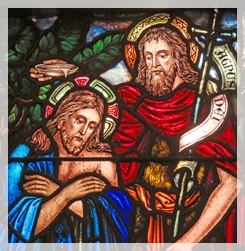 Although I don’t remember my Baptism as an infant, I do have a picture that tells me I wore a long white dress and a bonnet. Another picture tells me that I wore a shorter white dress, a hat instead of a bonnet and my first pair of nylon stockings and heels at my Confirmation thirteen years later. That, however, is about all I remember of making a public reaffirmation of my faith and recommitting to the baptismal promises made for me when I was a baby. Although I knew a lot about Jesus at the time, I’m not sure that I truly knew Him. I know Him now and, in a much simpler ceremony, I recently reaffirmed my Baptism in a way I will never forget.
 Devotions of the Heart