IF SOMEONE ASKS

And if someone asks about your hope as a believer, always be ready to explain it. [1 Peter 3:15b (NLT)]

Yesterday, I echoed Paul’s words that, when witnessing, we need to speak our words with love. Of course, before that can happen we need to speak and, therein lies our problem. To speak, we need words and most of us are sure we don’t have them. Granted, the way we conduct ourselves is a continuous sermon but, if we never speak, no one will know what makes us the way we are. Actions may speak louder than words but that doesn’t mean words aren’t necessary.

We don’t have to go knocking on doors, stand on street corners with a sign, accost strangers, or go on a mission trip; we just have to be open to the opportunities that arise nearly every day to share our love of God. Peter instructed us to be ready to explain the reason for our hope; I think we’re asked that question more than we realize. There’s a good chance people have commented on your joy, peace, or calmness. In all likelihood someone may have said something like, “How do you do it?” or, “You don’t seem to worry,” or even, “I wish I had your life!” In reality, that person is asking about the source of your hope. Rarely have my answers to such comments revealed the true source of that hope, strength, peace and joy. I’ve chosen the innocuous reply rather than the true one simply because I didn’t think I had the right words to explain! When Jesus told us to go out into the world and be His witnesses, He promised we wouldn’t have to do it alone. Since the Holy Spirit will empower us to be His messengers, let’s allow Him to do His work! We can’t speak with love until we speak!

God forbid that I should travel with anybody a quarter of an hour without speaking of Christ to them. [George Whitefield]

But this will be your opportunity to tell them about me. So don’t worry in advance about how to answer the charges against you, for I will give you the right words and such wisdom that none of your opponents will be able to reply or refute you! [Luke 21:13-15 (NLT)]

Copyright ©2017 jsjdevotions. All rights reserved.

SOUNDING BRASS

Though I speak with the tongues of men and of angels, and have not charity, I am become as sounding brass, or a tinkling cymbal. [1 Corinthians 13:1 (KJV)]

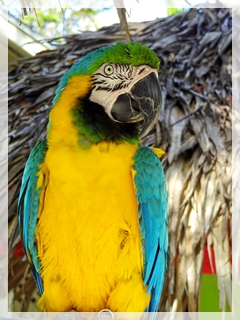
maccaw

1 Corinthians is actually Paul’s second letter to the young church at Corinth;  the first letter does not remain. What we consider the first letter is actually Paul’s reply to the Corinthians’ response to his first one. While much of his letter is spent confronting the Corinthians about their sins and correcting their behavior, this rebuke to a troubled church has one of the most beautiful chapters in the Bible: 1 Corinthians 13. Paul, however, is actually writing about the Corinthians’ abuse of their spiritual gifts. By only associating this chapter with weddings and anniversaries, we may miss some of its original meaning.

The “tongues of men” probably refers to the Sanhedrin, the supreme judicial and administrative council of the Jews. Having jurisdiction over religious matters, the high priest acted as its president and its members consisted of the chief priests, scribes and elders. They were to be men of distinction and wisdom conversant in all seventy languages of mankind so interpreters weren’t needed in court. It’s likely that the tongues of men to which Paul referred were the supposedly wise and multilingual tongues of the Sanhedrin. Being ministering spirits, angels have no need for tongues. Nevertheless, there were times they took on flesh and appeared to man and, when acting as God’s messengers, they were inspiring and eloquent in their speech.

Personally, I like brass quartets and the sound of those tinkling cymbals worn on the fingers of Middle Eastern dancers, but those are not what Paul meant. Paul actually was referring to sounding (or echoing) brass which were large cast urns placed around the back of a theater. This primitive sound system served to amplify the actors’ voices and Corinth had a famed set of them. The “sounding brass” could no more create their own sound than could a Bose speaker; having no voice of their own, they only could reproduce sound. As for tinkling cymbals, the two kinds of cymbals used during Jewish worship were percussion instruments. Only played during interludes in the vocal music, they didn’t produce a light tinkle. One was more of a shaker with small cymbals attached to a handle that was shaken. The other cymbals were smaller and heavier than today’s orchestral ones. Rather than the pleasant ringing of wind chimes, they were said to penetrate “as far as Jericho.”

In their cultural context, Paul’s words make far more sense. Even if he could speak with great wisdom, in every language known to man and as magnificently and eloquently as an angel, if his words didn’t come from his heart, they would have no meaning. If he just thoughtlessly  echoed words, his voice simply would be an irritating  loud sound.

We worry so much about what to say and how to say it when an opportunity to share our faith arises that we usually fail to share God’s message at all. Paul’s words should reassure us that it’s not the words or eloquence that matter; it’s the love behind those words. If we love God and love people, then the words we speak will be filled with love. Without love, however, no matter how articulate, self-assured and knowledgeable we are, our message will be meaningless noise.

The purpose of my instruction is that all believers would be filled with love that comes from a pure heart, a clear conscience, and genuine faith. [1 Timothy 1:5 (NLT)]

Copyright ©2017 jsjdevotions. All rights reserved.

STORMS

God is our refuge and strength, always ready to help in times of trouble. So we will not fear when earthquakes come and the mountains crumble into the sea. Let the oceans roar and foam. Let the mountains tremble as the waters surge! [Psalm 46:1-3 (NLT)]
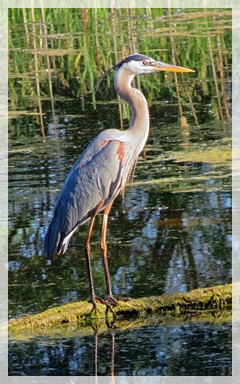
great blue heronThe damage done by Hurricane Harvey seemed unbelievable until Irma hammered the entire state of Florida. Fortunately, our Florida home was prepared and we were safely situated in the Midwest during Irma’s tirade. Would that all the storms of life announced themselves a week in advance to give us time to put up storm shutters and evacuate to safety.

Unfortunately, most of life’s storms are more like tornadoes and hit with little or no warning. Yesterday, sixteen years after 9/11, we were again reminded how unpredictable and precarious life can be. Plywood, sand bags, flashlights, batteries, generators, and stores of fuel, water, and canned goods are of no use when a plane crashes into a building, a spouse has a disabling stroke, a car careens into a crowd, or a stray bullet hits. Addiction, Alzheimer’s, job loss, divorce, cancer, mental illness or a drunken driver don’t warn us before wreaking havoc with our lives. We cannot escape from life’s tempests and trials and they can be far more destructive than any hurricane with its accompanying storm surge.

Someone asked if I had a digital record of our property and another if I was worried about losing anything. Possessions were the least of my concerns; “It’s just stuff!” was my response. We did our best to protect our Florida home and belongings but they are things. I can’t take them with me at the end so, if I lose them now, what difference does it really make? Perhaps I’m being cavalier; it’s our second home so, even if everything is destroyed, I still have a place to rest my head. Nevertheless, although most of those affected have only one home, the same holds true for us all; it really is just stuff. Eventually, power will be restored and homes and businesses will be rebuilt; life goes on.

The question about what I didn’t want to lose got me wondering about my answer—if not house and possessions, to what am I attached? The answer is my faith and relationships, neither of which can be insured or replaced. In the last few days I’ve heard from friends far and near, checking on us and offering their help. These are people who already have more than enough on their plates and yet they offered us both moral support and helping hands. I would mourn losing relationships like those far more than anything in my houses. As for my faith, I’d like to think it will take more than a hurricane or even a terrorist attack to topple it.

Our Florida home was built to withstand a hurricane and should have survived the storm’s onslaught; I don’t yet know. The more important question is whether my faith and relationships can survive the sort of pounding that Irma inflicted on Florida. Are they strong enough to survive gale force winds? Rather than taking pictures of stuff, shuttering the windows or putting furniture up on blocks, what am I doing to reinforce and protect both my faith and relationships to make sure they survive whatever storms come my way?

Heavenly Father, thank you for keeping us strong during life’s storms. Let your written word and the Spirit’s voice bolster us when we start to waver in the wind. Thank you for the gift of friends and family—the people who love and strengthen us so we can survive the squalls, challenges, and losses of our troubled world. Help us be the kind of friends who can be counted on to encourage, reinforce and sustain those around us.

Two people are better off than one, for they can help each other succeed. If one person falls, the other can reach out and help. But someone who falls alone is in real trouble. Likewise, two people lying close together can keep each other warm. But how can one be warm alone? A person standing alone can be attacked and defeated, but two can stand back-to-back and conquer. Three are even better, for a triple-braided cord is not easily broken. [Ecclesiastes 4:9-12 (NLT)]

Copyright ©2017 jsjdevotions. All rights reserved.

ON THE TRAIL

You go before me and follow me. You place your hand of blessing on my head. [Psalm 139:5 (NLT)]

Lake louiseOur recent trip to the Canadian Rockies reminded me of a hiking trip I took there with my daughter more than twenty years ago. With two guides for our group, one acted as lead and tied orange ribbons along the trail to mark the way. Knowing that we are to leave nothing in the forest but footprints, a second guide (the sweep) followed the last hiker and removed the trail markers. That morning’s hike was a trek up to a mountainside teahouse and my daughter and I (both fast walkers) wanted to have time at the top to explore. Confident we couldn’t get lost, we shot ahead of the guide, promising to meet at the teahouse. Apparently, there was a fork in the trail we missed in our haste; we veered left when we should have stayed right. After a while, it occurred to us that we seemed to be going down when the trail should be going up. Nevertheless, expecting an uphill just around the next turn and unwilling to admit we may have erred, we continued down. When we arrived at the same lake from which we’d started, we saw the error of our ways, turned around, and made the hike back uphill. By the time we reached the main trail, the trail markers placed by the lead guide had already been removed by the sweep. Knowing we needed to go further uphill, we continued our trek and eventually rejoined our group at the teahouse. In our case, the first really were the last and we barely had enough time to eat lunch before starting back down the mountain.

“You go before me and follow me,” David said about God in Psalm 139. Had my daughter and I allowed the lead to set the pace, the same could have been said about our hiking guides. Sure that we knew the way, however, we charged ahead, lost our way, and went down instead of up. Sarah charged ahead of God by giving Hagar to Abraham, Saul charged ahead by making a sacrifice without waiting for Samuel, and the prodigal son charged ahead when he demanded his inheritance before his father’s death. As so often happens when people take matters into their own hands rather than waiting for God, they discovered that things can go downhill quickly and often with tragic consequences.

Fortunately, God is in front of us—leading us, marking the way, lighting the path ahead, and smoothing the trail. He also is behind us—lifting us when we stumble, strengthening us when we weaken, encouraging, correcting and protecting us. Like our hiking guides, however, He will allow us to barge ahead and make mistakes along the trail. Fortunately, along with allowing us the freedom to turn the wrong direction, God allows us to make U-turns! Unlike our hiking guides, however, we can never leave Him in the dust nor will He ever leave us behind Him. Moreover, He won’t remove the signs that show us the right path. He is right there, both in front and behind us, leading and sweeping, like the extraordinary guide that He is.

Then I will lead the blind along a way they never knew; I will guide them along paths they have not known. I will make the darkness become light for them, and the rough ground smooth. These are the things I will do; I will not leave my people. [Isaiah 42:16 (NCV)]

If you go the wrong way—to the right or to the left—you will hear a voice behind you saying, “This is the right way. You should go this way.” [Isaiah 30:21 (NCV)]

Copyright ©2017 jsjdevotions. All rights reserved.


MASTER WEAVERS

And we know that God causes everything to work together for the good of those who love God and are called according to his purpose for them. [Romans 8:28 (NLT)]

spider websIt rained last night. During our early morning walk, we looked out over the prairie and saw hundreds of sparkling spider webs. As the morning sun caught the water droplets on the silk, the master weavers’ work glistened in the mist. Although we take that trail several times a week, it was the first time this season we saw those arachnidan works of art. The spiders didn’t start spinning just the previous night; their webs have been there all summer but weather and light conditions kept us from seeing them. In fact, had we chosen to walk the loop in the other direction, we never would have seen them at all!

God, like his eight legged creations, is always busy weaving the strands of our lives. Much of the time, however, as with the spider webs, we don’t see or understand what He’s doing. “Where is God in all of this?” we ask. It is usually in hindsight that we recognize His presence—the way He moved, guided, protected, instructed, disciplined or provided for us. Nevertheless, whether or not we see His hand in our circumstances, we know that He, like the spiders, is ever-present and busy weaving.

I find those beautiful webs reassuring. They show me that God will give us beautiful gifts when we least expect them but that we must be willing to look for them in the most unlikely places. The webs remind me that we don’t need to see God to know that He is always there and always working. Moreover, God reveals himself in a variety of ways. While an angel or burning bush is dramatic and impressive, let’s remember that Elijah did not find God in the mighty wind, earthquake or fire. He found God in a gentle whisper. As for me, spiders’ webs on a misty morning are one of the ways God reassures me of His presence and His amazing plan; they are God’s gentle whisper of reassurance from the Master Weaver!

Our lives are but fine weavings
That God and we prepare
Each life becomes a fabric planned
And fashioned in His care.
We may not always see just how
The weavings intertwine,
But we must trust the Master’s hand
And follow His design,
For He can view the pattern
Upon the upper side,
While we must look from underneath
And trust in Him to guide.
Sometimes a strand of sorrow
Is added to His plan,
And though it is difficult for us,
We still must understand
That it is He who fills the shuttle,
It is He who knows what is best,
So we must weave in patience
And leave to Him the rest.
Not till the loom is silent
And the shuttles cease to fly
Shall God unroll the canvas
And explain the reason why
The dark threads are as needed
In the Weaver’s skillful hand
As the threads of gold and silver
In the pattern He has planned. [Author unknown]

Just as you cannot understand the path of the wind or the mystery of a tiny baby growing in its mother’s womb, so you cannot understand the activity of God, who does all things. [Ecclesiastes 11:5 (NLT)]

Copyright ©2017 jsjdevotions. All rights reserved.
FOR OUR ENEMIES

O Lord, oppose those who oppose me. Fight those who fight against me. … Make their path dark and slippery, with the angel of the Lord pursuing them. [Psalm 35:1,6 (NLT)

Let death stalk my enemies; let the grave swallow them alive, for evil makes its home within them. [Psalm 55:15 (NLT)]

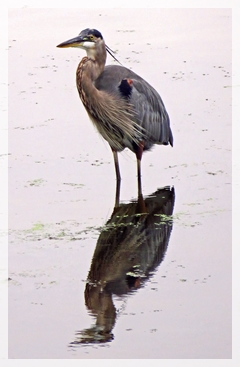
great blue heronA few nights ago, I had some unwelcome visitors—worry and anger—and they wouldn’t let me sleep. I responded to their visit with prayer and yet it seemed God had closed His office for the night. We’d just received an accusatory and demanding “do this or else” letter from an attorney and my prayers had been as accusing and vindictive as was the letter. No wonder God turned a deaf ear to them.

Throughout much of King David’s life, he was beset by enemies: Philistines, Babylonians, Moabites, Ammonites, King Saul, and even his own son Absalom. As a result, many of his Psalms include what are known as imprecatory prayers in which he asks God to punish and destroy his enemies, sometimes in quite horrible ways. Although David was asking God to settle the matter of evil, I find it hard to reconcile his words with Christianity’s love, forgiveness, meekness and peace. As Christians, no matter how much we dislike someone or how malicious or nasty he (or she) happens to be, we are never to curse them or wish evil upon anyone. In fact, Jesus tells us to do the exact opposite—we are to love, pray for and bless those who curse us. Moreover, we are to submit to God’s sovereignty and pray that His (not our) will be done. The only way to be at peace with God is to be at peace with his children.

I’ve encountered opposition several times, but having flesh and blood adversaries or enemies is new to me. Our integrity has never been questioned before this and I was wounded, confused and irate. I knew I had to pray for our legal enemies and, while I didn’t curse them with imprecatory prayer, I certainly wasn’t blessing them either. As I prayed that they would be reasonable, see the light, change their minds, concede the error of their ways, and go away quietly, I was really praying about me, not for them. Again, it seemed that God was deaf to my pleas. It took me awhile before I understood that my real enemy wasn’t human; he was right there in my mind, tormenting me with outraged, vengeful and worrisome thoughts. It was not until I stopped thinking of these people as foes and started to pray blessings for them that I felt God again open His door to me and my prayers. As I prayed for them, for their health and happiness and even their prosperity, my anger subsided and my worry disappeared.

While I think we’ve acted honorably and been honest and forthright, I’m sure the other party is as sure they’re justified in their accusations and demands. In actuality, the truth probably lies somewhere in between. I’ll leave it to the lawyers and God to figure out a sensible and peaceful solution. I’ve already lost one night’s sleep over this; I’m not about to lose my soul, as well. As for me, I’m going to love, forgive and pray blessings for my enemy and, if need be, even turn the other cheek.

Bless those who persecute you. Don’t curse them; pray that God will bless them. … Never pay back evil with more evil. Do things in such a way that everyone can see you are honorable. Do all that you can to live in peace with everyone. Dear friends, never take revenge. [Romans 12:14,17-19a (NLT)]

But to you who are willing to listen, I say, love your enemies! Do good to those who hate you. Bless those who curse you. Pray for those who hurt you. If someone slaps you on one cheek, offer the other cheek also. If someone demands your coat, offer your shirt also. Give to anyone who asks; and when things are taken away from you, don’t try to get them back. Do to others as you would like them to do to you. [Luke 6:27-31 (NLT)]

Copyright ©2017 jsjdevotions. All rights reserved.