
Get rid of all bitterness, rage, anger, harsh words, and slander, as well as all types of evil behavior. Instead, be kind to each other, tenderhearted, forgiving one another, just as God through Christ has forgiven you. [Ephesians 4:31-32 (NLT)]
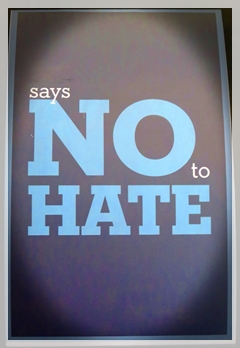 I walked into the university workout facility and was greeted by a large sign telling me the school says no to hate. I was surprised that a Christian University felt the need to say what should be obvious. Has hate become so much a part of our everyday lives that we have to be reminded not to do it? There wasn’t a sign telling us not to pee in the pool, have fist fights, or swear. Evidently, certain acceptable behavior was assumed but not hating wasn’t! Apparently, the sign is necessary because people feel freer to express their prejudice, intolerance, and bias than do any of those other things.
Monday, Massachusetts governor Charlie Baker re-established a task force on hate crimes. It will advise him on issues such as the prevalence, deterrence and prevention of hate crimes and support for hate’s victims. In 2015, the state had 424 hate crimes including intimidation, vandalism and assault. The Massachusetts Anti-Defamation League found a 44% increase in anti-Semitic incidents in the first nine months of 2017 and the state’s hate crime hotline has received more than 2,000 calls since it began just a year ago.
One look at the news tells us that Massachusetts is not alone. Hate (and its cousin anger) make the headlines regularly—violence in Charlottesville, a sport star’s home vandalized with racial slurs, Asian-Americans told they don’t belong here, swastikas painted on Jewish temples, and a Texas mosque burned to the ground. Trucks become weapons in the hands of extremists and shootings in theatres, shopping centers, schools, concerts and churches almost seem commonplace. Last night, a local pastor was interviewed about the large security/safety staff now present during any church function. His church is not alone; many places of worship have felt the need to protect themselves from haters.
Hate can express itself in subtle ways through slurs, intolerance, intimidation, harassment, marginalization, and exclusion. Hate is also a crime when a criminal offense is motivated by race, ethnicity, ancestry, sexual orientation, gender, gender identity, religion, or disability. Whether or not a crime is committed, in God’s book, hate is an offense. Worse, hate is like an infectious disease—the victim of hate often becomes a hater himself!
As Christians we are allowed to hate evil. We can and should hate things like hypocrisy, godlessness, violence, greed, immorality, exploitation, dishonesty, brutality, deceit, abuse, idolatry, betrayal, false teaching, corruption, intolerance, and hate. What we must never do is hate people. Rather than hate, we are commanded to love and that love isn’t limited to Christians or people who think, look, speak or act like us. We are to love all of God’s children. There’s plenty that’s wrong in our broken world; let’s not add to it by spreading hate through bigotry, intolerance, racism, discrimination or prejudice. We shouldn’t need a sign that tells us to say no to hate. Let us be the ones who demonstrate God’s love in this broken world of ours.
 These people are false apostles. They are deceitful workers who disguise themselves as apostles of Christ. But I am not surprised! Even Satan disguises himself as an angel of light. So it is no wonder that his servants also disguise themselves as servants of righteousness. In the end they will get the punishment their wicked deeds deserve. [2 Corinthians 11:13-15 (NLT)]
 There are always going to be poor and needy people among you. So I command you: Always be generous, open purse and hands, give to your neighbors in trouble, your poor and hurting neighbors. [Deuteronomy 15:11 (MSG)]
 The celebration of the Eucharist or Holy Communion has been central to our Christian worship since the early church. If asked the meaning of the word eucharist, most of us would probably respond that it is the Christian sacrament that commemorates the Last Supper with bread and wine. While it has come to mean that and often refers to the consecrated elements, especially the bread, the word eucharist originally meant something else entirely. Coming from the Greek words eukharistos, meaning grateful, and kharizesthai, meaning to offer graciously, it is a translation of the Hebrew word berekah which means a blessing or benediction. Acknowledging God as the source of all good things, a berekah would be similar to the grace or table blessing we offer before or after a meal.
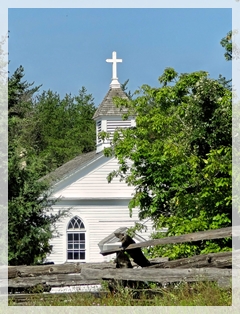 Yesterday I mentioned getting an email with the subject, “How firm is your foundation?” Although it was an advertisement for a new study Bible connecting Biblical teachings to Christian beliefs, that very question has been the topic of discussion in our northern church for the last few weeks. The parish is doing a church-wide study of Martin Luther’s Small Catechism. Back in the 1500s, Martin Luther was appalled at the lack of knowledge of both pastors and their congregations. Not especially tactful, he accused some pastors of being “lazy bellies and presumptuous saints!” His words for their congregations, “simple cattle and mindless pigs!” were no more diplomatic. People who called themselves Christians had no idea what that meant. They didn’t know the Ten Commandments, the Apostle’s Creed or even the Lord’s Prayer, let alone anything else in the Bible. Last week, our Pastor asked us what Luther might say if he visited today’s churches. We agreed that his words for our pastors would be more complimentary but that his words for their congregations might be the same or worse!

