IT’S OKAY

Our hearts ache, but we always have joy. We are poor, but we give spiritual riches to others. We own nothing, and yet we have everything. [2 Corinthians 6:10 (NLT)]

lilac breasted rollerToday’s email contained a meme of that lovable loser Charlie Brown with the caption: “The smile on my face doesn’t mean my life is perfect. It means I appreciate what I have and what I have been blessed with. I choose to be happy.” The meme reminded me of words spoken by Jane Marczweski when she appeared on America’s Got Talent last week: “You can’t wait until life isn’t hard anymore before you decide to be happy.” Known as Nightbirde, the 30-year-old vocalist sang an original song called “It’s Okay” and received the “golden buzzer” from judge Simon Cowell. She said she wrote the song as a reminder that, “You can be happy and also be going through something really hard at the same time—you don’t have to pick one or the other.”

The young woman knows what she’s talking about. After being treated for breast cancer in 2017, numerous tumors in her lungs, liver, nymph nodes, ribs, and spine were discovered in December of 2019. The overwhelming diagnosis of terminal cancer came with the prognosis of six months to live and only a 2% chance of survival. But, as she optimistically says, “2% is not zero. 2% is something and I wish people knew how amazing it is.” Although declared “cancer-free” after her second battle with cancer, she recently was diagnosed with this terrible disease a third time. At the time of her audition, she had “some cancer” in her lungs, spine and liver. Although Jane received more treatment after the audition, it is too early to know the results. But, as she so aptly puts it, “2% is not zero!”

As Christians, we shouldn’t need a cartoon character meme or even an amazing young woman’s example to remind us that circumstances need not determine our state of mind. Regardless of what we happen to be going through, as Christians, we know we are blessed every day in every way. Faith is trusting God’s plan, as inexplicable (and unpleasant) it may be. Faith is being able to smile in the midst of pain because we know that, in spite of our anguish, God loves us. Faith is being able to rejoice in the Lord regardless of what He throws at us because we know that we are not alone. As Christians, we know that faith is not about everything turning out okay; faith is about being okay regardless of how things turn out! Faith is being able to echo the words of Job: “The Lord gave, and the Lord has taken away; Blessed be the name of the Lord.” [1:21]

But here’s one thing I do know: when it comes to pain, God isn’t often in the business of taking it away. Instead, he adds to it. He is more of a giver than a taker. He doesn’t take away my darkness, he adds light. He doesn’t spare me of thirst, he brings water. He doesn’t cure my loneliness, he comes near. … And I guess that means I have all the more reason to say thank you, because God is drawing near to me. [Jane Marczweski (Nightbirde)]

So be truly glad. There is wonderful joy ahead, even though you must endure many trials for a little while. … You love him even though you have never seen him. Though you do not see him now, you trust him; and you rejoice with a glorious, inexpressible joy. [1 Peter 1:6,8 (NLT)]

Always be joyful. Never stop praying. Be thankful in all circumstances, for this is God’s will for you who belong to Christ Jesus. [1 Thessalonians 5:16-18 (NLT)]

Copyright ©2021 jsjdevotions. All rights reserved.

TEACH IT

Jesus came and told his disciples, “I have been given all authority in heaven and on earth. Therefore, go and make disciples of all the nations, baptizing them in the name of the Father and the Son and the Holy Spirit. Teach these new disciples to obey all the commands I have given you. And be sure of this: I am with you always, even to the end of the age.” [Matthew 28:18-20 (NLT)]

tri-colored heronSince 1890, a common teaching method in a surgical residency is to “see one, do one, teach one.” The med student learns the basics by watching an experienced physician do a procedure and then puts his knowledge into practice by doing the procedure himself. He hasn’t mastered the procedure, however, until he’s taught someone else to do it; it is only when we can teach something that we truly understand it.

While Jesus doesn’t call us all to be physicians, he does call us all to be disciples and discipleship follows much the same “see, do, and teach” philosophy of med school. Almost anyone, if they studied hard and observed enough of them, could learn how a coronary heart bypass is done, but that wouldn’t make them cardiovascular surgeons any more than just knowing about Jesus makes someone a disciple of Christ. The first disciples did more than just watch Jesus perform miracles and listen to His parables and, if we’re to be Christ’s disciples, we need to do more than just learn about our Lord.

For the budding heart surgeon, just knowing how a heart bypass is done isn’t enough; he actually has to do one. He actually has to do it by making an incision, opening the chest, touching the heart, and grafting blood vessels from other parts of the body to reroute the blood around the clogged arteries. For Christians, the equivalent of doing one is living like Jesus—applying the Lord’s teachings to our lives and becoming like Him. We put into practice all that we’ve learned about love, forgiveness, redemption and salvation. While few of us would be able to take that second step in medicine and perform bypass surgery, we can take that second step in our faith and put into practice what we’ve been taught by Jesus.

Just seeing and doing, however, aren’t enough if we really want to comprehend something or master a skill. It’s when we try to help someone else understand a concept or technique that we learn in greater depth. In the third step, the training physician teaches someone else how to do the procedure. Because this new student sees things from another viewpoint and asks different questions, the teacher has to think harder and dig deeper to answer and explain his reasoning. It is when the new surgeon can clearly explain and demonstrate which arteries have the best results when grafted and how to remove and reattach them, that he has become a competent surgeon. It’s successfully taking that third step of teaching that eventually turns a med student into a skilled physician.

In Christianity, we often hold back when it comes to that third step: teaching, talking about, and demonstrating how our faith in Jesus works. The command to be disciples was given to us so the gospel message could spread far and wide but, perhaps, in His wisdom, God also knew that it is in sharing our faith that it becomes deeper and stronger. The faith of those early disciples intensified as they spread the gospel message and their knowledge expanded as they taught. When reading Acts and the Epistles, we see how the men who abandoned Jesus in the garden became mature disciples as they shared the gospel, clarified points, answered questions, and explained their belief. Most of us have no hope of ever becoming a surgeon and we’re probably not going to become theologians or even Sunday school teachers. Nevertheless, we have an opportunity to teach about Jesus whenever we open our mouths. Our faith will grow stronger and deeper not just by seeing Jesus in Scripture and doing as would He, but by sharing the gospel message with others.

To teach is to learn twice. [Joseph Joubert]

Then we will no longer be immature like children. We won’t be tossed and blown about by every wind of new teaching. We will not be influenced when people try to trick us with lies so clever they sound like the truth. Instead, we will speak the truth in love, growing in every way more and more like Christ, who is the head of his body, the church. [Ephesians 4:14-15 (NLT)]

Copyright ©2021 jsjdevotions. All rights reserved.

FAKING IT

The teachers of religious law and the Pharisees are the official interpreters of the law of Moses. So practice and obey whatever they tell you, but don’t follow their example. For they don’t practice what they teach. They crush people with unbearable religious demands and never lift a finger to ease the burden. Everything they do is for show. On their arms they wear extra wide prayer boxes with Scripture verses inside, and they wear robes with extra-long tassels. [Matthew 23:2-5 (NLT)]

cliffroseThere is a funny scene in the movie When Harry Met Sally when, in the middle of a delicatessen, Sally proves to Harry that women can successfully fake being in the throes of passion. After a rather loud and vivid demonstration, Sally calmly returns to her meal. After watching Sally’s display of ecstasy, an older woman tells her waiter, “I’ll have what she’s having!” While it may be possible to fool people about a number of things, we can’t fool God. He looks beyond appearances right into our hearts.

Around the 4th century BC, the Jewish rabbis starting taking the commands in Deuteronomy 6:8, 11:18, and Exodus 13:9 literally. They wrote God’s command to love Him and keep His commandments, placed the words in small leather containers called tefillin or phylacteries, and strapped them to their left hand and forehead during prayers. There were various rules regarding the length and width of the straps, the color of the boxes, the knots used, the parchment and ink, and even the number of lines for each verse. These were the “extra wide prayer boxes” to which Jesus referred.

The “extra-long” tassels Jesus mentioned were called tzitzit and were worn on the four corners of an outer garment’s hem. In response to the command in Numbers 15:38-40, the original intent was to remind the people to keep the Lord’s commandments and be holy before Him. As happened with the prayer boxes, by Jesus’ time, additional rules had been added regarding the quantity of threads used in each tassel, the amount of white and blue tassels, and the knots used.

Jesus wasn’t criticizing the wearing of tefillin or tzitzit. After all, as Jews, He and the disciples may have worn them. Jesus was criticizing the religious leaders for the burden they placed on the people with so many demanding man-made regulations. Moreover, He was taking to task those men who sought to draw attention to themselves rather than God by enlarging their tefillin and lengthening their tzitzit in a conspicuous show of their piety and religious zeal when they didn’t truly obey God’s commands. Their garish example of faith was as false as Sally’s intense example of ecstasy. While their display may have fooled and impressed the people, it didn’t fool Jesus.

Some Christians wear crosses or t-shirts announcing their faith while others might display bumper stickers or hang crosses in their homes. More important than how we decorate ourselves or our possessions is the way in which we conduct our lives. Without the love of Jesus and the fruit produced by the Holy Spirit, we’re no different than the self-righteous Pharisees; we’re just faking it.

I remember a song from my Sunday school days in which I proclaimed having the “joy, joy, joy,” the “love of Jesus,” and the “peace that passes understanding down in my heart…down in my heart to stay!” It’s that joy, that love of Jesus, and that peace that passes understanding that truly identify us as Christians. When we know, love and worship God, His love instills a joy into our hearts and lives that only He can produce and, unlike passion and piousness, they can’t be faked. It is, however, only through the power of the Holy Spirit that we can live the kind of lives and exhibit the sort of behavior that truly will make people say, “I’ll have what they’re having!”

But the Holy Spirit produces this kind of fruit in our lives: love, joy, peace, patience, kindness, goodness, faithfulness, gentleness, and self-control. [Galatians 5:22-23a (NLT)]

Copyright ©2021 jsjdevotions. All rights reserved.

THE SKINK

Oh, that I had wings like a dove; then I would fly away and rest! I would fly far away to the quiet of the wilderness. How quickly I would escape—far from this wild storm of hatred. [Psalm 55:6-8 (NLT)]

five-lined southwestern skinkThe skink is a reptile that looks as if it can’t decide whether it’s a lizard or a snake. As one scampered away down the boardwalk, it looked more lizard-like than usual because it was missing the pointed end of his long tail. Like many lizards, if a predator manages to catch a skink by the tail, the tail will break off. Since the detached tail continues to wiggle, the predator gets distracted which allows the lizard to escape.  Even though a raccoon, snake, or hawk had appropriated its tail, that skink escaped to see another day. Although skinks don’t have much with which to defend themselves, with their detachable tails (caudal autonomy), God provided them with an effective mode of escaping trouble!

Like the skink, we all want to be able to escape when disaster occurs. The Department of Transportation designates evacuation routes in case of a hurricane and public buildings mark exits and stairwells so we can flee in case of fire, but we wish to escape from more than storms and burning buildings. We want to flee from things like chronic pain, stage-4 cancer, paralysis, Parkinson’s, or MS. We wonder where the emergency exit is when caregiving for a spouse disabled by stroke, an elderly parent with dementia, or a child with cerebral palsy. Where do we go to flee from a loved one’s addiction, the loneliness of widowhood, overwhelming debt, a troubled marriage, or the consequences of our failings? There are, however, no detachable tails or specially marked exits for those situations.

Adam and Eve ran from God after eating the forbidden fruit, the pregnant Hagar ran away from Sarai’s harsh treatment of her, Jonah ran the opposite way when God told him to go to Nineveh, and Elijah tried to escape Jezebel’s wrath by fleeing to Beersheba. Running and hiding, however, didn’t keep God from finding them and setting them back on the path He set for them. Unlike the skink, they couldn’t turn tail (or leave their tails behind) and run away; neither can we. Although some people try to flee their difficulties through abandonment, denial, addiction, or emotional detachment, their troubles eventually catch up with them. Instead of escaping like a skink, we have to turn around and face our troubles head on as did Adam, Eve, Hagar, Jonah, and Elijah.

While God doesn’t promise to fix our problems, He does promise we’ll not face them alone. Unlike the skink whose only defense is a detachable tail, God has provided us with His armor, the power of prayer, the Holy Spirit, and our brothers and sisters in Christ.

Heavenly Father, when we want to flee, please give us the strength and courage to meet our challenges face to face. We know we can’t do it alone but, with you, all things are possible.

Don’t pray to escape trouble. Don’t pray to be comfortable in your emotions. Pray to do the will of God in every situation. Nothing else is worth praying for. [Samuel M. Shoemaker]

But I will call on God, and the Lord will rescue me. Morning, noon, and night I cry out in my distress, and the Lord hears my voice. He ransoms me and keeps me safe from the battle waged against me, though many still oppose me. … Give your burdens to the Lord, and he will take care of you. He will not permit the godly to slip and fall. [Psalm 55:16-18,22 (NLT)]

Copyright ©2021 jsjdevotions. All rights reserved.

CLOSED EYES (Shema – Part 3)

Do not be afraid or discouraged, for the Lord will personally go ahead of you. He will be with you; he will neither fail you nor abandon you. [Deuteronomy 31:8 (NLT)]

With its declaration of one all-powerful infinite God, Jewish tradition holds that the Shema’s first verse “Hear, O Israel: The Lord our God, the Lord is one,” is the most important and, as such, demands greater concentration so the eyes are closed or covered by the right hand during its recitation. The Talmud traces this practice back to Rabbi Judah the Prince (135 – 219 AD) who often interrupted his lectures to recite the Shema. Whenever he did so, the rabbi placed his hands over his eyes as a way of disconnecting from his surroundings.
Reading about covering eyes during Shema caused me to ponder why we usually close our eyes during prayer. Closing our eyes certainly helps us avoid distractions but I came across additional Talmudic explanations for this practice. Rather than closing his eyes as a way to shut out the world, 13th century Rabbi Yonah Gerondi rotated his eyes so he could see God in all directions. He only covered them during the Shema to ensure his spiritual privacy while rolling his eyes. In his explanation for shutting the eyes, 17th century Rabbi Ezekiel Landau said, “it would be difficult to express complete faith in God while looking at the pain in the world around us.” Indeed, sometimes it is difficult to express our faith in the midst of the suffering and ugliness in the world.

Another Talmudic explanation for closing the eyes while reciting the Shema is that its meaning goes beyond stating there is only one God—the Shema also means there is no existence outside of God. By closing one’s eyes during its recitation, a person briefly steps outside the physical reality of the world and into a reality centered only on God.

While there are times I pray with my eyes open (when walking in the morning, inspired by God’s glorious creation, witnessing something troubling, or saying a quick prayer for a stranger or passerby), I usually pray with my eyes closed (as I suspect most people do). Why? After all, when Jesus taught us to pray, He didn’t tell us to close our eyes before starting!

Perhaps we close our eyes during prayer for all of the reasons found in the Talmud—to avoid distraction, to see past the pain, to see God in all directions, and to acknowledge that nothing exists outside of Him. It could simply be that when we close our eyes all we can see is darkness. Nevertheless, even though we can’t see our surroundings, we know they haven’t disappeared because we also know that not seeing something doesn’t mean it isn’t there. Our closed eyes remind us that even though we can’t see God, His purpose, or His plan, He’s right beside us. Perhaps, we close our eyes because, as follower of Christ, we live by faith, not sight!

For we live by believing and not by seeing. [2 Corinthians 5:7 (NLT)]

And be sure of this: I am with you always, even to the end of the age. [Matthew 28:20b (NLT)]

Copyright ©2021 jsjdevotions. All rights reserved.

THE SHEMA (Part 1)

Hear, O Israel: The Lord our God, the Lord is one. You shall love the Lord your God with all your heart and with all your soul and with all your might. And these words that I command you today shall be on your heart. You shall teach them diligently to your children, and shall talk of them when you sit in your house, and when you walk by the way, and when you lie down, and when you rise. You shall bind them as a sign on your hand, and they shall be as frontlets between your eyes. You shall write them on the doorposts of your house and on your gates. [Deuteronomy 6:4-9 (ESV)]

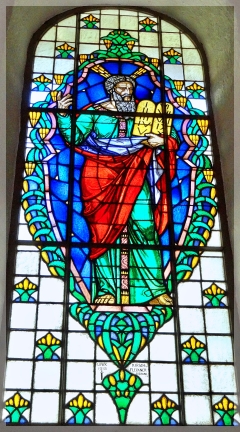
Meiringen-MichaelskircheMy morning’s reading took me to Deuteronomy 6 and the words that Jesus cited as the first, and most important commandment. Known as the Shema and found in verses 4 through 9, it is the essential declaration of the Jewish faith. Its name comes from the first Hebrew word of the verse, shema, which means “hear.” Observant Jews recite its words twice a day (morning and evening), on the Sabbath and religious holidays, and as the last words before death. The Shema is so entrenched in Judaism that a story is told about Rabbi Yitzhak Herzog who, in 1946, went searching for Jewish children who’d been hidden by Christians during the Holocaust. As he walked through European convents, monasteries, and orphanages, the rabbi would start to recite the Shema. He easily found the Jewish children because they immediately joined in saying the sacred words.

The Shema’s first words sum up the essence of Judaism—there is only one true God and He is Israel’s God. During the time of the Temple, a second line was inserted into the Shema. After the priest recited, “Hear, O Israel: The Lord our God, the Lord is one,” the congregation replied, “Blessed be the name of the glory of His kingdom forever and ever.” In acknowledgement that this phrase is not part of the original Scripture, it usually is said in an undertone. The rest of the original prayer then follows.

When Moses passed these words along to the Israelites, they had spent centuries surrounded by people who worshipped many gods. The Shema’s daily repetition impressed upon them that love, obedience, and faithfulness to their one true God was the only way to live. These words may have been passed to the Jews some 3,500 years ago but its message holds true for all of God’s children—there is one true God and He is ours!

The rest of the original Shema details how that belief in the one true God is to be lived and its words continue to apply to Christians as well as Jews. We are to love Him with our whole being, teach his word to the next generation, make His words part of our daily conversation, and impress His word into all aspects of our lives.

In verses 8 and 9, we find the command to bind the God’s words to our hands, foreheads, doorposts, and gates. Taking the words literally, Jews wore black leather boxes (tefillin) containing scripture on their heads and arms and placed mezuzot, containing part of the Shema, on their doorposts. Observant Jews continue to do so today.

Even when taking those instructions figuratively, it’s not difficult to understand what is meant by placing God’s word between our eyes or on our arms. God’s words must affect the way we think and see as well as our every action. While we don’t place Scripture on doorways and gates, when stepping into a Christian’s home or workplace, God’s presence and influence should be felt by all who enter. For the Christian, the Shema’s words mean that we are to write God’s words in our hearts and minds and love Him with our whole being!

Because the words of the Shema were important to Jesus, they are important to us. Whether Christian or Jew, I can’t think of a better way to start or end my day than with these words: “The Lord our God, the Lord is one. You shall love the Lord your God with all your heart and with all your soul and with all your might.”

And one of the scribes…asked him, “Which commandment is the most important of all?” Jesus answered, “The most important is, ‘Hear, O Israel: The Lord our God, the Lord is one. And you shall love the Lord your God with all your heart and with all your soul and with all your mind and with all your strength.’” [Mark 12:28-30 (ESV)]

Copyright ©2021 jsjdevotions. All rights reserved.