
 Not that I was ever in need, for I have learned how to be content with whatever I have. [Philippians 4:11 (NLT)]
Perhaps it was because of the dreary weather, but I started my litany of complaints as soon as I got out of bed. It was chilly and damp (by Florida standards) and my arthritic knees ached. As I gingerly walked across the cold tile floor, I remembered a friend whose rheumatoid arthritis has left her unable to walk even moderate distances. In spite of a few creaky joints, I still manage to get in my 10,000 steps every day. As dreary as the day was, the only reason I didn’t complain about the weather is that, even at my grouchiest, I know that a bad winter day in southwest Florida is better than a good one just about anywhere else!
Nevertheless, my moaning and groaning continued as I faced the mirror and saw those pesky gray roots peeking out from my colored hair. I grumbled about those until I recalled my many friends who lost their tresses to chemo-therapy and radiation. I scrutinized the age spots on my face and the wrinkles around my eyes and then remembered my elderly friend whose skin cancer left him without an eye. While I was on a roll, though, I looked with disdain at my old lady neck and remembered Nora Ephron’s words: “You have to cut open a redwood tree to see how old it is, but you wouldn’t if it had a neck.” Truer words were never said but, before I could even voice that grievance, I thought of a friend’s wife who lost both her jaw and life to cancer; had she lived into her 70s, I don’t think she’d be complaining about a crepey neck.
Not yet done with negativity, though, I grumbled because the sundress I’d planned on wearing wouldn’t be warm enough. As I browsed through my over-full closet to pick a warmer outfit, I thought of all those people who have no closet stuffed with clothing, pantry filled with food, or furnace running to keep them warm. “Shame on me!” I thought, but I wasn’t done yet with my litany of complaint.
Later that morning, I became annoyed that my limping husband can no longer keep up with me. Before I could bemoan the fact that we can no longer ski together, I remembered the man who pushes his wife’s wheelchair along the boardwalk every morning. I’m sure they both would be thrilled if she could walk, even with a limp! I then thought about the neurosurgeon without whose skill my spouse couldn’t walk at all. There are many places in the world where the speedy and expert treatment my husband received would be unavailable and, like that woman, he would need a wheelchair.
“Count your blessings!” my mother used to say, but I’d wasted a fair amount of the morning counting petty complaints instead. How easy it is to gripe about stupid little things and forget how fortunate we really are. When I need an attitude adjustment, as I so desperately did that morning, I find reading Psalm 100 an excellent antidote to a case of the grumbles. My spirits improved once I’d stopped whining, taken stock of the many blessings of my life, and thanked God for them. While some of us are “glass half full!” kind of people, others are more of the “glass half empty!” sort. What we need to remember is to be thankful that we have a glass at all! Indeed, “Give thanks to him and praise his name.”
The Lord afflicts us at times; but it is always a thousand times less than we deserve, and much less than many of our fellow-creatures are suffering around us. Let us therefore pray for grace to be humble, thankful, and patient. [John Newton]
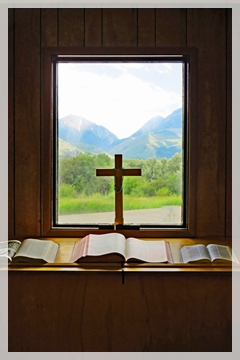 Before the incarnation of Christ, God dwelt first in the tabernacle and then in the temple. The innermost room of the temple was called the “Most Holy Place” and it was in this inner room that God’s glory was said to dwell. This was where the Ark of the Covenant was kept and where the high priest came with a sacrifice to atone for his and the nation’s sins every year. With the incarnation of Jesus, God no longer dwelt in the temple but in the flesh of His son and, for a brief time, God actually walked among His people. Yet, when Jesus lived as a man, only a few people at a time could be in His presence. With His death, there is no yearly atonement ritual because Jesus atoned for our sins once and for all. Moreover, because of His resurrection, ascension, and the presence of the Holy Spirit, it is possible for countless people, everywhere, to be in His presence at the same time. Once we become believers, the Holy Spirit moves into our hearts and each one of us, as members of Christ’s church, become part of His body and the temple of God.
 Some prophets weren’t bothered by the truth and were available for hire. Ahab, for example, had 400 prophets on his payroll acting as his “yes men.” When he asked Jehoshaphat to join him in a campaign against Aram, Jehoshaphat requested the advice of prophets so Ahab summoned his seers. Jehoshaphat, however, recognized them as pagans; when he asked for a true “prophet of the Lord,” Micaiah was summoned.
 In 539 BC, thousands of Medes and Persians were digging outside Babylon’s walls. Thinking they were futilely trying to undermine the city’s impregnable walls, Babylon’s King Belshazzar was unconcerned. While carousing with 1,000 of his nobles, he gave orders to bring out the gold and silver cups that Nebuchadnezzar had looted from Jerusalem’s temple 47 years earlier. The revelers were drinking to their false Babylonian gods with vessels dedicated to the one true God when a human hand appeared and started writing on the plaster wall. No longer so arrogant, the frightened Belshazzar called for his astrologers and diviners but, when the pagans were incapable of deciphering God’s message, Daniel was called to interpret the words.
 Someone was missing from yesterday’s story of Shadrach, Meshach, and Abednego and the fiery furnace: their good friend Daniel. When Nebuchadnezzar’s giant statue was erected on the plain of Dura, word was sent to all of his officials to assemble there for the statue’s dedication. We know Shadrach, Meshach, and Abednego were there because Daniel reported that they got tossed in a fiery furnace for refusing to bow to an idol. But what of Daniel? He’s the one who chronicled the event: the one who wrote that all of the high officers, officials, governors, advisers, treasurers, judges, magistrates, and provincial officials were present. Daniel gives no explanation for his absence at the dedication of the king’s golden statue.
 One night King Nebuchadnezzar had a disturbing dream and asked the court’s wise men to interpret it. Whether he couldn’t remember it (as happens with dreams) or, being obstinate, wanted to test the soothsayers and astrologers, we don’t know, but the king expected them to tell him the dream’s meaning without his revealing its content. Indignant at their failure to do so, he ordered the execution of all of Babylon’s counselors (which included Daniel, Shadrach, Meshach, and Abednego). Daniel approached the king and asked for time so that he could discover the dream’s meaning.
 Devotions of the Heart