
So we do not lose heart. Though our outer self is wasting away, our inner self is being renewed day by day. For this light momentary affliction is preparing for us an eternal weight of glory beyond all comparison, as we look not to the things that are seen but to the things that are unseen. For the things that are seen are transient, but the things that are unseen are eternal. [2 Corinthians 4:16-18 (ESV)]
 No matter what translation is used for the above verses, I find it difficult to picture something that is described as suffering, trouble, affliction, or tribulation as being small, little, or light. Moreover, while I’d like afflictions to be so, they rarely seem to be temporary or momentary. Perhaps, I’m splitting hairs but what exactly is “momentary” and “light” when it comes to suffering and affliction?
While Paul was writing about his persecution as a follower of Christ, what of other hardships and woes? Does “light and momentary” describe the twelve years of constant bleeding and painful treatments endured by the woman with the “issue of blood,” the thirty-eight years the man lying by the pool at Bethesda had been an invalid, or Job’s grief at the loss of his family and the agony of his illness? Is “temporary” the sixteen years Anthony Broadwater spent in prison after being wrongfully convicted of rape or the thirty years Michael J. Fox has suffered from Parkinsons? Is “momentary, light distress” the three hours Jesus suffered on the cross, the nine months during which Elizabeth Smart experienced being raped by her kidnapper, or the six years John McCain was tortured as a prisoner of war? Does “passing trouble” describe the mental anguish of my bipolar uncle who spent the last twelve years of his life in a mental hospital? Could the twenty years my brother-in-law struggled with Parkinson’s or the thirty my sister dealt with MS be described as “short-lived”? What of the nearly fifty-five years Joni Eareckson Tada has spent as a quadriplegic and the chronic stabbing pain, COVID complications, and two cancer diagnoses she’s endured? Is her suffering merely “momentary, light distress”? When we’re the ones hurting, even if only from an abscessed tooth or a pinched nerve, nothing about it seems light or momentary!
Paul knew what he was talking about; he’d been whipped, beaten, stoned, imprisoned, and shipwrecked and his life was in continual jeopardy because of his ministry. He knew struggle, hunger, betrayal, hardship, persecution, pain, and affliction first-hand. Nevertheless, he also knew that every trial, no matter how he suffered, was just a prelude to the resurrection power of Jesus!
Regardless of its length or severity, for a believer, our suffering here on earth is light and momentary, especially in light of the many blessings we receive in the midst of our afflictions or the adversities suffered by others. Our suffering is small and momentary when compared to what we actually deserve or to what Jesus did for us. Most of all, whatever our afflictions may be, they are “but for a moment” in the light of eternity. No matter how long we live or how difficult our lives are, our years here are a mere dot on God’s eternal timeline. Though our afflictions may last a lifetime, they will not have the last word! What waits for us is eternal not temporary and, rather than light, it is heavy because it is the entire weight of God’s glory!
 Paul was speaking metaphorically of his thorn and whether it was a spiritual, emotional, physical affliction, or something else entirely, we don’t know. Since Paul dictated his letters, some speculate that that he had poor eyesight: perhaps cataracts or macular degeneration. Then again, severe arthritis in his hands may have prevented him from holding a stylus. Paul may have had a chronic medical problem such as gout, migraines, severe asthma, or spinal stenosis. It may have been a person: perhaps, Alexander the metalsmith who was harming his ministry. Considering the number of times the apostle was arrested, the thorn may have been an old injury from the many beatings inflicted upon him. Paul even may have suffered from bouts of depression or the 1st century equivalent of Chronic Fatigue Syndrome. The identity of his thorn (or even thorns) is unimportant to us. It is how Paul dealt with his thorn that matters.
 Being a prophet was a calling from the Lord and probably an unwelcome one at that. Amos, a businessman from Tekoa in Judah, was minding his own business when God called on him. He probably would have preferred tending his sheep and cultivating his fig trees to pronouncing judgment upon the Israel, Judah, and other nations. Nevertheless, this layman accepted God’s call and denounced the nations’ sins with brutal frankness. It was at the height of Israel’s prosperity that he prophesied their end by singing a funeral song for the northern kingdom. Needless to say, the words of a Judean pronouncing judgment upon Israel were not welcomed. Even though Amaziah ordered him back to Judah, Amos continued to give God’s message to the people.
 I was listening to Randy Travis sing, “I’m diggin’ up bones, exhuming things that’s better left alone.” It seemed an appropriate song for this time of year when we tend to dwell on the past—not just past loves, but past losses, mistakes, oversights, misunderstandings, injuries and pain. As one year ends and another begins, we often dig up all the grievances, regrets, and ”if onlys” of our yesterdays.
 When the religious scholar asked, “And who is my neighbor?” Jesus answered with the parable of the Good Samaritan in which he made it clear that one’s neighbors can be strangers—even enemies. Sometimes, however, our neighbor really is the guy next door or the couple sitting in the pew behind us at church.
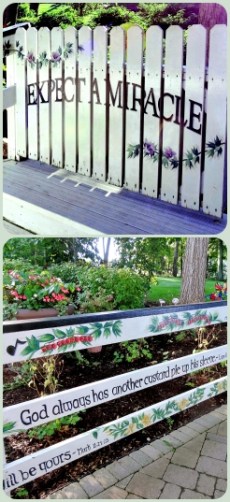 When we lived in the north, we often walked a public path that meandered along the shoreline of a nearby lake. Running through both public and private properties, it crossed the front lawns of historic lakefront estates and stunning homes with beautifully landscaped yards and gardens. One such home placed a lakeside bench for tired walkers that said, “Sit-Pray-Mediate-Enjoy” under a sign that read, “You can trust me. Love, God.” A delightful white fence delineated their private property from the public path. Decorated with whimsey, “Expect a Miracle” was the message on the gate and assorted Bible verses and words of wisdom were painted on the fence’s horizontal slats.
 Devotions of the Heart