
 And I will give you a new heart, and I will put a new spirit in you. I will take out your stony, stubborn heart and give you a tender, responsive heart. And I will put my Spirit in you so that you will follow my decrees and be careful to obey my regulations. [Ezekiel 36:26-27 (NLT)]
Last Friday, doctors in Maryland made history when they transplanted a genetically modified pig’s heart into a human in a last-ditch effort to save the life of David Bennett, Sr. A medical first, Bennett was too ill to qualify for a routine heart transplant or an artificial ventricular assist device. The 57-year-old’s prognosis is uncertain and it will be months before doctors know whether the transplant can be deemed a “success.” As with any organ transplant, the main risk is that of organ rejection and Bennett will need potent immunosuppressing drugs for the remainder of his life.
I remember how astonished the world was back in 1967 when Dr. Christiaan Barnard performed the first human-to-human heart transplant. The news that a surgeon had cut open someone’s chest, lifted out a diseased heart, and successfully replaced it with a healthy one from a dead donor was astounding. Although that first heart transplant recipient lived only eighteen days, today’s recipients have an 85% chance of living one year and a 69% chance of surviving five. The survival rate continues to decrease through the years with only 50% of heart transplant recipients living ten years and just 15% making 20 years. In spite of the risks, last year over 50,000 transplant candidates worldwide vied for the 5,000 hearts that were available. Sadly, there just aren’t enough hearts to go around.
54 years ago, the medical journals were wrong when they credited Dr. Bernard with the first heart transplant; God has been replacing hearts for ages! He takes our damaged hearts of stone, hearts unwilling to respond to Him, and replaces them with a new heart and spirit. After accepting His new heart, we have no need for immunosuppressive drugs because the new heart won’t be rejected. Unlike transplant candidates, we don’t have to meet specific criteria or put our names on a waiting list. Everyone qualifies and all we have to do is repent! The best news is that there’s no heart shortage and we don’t have to wait for someone to die; Jesus did that for us 2,000 years ago!
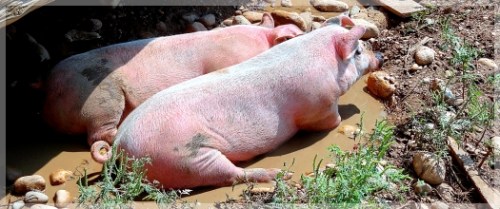
Even with a pig’s heart, Mr. Bennett won’t to want to live in a sty, cool off with a mud bath, snuffle in the soil, or start eating a mix of corn, soybeans, sorghum, and wheat. While his new heart will give him a new lease on life (at least for a short time), it will not change him. He will be the same man with the same favorite activities, world view, media preferences, attitudes, likes and dislikes, morals and principles he had before surgery. On the other hand, the new heart God gives us will make a huge change in us. We will have a new mind, new preferences, new spiritual gifts, new beliefs and morals, a new love for who and what we may have hated, and a new aversion to things we once might have loved. Rather than getting immunosuppressant drugs, we will receive an infusion of love, joy, peace, patience, kindness, goodness, faithfulness, gentleness, and self-control! Getting a new heart in God’s hospital also yields a far better survival rate—no death, only eternal life!
O Holy Spirit, descend plentifully into my heart. Enlighten the dark corners of this neglected dwelling and scatter there thy cheerful beams. [Augustine]
 In immersion baptism, a person is completely submerged in the water and, every time I witness a full immersion baptism done in the Gulf of Mexico, I think of what it must have been like when John baptized Jesus and the Holy Spirit descended on our Lord. Since the Greek word used to describe this event was baptizo, meaning to dip, sink, or submerge, we can safely assume His was a full immersion baptism.
 When we pray about a decision, we often set the desired outcome we want rather than ask God to reveal His will to us. Instead of trusting our decision to Him and bending our will to His, we want God to bend His will to our desires. If His response to our pleas isn’t the one we want, we refuse to recognize it or complain that He never answered our prayers! Until we’re willing to step back and say, “Thy will be done,” we can’t truly discern God’s will.
 “They are to be pitied, not….” Not what? Author C.S. Lewis did not complete the sentence and I don’t think the omission was by accident. When I read the above passage, I thought of the words I (as a Christian) should use to replace the ellipsis; they are not to be reviled, hated, judged, condemned, berated, scorned, abused, or despised. Regretfully, my initial reaction upon running across the scum of the earth—the rapists, molesters, traffickers, exploiters, extorters, attackers, murderers, deceivers, hate-spewers, and tyrants that seem to populate our world—is more likely to be the exact opposite. Rather than a feeling of pity, compassion, mercy, forgiveness, or love, it’s one of outrage, loathing, and disgust.
 The Bible is filled with evidence of God’s goodness and the great (and miraculous) things He’s done for His people. Daniel emerges unscathed from a lion’s den, David defeats Goliath and the shepherd boy becomes a king, wisdom and riches are given to Solomon, and Shadrach, Meshach, and Abednego aren’t even scorched from a fire. Water is parted more than once, the walls of Jericho collapse, jail doors miraculously open, and storms cease at a word. Armies are led to victory, manna falls from heaven, fish and bread multiply, the barren give birth, the sick and lame are healed, and the dead rise. The Bible is full of marvelous accounts of miracles, majesty, and triumphs.
 Although we try to keep Christ in Christmas, many of our ideas about Christmas aren’t Bible based. In spite of the delightful carols, the gospels make no mention of a little drummer boy, cattle lowing, Jeanette or Isabella, a partridge in a pear tree, and, rather than mid-winter, it’s more likely that Jesus was born in early fall.
 Devotions of the Heart