
The Lord detests the proud; they will surely be punished. … Pride goes before destruction, and haughtiness before a fall. First pride, then the crash—the bigger the ego, the harder the fall. [Proverbs 16:5,18 (NLT)]
 While reading C.S. Lewis’ The Horse and His Boy, I couldn’t help but think of the proud Babylonian King Nebuchadnezzar. He was so full of himself that he erected a 90-foot golden statue and then demanded that people fall down and worship it as a sign of loyalty to him. When interpreting one of the king’s dreams, Daniel told Nebuchadnezzar that he would be driven from human society and only regain his kingdom when the king learned that heaven, not man, rules. The king was warned to change his evil behavior. In spite of the caution and even though he’d seen the power of the Israelites’ one true God when Shadrach, Meshach, and Abednego survived the fiery furnace, Nebuchadnezzar didn’t change his ways. While looking down from his rooftop and surveying the wonders of Babylon, he expressed pride in his accomplishments and congratulated himself on his mighty power. Before the words were even out of his mouth, a voice from heaven pronounced judgment upon him. The king developed what is known as boanthropy, a psychological disorder in which one becomes delusional and thinks he or she is a cow. The high and mighty king was driven from society and lived and ate like an animal for the next seven years.
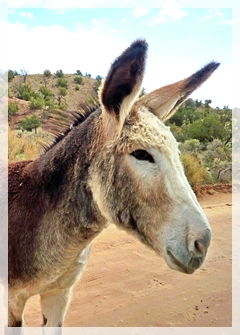
In The Horse and His Boy, instead of a king, the reader meets the pompous Prince Rabadash, the tale’s villain. Fancying himself a great warrior, he set off to seek revenge on a Narnian queen who spurned his advances. After being defeated in battle, the captured prince was told to forget his pride and anger and accept the mercy offered by Narnia’s kings. Even though he replied with an arrogant tirade, another chance to change his evil ways was offered to the proud prince. While responding with even more invective, Rabadash’s last words came out as braying. Unlike Nebuchadnezzar, who only thought he was an animal, the prince actually became one—a donkey.
Both true and fictional stories can help us understand God and life. After all, even Jesus made up stories with his parables. It is no mere coincidence that Rabadash’s fate resembles that of Nebuchadnezzar. C.S. Lewis considered pride to be the “great sin”—the sin that leads us to what he called “the complete anti-God state of mind” and the sin that leads us to all other sins. Pride causes us to look down on things and people (as it did with both Nebuchadnezzar and Rabadash) instead of looking up to God. It was only when the humbled king looked up at heaven that he returned to sanity and only when thousands had looked down at the four-legged prince that he regained his body.
Envy is private, lust and anger can be concealed, and selfishness and greed can be disguised as the virtues of prudence and fortitude. Things like pride, arrogance, contempt and conceit, however, are rather obvious and there is a sense of poetic justice to both men’s public humiliation. By the time they returned to their normal states, their subjects had witnessed them either acting like a cow or looking like a donkey. Behind the prince’s back while alive (and openly once dead), he was known as Prince Rabadash the Ridiculous. Although the Bible makes no mention of it, I can only imagine that the people of Babylon must have snickered when they saw the once powerful and proud king grazing in the fields, his hair long and matted and his untrimmed nails looking like claws.
God hates it when we’re proud and yet we all suffer from pride. Although Jesus took our punishment for that sin (and every other one), we often find ourselves recipients of some of God’s divine discipline when we err and stray. As for pride, God seems to have fitting and often public ways of knocking us down a peg or two when necessary. If we don’t keep ourselves humble, we can be pretty sure that God will do it for us. Like Nebuchadnezzar, we may find ourselves ostracized from society or, like Rabadash, looking like an awful lot like an ass.
Every Christian has a choice between being humble or being humbled. [Charles Spurgeon]
 After struggling with the writing of a devotion, it was finally finished. Thankful, I listed its completion in my gratitude journal that night. The next morning, I discovered it was lost—vanished into thin air and nowhere to be found (and believe me, I tried)! Looking back, I probably cut the devotion from my “Work On” file but got distracted and never pasted it into my “To Post” file. Unfortunately, by the time I discovered my error, both files had been saved in versions without the words over which I’d labored so long. When it became clear that those paragraphs truly had vanished into the black hole of my computer, I was annoyed with myself and upset, upset enough to want that thanks entry crossed out in my gratitude journal!
 His testimony enraged the Jewish high council and he was taken from the city and stoned to death. Stephen was the first of the Christian martyrs but clearly not the last. We’ve all been horror-stricken by the recent news from Egypt where ISIS thugs attacked Coptic Christians on their way to a remote monastery. According to witnesses, the men were told their lives would be spared if they recited the shahada, the Islamic declaration of faith. When they refused to do so, they were gunned down. Since December, more than 100 Coptic Christians have died in Egypt in four different attacks. On Palm Sunday, two of their churches were bombed leaving forty-four dead. It’s not easy being a Christian in Egypt.
 I’m in the midst of reading a series of seven children’s fantasy novels, The Chronicles of Narnia, by C.S. Lewis. Some of them, like The Lion, the Witch and the Wardrobe, I read as a girl but others are new to me. The world of Narnia is a world to which one wants to return again and again and I’m enjoying my visit ever so much. C.S. Lewis, however, was much more than a writer of fantasy, non-fiction and poetry; he was a well-known lecturer, a brilliant scholar and a renowned Christian apologist.
 The “Last Lecture,” a tradition at many universities, is given by a professor as if it is the last one delivered in the speaker’s lifetime. Hoping to inspire the audience to become better versions of themselves, the lecturer usually reflects on his life’s journey and shares his hard-earned wisdom. New meaning was given to this tradition in 2007 when Randy Pausch, a professor at Carnegie Mellon University, gave what truly was his last lecture. Terminally ill with pancreatic cancer, he was dead less than a year after giving it.
 Devotions of the Heart