God is our refuge and strength, always ready to help in times of trouble. So we will not fear when earthquakes come and the mountains crumble into the sea. Let the oceans roar and foam. Let the mountains tremble as the waters surge! [Psalm 46:1-3 (NLT)]
 The damage done by Hurricane Harvey seemed unbelievable until Irma hammered the entire state of Florida. Fortunately, our Florida home was prepared and we were safely situated in the Midwest during Irma’s tirade. Would that all the storms of life announced themselves a week in advance to give us time to put up storm shutters and evacuate to safety.
Unfortunately, most of life’s storms are more like tornadoes and hit with little or no warning. Yesterday, sixteen years after 9/11, we were again reminded how unpredictable and precarious life can be. Plywood, sand bags, flashlights, batteries, generators, and stores of fuel, water, and canned goods are of no use when a plane crashes into a building, a spouse has a disabling stroke, a car careens into a crowd, or a stray bullet hits. Addiction, Alzheimer’s, job loss, divorce, cancer, mental illness or a drunken driver don’t warn us before wreaking havoc with our lives. We cannot escape from life’s tempests and trials and they can be far more destructive than any hurricane with its accompanying storm surge.
Someone asked if I had a digital record of our property and another if I was worried about losing anything. Possessions were the least of my concerns; “It’s just stuff!” was my response. We did our best to protect our Florida home and belongings but they are things. I can’t take them with me at the end so, if I lose them now, what difference does it really make? Perhaps I’m being cavalier; it’s our second home so, even if everything is destroyed, I still have a place to rest my head. Nevertheless, although most of those affected have only one home, the same holds true for us all; it really is just stuff. Eventually, power will be restored and homes and businesses will be rebuilt; life goes on.
The question about what I didn’t want to lose got me wondering about my answer—if not house and possessions, to what am I attached? The answer is my faith and relationships, neither of which can be insured or replaced. In the last few days I’ve heard from friends far and near, checking on us and offering their help. These are people who already have more than enough on their plates and yet they offered us both moral support and helping hands. I would mourn losing relationships like those far more than anything in my houses. As for my faith, I’d like to think it will take more than a hurricane or even a terrorist attack to topple it.
Our Florida home was built to withstand a hurricane and should have survived the storm’s onslaught; I don’t yet know. The more important question is whether my faith and relationships can survive the sort of pounding that Irma inflicted on Florida. Are they strong enough to survive gale force winds? Rather than taking pictures of stuff, shuttering the windows or putting furniture up on blocks, what am I doing to reinforce and protect both my faith and relationships to make sure they survive whatever storms come my way?
Heavenly Father, thank you for keeping us strong during life’s storms. Let your written word and the Spirit’s voice bolster us when we start to waver in the wind. Thank you for the gift of friends and family—the people who love and strengthen us so we can survive the squalls, challenges, and losses of our troubled world. Help us be the kind of friends who can be counted on to encourage, reinforce and sustain those around us.
Two people are better off than one, for they can help each other succeed. If one person falls, the other can reach out and help. But someone who falls alone is in real trouble. Likewise, two people lying close together can keep each other warm. But how can one be warm alone? A person standing alone can be attacked and defeated, but two can stand back-to-back and conquer. Three are even better, for a triple-braided cord is not easily broken. [Ecclesiastes 4:9-12 (NLT)]
Copyright ©2017 jsjdevotions. All rights reserved.

 The men from the church were enjoying their monthly breakfast at their favorite diner. The new minister, Pastor Tim, decided to join them. Wanting to get to know the men better, he asked who would like to offer grace before the meal. John, a retired farmer from Iowa volunteered. After taking off his cap, he stood and said loudly, “Lord, I sure do hate buttermilk!” The old farmer then added, “And, Lord, I don’t care much for lard.” Pastor Tim wasn’t sure how to react but decided to see where this prayer was leading. Then John continued with, “Tell the truth, white flour doesn’t taste like much either and baking powder sure is bitter.” Pastor Tim started to stand up and take over saying grace when, in his booming voice, John added, “But, Lord, when you mix them all together and bake them, I truly do love those fresh biscuits! Thank you, Heavenly Father, for the biscuits, gravy, eggs, and bacon with which we are blessed this fine morning. Amen.”
 His cautionary words to the disciples are difficult to understand. How can Jesus, who told us to love our enemies and do good to them, tell us to hate our families? Do we have to despise our relatives if we want to be his disciples? Fortunately, after getting the disciples’ attention with that unusual statement, Jesus followed with a parable about a man who undertook a project without counting the cost and then couldn’t finish what he began. Hating our family is just a hyperbole; it’s a way of saying that anyone who follows Christ must love Him more than anything else. Christ is to be first and foremost in our hearts and minds. In comparison to our love for Jesus, we are to love them less (or “hate” them). To be His disciple, Jesus demands total commitment; we must be willing to give up everything for Him, even if that means the things and people we love. Sadly, when we choose Christ over loved ones, they might perceive our love of Jesus as a betrayal and may even hate us for that choice.
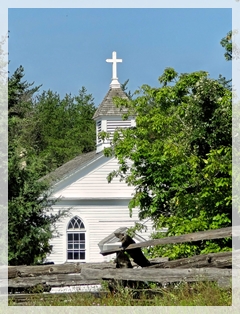 Yesterday I mentioned getting an email with the subject, “How firm is your foundation?” Although it was an advertisement for a new study Bible connecting Biblical teachings to Christian beliefs, that very question has been the topic of discussion in our northern church for the last few weeks. The parish is doing a church-wide study of Martin Luther’s Small Catechism. Back in the 1500s, Martin Luther was appalled at the lack of knowledge of both pastors and their congregations. Not especially tactful, he accused some pastors of being “lazy bellies and presumptuous saints!” His words for their congregations, “simple cattle and mindless pigs!” were no more diplomatic. People who called themselves Christians had no idea what that meant. They didn’t know the Ten Commandments, the Apostle’s Creed or even the Lord’s Prayer, let alone anything else in the Bible. Last week, our Pastor asked us what Luther might say if he visited today’s churches. We agreed that his words for our pastors would be more complimentary but that his words for their congregations might be the same or worse!
 Devotions of the Heart