
I want to do what is right, but I can’t. I want to do what is good, but I don’t. I don’t want to do what is wrong, but I do it anyway. [Romans 7:18b-19 (NLT)]
 Years ago, we were acquainted with “Henry, dear” and “Mary, darling.” We called them that because we never heard them refer to one another any other way. They always were so sweet and charming in public that halos seemed to hover over their heads. My husband and I often wondered what they called one another behind closed doors and, as we got to know them better, we realized our wariness was well-founded. As noble as they appeared in public, there always seemed to be an ulterior motive behind their kindness and, while “Henry, dear” was patting your back, his other hand probably was reaching into your back pocket. While we never knew what they called one another in private, we knew that what the public saw was not what they actually got.
I thought of them the other day when watching A Beautiful Day in the Neighborhood, a movie about Fred Rogers. Having read books both by and about him, there truly was nothing artificial or superficial about the man; what you saw actually was what you got. Rogers once said, “The greatest gift you ever give is your honest self,” and that’s exactly what he did!
Recently, my day began with bad news and sped downhill from there. In my frustration, my words and actions were not those of a “church lady.” I may write Christian devotions but what you see is not always what you get and the Fruit of the Spirit was nowhere to be found on my tree! Whether in public or private, Mr. Rogers’ faith was evident in all that he did or said. Mine, however, frequently gets obscured by my reaction to circumstances beyond my control. Like the Apostle Paul, “I want to do what is right, but I don’t do it. Instead, I do what I hate.” [Romans 7:15]
Both Fred Rogers (and the movie) were clear that, just like the rest of us, he was no saint. The difference is that, while many of us seem to think we can become good people effortlessly, Fred Rogers actually worked at being the very best person that he could be. One of the ways he did that was through self-discipline. He faithfully read the Bible, reflected and prayed every day, and his prayers continued all day long. He was disciplined in the way he cared for his body with healthy habits. He was disciplined about meeting his commitments, remembering his friends, and expressing gratitude. It’s not that he didn’t have emotions; it’s that he was disciplined enough to choose safe outlets for the negative ones. It’s not that he didn’t know any four-letter words; he just was disciplined enough to use words like “mercy, me!” instead of them! Rogers understood that while circumstances may be beyond our control, our reaction to them is not. He was disciplined in his faith, obedient to God, and saw everyone as his neighbor and a valued child of God. He didn’t give lip service to the power of the Holy Spirit; He lived, breathed, trusted and depended on the Spirit.
The difference between the “Henry, dears” and “Mary, darlings” of the world and Fred Rogers is that while they wear masks so they’ll look like good Christians, Mr. Rogers developed the strength of character to be a good Christian! Through self-discipline and the power of the Holy Spirit, he actually became good (or at least a whole lot better than many of us). The church would call that process sanctification. We can’t do it by ourselves and God doesn’t do it for us; rather, it is combining our efforts with God’s power to grow more and more like Christ. Spiritual progress doesn’t happen overnight and sanctification is not a passive process; it requires effort, discipline and obedience. Only then will people be able to say of us, “What you see is what you get!”
 There was a bit of a kerfuffle behind us during church last week; it started during the Old Testament reading and continued to the Gospel. As best as I can figure, a bottle of water had leaked onto the pew. The women behind me sat on the damp cushion and made quite a production of detecting, discussing, and complaining about it first to her husband and then to her neighbor (whose water it had been). There was room enough to move down in that pew and plenty of other pews (with dry cushions) available, but the couple never moved. Nevertheless, throughout the rest of the service, I felt the woman’s breath on my neck every time she exhaled another loud sigh of misery.
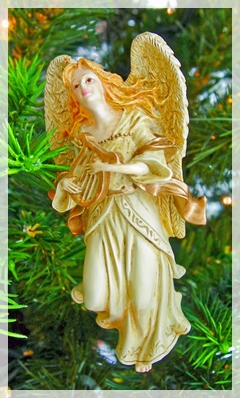 It’s no wonder that the angel Gabriel told Mary not to be afraid. Angels were not an everyday occurrence and, when they arrived, lives were changed. As God’s messengers, angels sometimes brought good news, offered protection, or comforted people, but they also brought warnings and executed God’s judgment. Although angels rescued Lot, they also warned of Sodom’s destruction! Balaam received a stern warning from a sword-bearing angel, David wrote of destroying angels, and 2 Samuel tells of an angel nearly destroying Jerusalem. Mary’s initial confusion and concern at seeing an angel is understandable. When reassuring the girl, Gabriel tells her she is “highly favored” by God; he’s not brought bad news, but good. Nevertheless, she knows her life is going to change; she just doesn’t know how!
 My Advent devotional suggested taking a prayer walk while looking for signs of hope. I took my regular route and, since I often pray while walking, I wasn’t sure how this walk would be different. Nevertheless, I went in search of hope. The first thing I noticed was the sun rising in the east—a sure sign of hope with its promise of a new day and all of its possibilities. I spotted a family of ducks waddling down to the pond. The five youngsters were no longer little yellow fluffs of feathers but mama duck still kept her eyes on them. Mothers of every species hope to keep their children safe—even when they’re no longer children! I noticed the lilies, canna, and arrowhead that had been planted at waters’ edge last spring to prevent shoreline erosion. They were starting to bear their first flowers—another sign of hope because it means they took root and will serve their purpose. A few people had decorated their houses for the holiday; since not all the décor was secular, I found hope that some people still keep Christ in Christmas. Further on, a patient great blue heron stood absolutely still, neck fully extended, hoping to catch a tasty fish breakfast. It reminded me that we must remain patient in our hope—all things in God’s time. Seeing a few wood storks wading in the water also was a hopeful sign; once an “endangered” breed, their status has been upgraded to “threatened,” meaning there is hope for the survival of their species.
 The National Retail Federation estimates that Americans will spend between 727.9 and 730.7 billion dollars on Christmas gifts and merchandise between November 1 and the end of the year. If they’re correct, we’ll have spent nearly $95 for every one of the 7.7 billion people on earth (most of whom won’t get any of those purchases). It’s ironic that a day set aside to honor the birth of Jesus, the Savior who sacrificed His life for us, has become a frenzied season of obtaining and consuming.
 I used the Lenox bone china that belonged to my mother and some of the stoneware that belonged to my husband’s grandparents at our Thanksgiving dinner. While the Lenox was special ordered from the city’s finest department store as a wedding gift in 1938, the stoneware was purchased in 1929 at the local five-and-ten-cent store. The ornate gold-rimmed Lenox is translucent and elegant; used only on special occasions, it still looks new after eighty years. The stoneware is opaque, less formal and meant for daily use; having been used every day for more than forty years, a few pieces are chipped or stained. When compared, people might think the Lenox more valuable than the stoneware, but they’d be wrong. Both are equally precious because they tell the story of generations gathering together for good food and fellowship and both sets of china served their specific purposes well.
 Devotions of the Heart