
IT’S A PROMISE!

Jenny Lake - Grand TetonsIf we are unfaithful, he remains faithful, for he cannot deny who he is. [2 Timothy 2:13 (NLT)]

When I first read the above verse in a daily meditation book, I felt reassured; even if I’m unfaithful to Jesus, He’ll remain faithful to me. Wondering if my interpretation was correct and suspecting the verse might have been taken out of context, I looked at the preceding lines: “If we die with him, we will also live with him. If we endure hardship, we will reign with him. If we deny him, he will deny us.” [2:11-12] Probably part of an early Christian hymn emphasizing the believer’s union with Christ, when put in context with, “If we are unfaithful, he remains faithful, for he cannot deny who he is,” we have a different meaning. Paul was echoing Jesus’ own words of warning: “But everyone who denies me here on earth, I will also deny before my Father in heaven.” [Matthew 10:33] Jesus cannot deny who He is; if we deny Him, He will remain faithful to His word and deny us.

But what of Peter? He denied Jesus three times and Jesus certainly didn’t deny him! Again I looked to the context: “If we die with him, we will also live with him. If we endure hardship, we will reign with him.” Rather than speaking of Christ followers who may have a temporary failing like that of Peter, Paul is speaking of those who have rejected Jesus and denied Him, as did Judas. When Peter denied knowing Jesus that night so long ago, he hadn’t stopped loving the Lord or having faith in Him. Yes, he failed Jesus but let us remember that God’s grace is greater than our human weaknesses. We all have unwavering faith until it is tested and, like Peter, we may fail when it is sorely tested. God, in His mercy forgave Peter, and He will forgive us.

Rather than words of cheer, Paul’s words are a serious warning for those who reject Jesus as Lord! Jesus can’t be false to himself. For the unbelieving and unfaithful, Christ will remain true to his word; no matter their works or virtue, if people have denied Him, He will deny them. Just as Jesus makes good on all of his promises, He’ll follow through on his threats, as well. Not so comforting a thought after all!

Since no man is excluded from calling upon God, the gate of salvation is open to all. There is nothing else to hinder us from entering, but our own unbelief. [John Calvin]

Anyone who believes and is baptized will be saved. But anyone who refuses to believe will be condemned. [Mark 16:16 (NLT)]

Everyone who acknowledges me publicly here on earth, I will also acknowledge before my Father in heaven. But everyone who denies me here on earth, I will also deny before my Father in heaven. [Matthew 10:32-33 (NLT)]

Copyright ©2020 jsjdevotions. All rights reserved.

IT’S THE THOUGHT THAT COUNTS

At the same time the Spirit also helps us in our weakness, because we don’t know how to pray for what we need. But the Spirit intercedes along with our groans that cannot be expressed in words. The one who searches our hearts knows what the Spirit has in mind. The Spirit intercedes for God’s people the way God wants him to. [Romans 8:26-27 (GW)]

sandhill craneAs a writer, I like to create with words. When writing a devotion, I carefully organize my thoughts, often cutting and pasting while moving sentences or entire paragraphs around. Supporting Bible verses are sought and various commentaries are consulted. Every word is carefully chosen (often after a synonym search). Grammar and spelling are double-checked and editing and rewriting continue right up to publication. All of that messing around with words, phrases and punctuation may be fine when putting pen to paper or fingers to keyboard, but not when praying. Prayers would never get said if they required that amount of composing, revising and polishing!

God isn’t like an editor with a blue pencil telling us to shorten a paragraph, elaborate on an idea or find a better adjective before the prayer is worthy. He’s not like a teacher with a red pencil checking off our misspellings or grammatical errors. He’s doesn’t grade our prayers or refuse to listen if we’ve ended a sentence with a preposition or split an infinitive. He’s more like a mother who reads and treasures her young child’s letter from camp with its smudges, messy printing, and misspellings. He’s just glad to hear from us.

We’ve all felt painfully inarticulate when it comes to prayer but that shouldn’t prevent us from praying. Although our words may be clumsy, being eloquent is not a requirement for prayer. The power of our prayers is not contained in words, sentence structure, or eloquence; the power of our prayers is found only in the One who hears those prayers! Fortunately, in God’s infinite mercy, He’s given us the assistance of the Holy Spirit. This Spirit, living in us, intercedes for us in our hearts and it’s that heartfelt prayer that reaches God’s ears.

Don’t be so concerned about wrapping the gift that you never give it. … Better to pray awkwardly than not at all. [Max Lucado]

Dear friends, use your most holy faith to grow. Pray with the Holy Spirit’s help. [Jude 1:20 (GW)]

Copyright ©2020 jsjdevotions. All rights reserved.

LEGACY – FATHER’S DAY 2020

And you must commit yourselves wholeheartedly to these commands that I am giving you today. Repeat them again and again to your children. Talk about them when you are at home and when you are on the road, when you are going to bed and when you are getting up. [Deuteronomy 6:6-7 (NLT)]

My husband, son, and sixteen-year old grandson were talking after dinner and reminiscing about Grandpa J, my husband’s father. A man of faith and fun, love and laughter, honesty and honor, he truly was one-of-a-kind. Having died shortly after my grand’s birth, the boy only knows his great-grandpa through photos and some wonderful stories that just seem to get better with time. The conversation gradually turned to the family business, started by Grandpa J nearly sixty-five years ago in the family’s garage. Although my grand had heard some of the stories, others were new and he listened intently.

As the men spoke, my son told his boy a story from when he first started selling for the business. He shared how he learned the importance both of taking responsibility for his mistakes and of quickly righting a wrong. The story was about integrity—doing the right thing even when it didn’t have to be done—and was a better lesson than any number of lectures on honesty and honor. Only three generations were sitting at the table, but a fourth one definitely was present. In my son’s words, I heard not just his father but also his father’s father. Sitting there, I saw Grandpa J in all of the men—their entrepreneurial spirit, humor, zest for life, and, most of all, their integrity. As I quietly listened, I thought how much Grandpa J would have loved to have been there and how proud he would have been of his legacy. Of course, if he’d been there, a game of Euchre would have been in progress!

Sunday is Father’s Day and, as I pondered what to write, I remembered that evening—how I saw Grandpa J in my husband; both Grandpa and my husband in our son; and Grandpa, my husband, and our son in the sixteen year-old grand. Grandpa J, however, wasn’t the only great-grandfather with the men that night. I heard echoes of my own father’s determination and felt his presence, too. Since he died shortly after our marriage, my husband barely knew my father and our son and grand never met him. Nevertheless, even though I’ve rarely spoken of him, without consciously doing it, something of my father has been imparted to my boys through me.

Remembering that night, I saw how each generation profoundly affects the next and the generations that follow. Fred Rogers once said, “One of the greatest dignities of humankind is that each successive generation is invested in the welfare of each new generation.” That’s a heavy responsibility and, sadly, not all of us had fathers who left an admirable legacy. Nevertheless, we all probably had men in our lives who encouraged, taught, and guided us: men who shared their wisdom and faith and exemplified integrity and honor. Let us remember to thank them, if they are still with us, and to thank God for them and their legacy. Just as we shed DNA wherever we are, we leave bits and pieces of our faith, ethics, and values on the lives of the people with whom we interact. Let us all, men and women alike, take seriously our responsibility for the development of the generations that follow and leave only good things behind in the lives of the people we touch.

If you could only sense how important you are to the lives of those you meet; how important you can be to the people you may never even dream of. There is something of yourself that you leave behind at every meeting with another person. [Fred Rogers]

Direct your children onto the right path, and when they are older, they will not leave it. [Proverbs 22:6 (NLT)]

The godly walk with integrity; blessed are their children who follow them. [Proverbs 20:7 (NLT)]

 Copyright ©2020 jsjdevotions. All rights reserved.


THE BOSS’S SON

Who, though in God’s form, did not regard his equality with God as something he [Jesus] ought to exploit. Instead, he emptied himself, and received the form of a slave, being born in the likeness of humans. And then, having human appearance, he humbled himself, and became obedient even to death, yes, even the death of the cross. [Philippians 2:6-8 (NTE)]

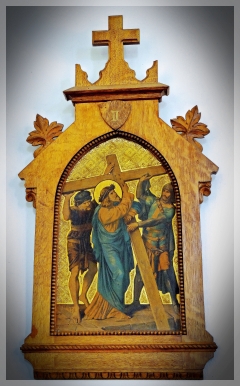
station of the cross II

My son is the third generation to run the family business. Although he is now its CEO, he didn’t begin that way. As his father had done before him, he started by sweeping floors and emptying trash.

The business expanded when my husband purchased a company in another town. With manufacturing processes that were unfamiliar, our son needed to learn new fabrication procedures and started working in the new facility. When he began, only his supervisor knew his relationship to the business’s new owner. He may have been the boss’s son but, to everyone else, he was just Jim, the new guy on the line. In his work shirt and steel-toed shoes, he looked like everyone else, kept the same hours, followed the same rules, and made the same money. What he didn’t do was pull rank or take advantage of his identity.

Although our son originally thought he could learn everything he needed by reading about it, a few days operating the machinery and getting his hands dirty told him there was nothing like first-hand experience! Now that he’s the boss, his employees recognize that he understands and appreciates the challenges they face in doing their jobs.

I tell this story to help us understand what it was like when Jesus put on human flesh and lived as a man. Clothed in work clothes, my son looked like every other hourly employee on the line. Although Jesus is often depicted with a halo, when He was clothed in human flesh, there was no halo and He looked like any other man. Instead of giving up coat and tie for overalls, Jesus gave up His immortal perfect form and took on the aches, indignities, and illnesses that come with a mortal body.

Just as my boy remained the boss’s son but gave up any status or privileges that came from that, Jesus remained God’s son but gave up the benefits that came with His divinity. Of course, Jesus gave up far more than did my son! He set aside the glory of heaven for life on earth and relinquished the divine life He had in heaven to be an itinerant rabbi in Galilee. Even though equal with His Father, Jesus chose to submit to Him as an earthly son does to his father.

Just as our boy never stopped being the boss’s son, Jesus remained fully God while fully man. Just as his co-workers didn’t know our boy’s real identity, people had trouble recognizing Jesus as God’s Son. While my son did what he did so he could learn the family business, Jesus did what He did to take away the sins of the world. Our son may have humbled himself by starting at the bottom but Jesus humbled himself by deliberately choosing to die a torturous death as a criminal on the cross!

My son knows what it means to be one of his employees and he’s a better boss because of it. Jesus knows what it’s like to be human and we are better because of that! Jesus knows what it is to hurt, be disappointed, suffer, struggle, get tired, thirst, feel hungry, bleed, hope, love and die. Because He lived as one of us, we can come to Him confidently and without fear; instead of condemnation, we will receive God’s grace and mercy!

Well, then, since we have a great high priest who has gone right through the heavens, Jesus, God’s son, let us hold on firmly to our confession of faith. For we don’t have a high priest who is unable to sympathize with our weaknesses, but one who has been tempted in every way just as we are, yet without sin. Let us then come boldly to the throne of grace, so that we may receive mercy, and may find grace to help us at the moment when we need it. [Hebrews 4:14-16 (NTE)]

Copyright ©2020 jsjdevotions. All rights reserved.

DIAMOND MINING

Some of his [Paul’s] comments are hard to understand, and those who are ignorant and unstable have twisted his letters to mean something quite different, just as they do with other parts of Scripture. And this will result in their destruction. [2 Peter 3:16 (NLT)]

butterfly weed“You have to drill through mud and water to get oil; you have to sift through sand and silt to get gold; you have to chop and hack through stone to get diamonds. So why do so many people feel that the treasure of ideas should come to them with little or no effort?” asked Sydney J. Harris. Even though he wasn’t referring to the Bible, the journalist’s words made me think of the way we often approach Scripture; complaining that it’s too hard to understand, we simply don’t study it!

If we’ll put forth effort to perfect our golf or tennis swing, train for a marathon, master chess or bridge, plant a garden, or become a gourmet cook, I wonder why we think understanding Scripture should be effortless. It’s only natural that words penned by 40 (or more) people, between 1400 BC to 90 AD, in a wide variety of genres, in another language, and shaped by different cultures and traditions, require some work to comprehend. Scripture’s words were God breathed by the One who created words and thoughts! He is greater than any novelist or journalist so we should expect His words and ideas to be more difficult to understand than theirs! But, because of the effort required to understand them, many of us don’t bother and stick to a few favorite stories, verses and Psalms.

During this sheltering in place, our church conducted an online Bible study and, after thirteen weeks of video lectures given by Biblical scholar N. T. Wright, we finally completed our study of Philippians. In some sessions, Professor Wright walked us through as few as five verses, but the way he shed light on Paul’s circumstances, the Philippians’ society and environment, the political situation of the time, the original Greek meaning of many of the words, the way Paul’s words in Philippians related to his other letters, and what the Apostle’s words meant to us, was immensely rewarding. It was like taking a beautiful old piece of heavily tarnished silver and polishing it. Before this study, I appreciated Philippians the way I might the tarnished silver piece. After studying the epistle in depth, however, the profoundness of Paul’s words were uncovered the same way silver’s true beauty is revealed when it’s polished! Polishing silver, however, takes “elbow grease” and comprehending Scripture takes effort, as well.

Admittedly, understanding Bible passages and spiritual concepts can be challenging but that shouldn’t discourage or surprise us. Even the Apostle Peter admitted the difficulty of comprehending Paul’s words! Nevertheless, the Apostle knew the importance of trying to understand Scripture to avoid being misled. Peter was concerned about teachers who claimed that Christ’s followers could still live immoral lives. Today’s false teachers may be spouting other nonsense but, without our making the effort to study Scripture, we won’t recognize their errors.

Since each Bible study on Philippians lasted about 45 minutes, we spent around 585 minutes on four chapters. That sounds like a lot of time until we consider the 52 billion-plus minutes of The Office that were streamed by Netflix users in 2018 or the 437 billion minutes spent watching NFL and college football’s regular seasons that same year.

For the last several years, I’ve devoted a part of every day to studying Scripture. I still can’t quote chapter and verse, but my life is fuller and more purposeful because of its words. It’s worth the effort because, like mining for diamonds, each time I dig deep into God’s word, another beautiful gem appears.

The book to read is not the one which thinks for you, but the one which makes you think. No book in the world equals the Bible for that. [Harper Lee]

All Scripture is inspired by God and is useful to teach us what is true and to make us realize what is wrong in our lives. It corrects us when we are wrong and teaches us to do what is right. God uses it to prepare and equip his people to do every good work. [2 Timothy 3:16-17 (NLT)]

Copyright ©2020 jsjdevotions. All rights reserved.

THE “TERRIBLE PETITION”

Blessings on the merciful! You’ll receive mercy yourselves. [Matthew 5:7 (NTE)]

Yes: if you forgive people the wrong they have done, your heavenly father will forgive you as well. But if you don’t forgive people, neither will your heavenly father forgive you what you have done wrong.’ [Matthew 6:14-15 (NTE)]

large striped swordtail butterflyWhen our pastor did a sermon series on “Dangerous Prayers,” he didn’t mention one many of us pray regularly: “Forgive us our trespasses as we forgive those who trespass against us.” After giving the disciples “The Lord’s Prayer,” Jesus elaborated on this single petition by categorically stating, “If you don’t forgive people, neither will your heavenly father forgive you what you have done wrong.”  The parable of the unforgiving debtor told in Matthew 18 leaves no room for ambiguity on this point. After the servant refuses to forgive the debt of a fellow servant, the angry king rescinds his forgiveness of the unforgiving man and sends him to be tortured in prison until the debt is paid. His debt (equivalent to several billion dollars today) was insurmountable and that torture would never end. Jesus warned his listeners that the same thing would happen to them if they withheld forgiveness.

Asking God to forgive us in the same way we extend forgiveness to others is dangerous. We are asking God to forgive us by the standard that we set—to deal with us as we deal with others! Called the “terrible petition” by St. Augustine, we’re actually asking God not to forgive us if we harbor any unforgiveness in our hearts! For some of us, could these words be a petition for condemnation rather than salvation, ones for death rather than everlasting life? If we’re unwilling to forgive, I suppose they are!

Paul’s words to the Ephesians tell us to get rid of bitterness, rage, anger, and harsh words and to “forgive one another, just as God forgave you in the king.” [4:31-32] Without a doubt, forgiveness is a difficult process and time is needed between our being hurt and our ability to forgive. The struggle to forgive, however, isn’t the sin; it’s the decision not to forgive, to hold onto our bitterness, that is!

Fortunately, forgiveness is a fruit of the Spirit! Jesus said that good trees produce good fruit and that every tree failing to produce good fruit would be cut down and burned. Clarifying that people are identified by their actions, Jesus warned that only those who actually did the will of the Father would enter the kingdom of heaven! From His words, it seems that profession of faith alone does not equal salvation. While salvation is not earned by works, our faith is evidenced by them: by our willingness to do the Father’s will! Can there be an unforgiven Christian? I don’t think so. But, if we refuse to forgive, are we true disciples of Christ or merely hypocrites who say we are?

No part of His teaching is clearer: and there are no exceptions to it. He doesn’t say that we are to forgive other people’s sins provided they are not too frightful, or provided there are extenuating circumstances, or anything or that sort. We are to forgive them all, however spiteful, however mean, however often they are repeated. If we don’t, we shall be forgiven none of our own. [C.S. Lewis]

Actually, good trees can’t produce bad fruit, nor can bad ones produce good fruit! Every tree that doesn’t produce good fruit is cut down and thrown on the fire. So: you must recognize them by their fruits. Not everyone who says to me, “Master, Master” will enter the kingdom of heaven; only people who do the will of my father in heaven. [Matthew 7:18-21 (NTE)]

Copyright ©2020 jsjdevotions. All rights reserved.