SEEING THE LIGHT

Blessed are those who fear to do wrong, but the stubborn are headed for serious trouble. [Proverbs 28:14 (NLT)]

Don’t you see how wonderfully kind, tolerant, and patient God is with you? Does this mean nothing to you? Can’t you see that his kindness is intended to turn you from your sin? But because you are stubborn and refuse to turn from your sin, you are storing up terrible punishment for yourself. For a day of anger is coming, when God’s righteous judgment will be revealed. [Romans 2:4-5 (NLT)]

Duluth MN lighthouseAn old maritime legend describes the conversation between a U.S. Naval ship and Canadian authorities off the coast of Newfoundland. The ship kept telling the Canadians to divert their course 15 degrees north to avoid a collision while the Canadians repeatedly responded with the suggestion that the Americans divert their course 15 degrees to the south. Finally, the Navy sent the following message: “This is the aircraft carrier USS Lincoln. We are accompanied by three destroyers, three cruisers and numerous support vessels. I demand that you change your course 15 degrees north or counter-measures will be undertaken to ensure the safety of this fleet.” It was only when the Canadian authorities responded, “This is a lighthouse. It’s your call,” that the American vessels stopped being so unyielding and changed their course! While this story of an aircraft carrier trying to bully a lighthouse out of its way is just fiction, it’s a lesson about stubbornness, inflexibility, and pig-headedness.

Hoping to catch Him breaching the law, Jesus’ adversaries watched Him closely. When He healed a woman who’d been crippled for eighteen years on the Sabbath, they were outraged. Healing was considered work and He’d broken the Sabbath by restoring her to health. The Pharisees were unyielding when it came to strict observance of the law—even when it made no sense. Carrying clothes out of a burning building on the Sabbath was prohibited but stopping, putting on as many as 18 garments, and wearing them out was allowed! Pointing out that the Pharisees worked on the Sabbath by untying and watering their animals, Jesus chastened the synagogue leaders for their lack of compassion on the woman. Like the aircraft carrier, they were so sure they were right, it never even occurred to them to rethink their position.

There are times we must be unyielding as a lighthouse and firmly hold our position. In fact, we specifically pray not to yield to temptation. [Luke 11:4] Things like obedience to God and our faith in Jesus are non-negotiable and may well place us in opposition with today’s world. There are times, however, when we’re more like the aircraft carrier and the Pharisees—unyielding to a fault. Like them, we’re often so sure we’re in the right that we fail to examine our course or consider the possibility that we could be in error. Perhaps it’s time to re-examine some of our positions to make sure we’re not on a collision course with God’s word. The aircraft carrier failed to see the light ahead of them just as the Pharisees failed to see the Light of World standing in front of them. Let’s not make the same mistake. If we’re headed toward a conflict, confrontation, or collision perhaps it’s time to rethink our course and surrender the controls to God!

But the wisdom from above is first of all pure. It is also peace loving, gentle at all times, and willing to yield to others. It is full of mercy and the fruit of good deeds. It shows no favoritism and is always sincere. [James 3:17 (NLT)]

Copyright ©2020 jsjdevotions. All rights reserved.

DO WE WANT THE TRUTH?

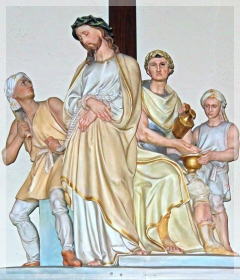
Jesus answered, “You say that I am a king. For this I was born, and for this I have come into the world, to bear witness to the truth. Every one who is of the truth hears my voice.” Pilate said to him, “What is truth?” [John 18:37-38b (RSV)]

loretto - pilate washing his hands

In the movie A Few Good Men, while being questioned in court, Colonel Jessep asks, “You want answers?” When Lt. Kaffee answers, “I want the truth!” Jessep responds, “You can’t handle the truth.” What eventually follows, while revealing the facts, is really just the colonel’s version of the truth. So, what exactly is truth?

The question of truth has fascinated philosophers for centuries. We know that truth isn’t falsehood or lies but defining it is harder, especially since some people believe truth can be subjective: truth is what things seem to be, involves preference and opinion, can be arrived at by consensus, or that no ultimate standards exist. We’ve all heard of alternative facts and know that even the most accurate statistics can be manipulated, massaged, and misstated to say just about anything. Tyler Vigen illustrated that by finding correlations between totally unrelated things such as a 99.26% correlation between the divorce rate in Maine and the per capita consumption of margarine and a 98.51% correlation between total arcade revenue and the number of computer science doctorates awarded each year in the U.S.

Truth in Scripture, however, is absolute. Pastor John MacArthur explains that, “Truth is that which is consistent with the mind, will, character, glory, and being of God….Truth is the self-expression of God.” Since truth is related to the character of God, something eternal and unchanging, the nature of truth is fixed. It has no expiration date and, unlike a computer program, it’s not up for revision, correction or updating. Author Josh McDowell defines truth as, “That which is true at all times in all places for all people.”

Pilate asked Jesus, “What is truth?” Wouldn’t you love to have heard His answer to this profound question? Pilate, however, never waited for an answer because his was just a rhetorical question. Pilate didn’t care about the truth once he knew Jesus hadn’t incited rebellion against Rome. Wanting to do the expedient thing, he went back outside to tell the people that Jesus wasn’t guilty of a crime. Thinking the crowd that had welcomed Jesus’ arrival less than a week earlier would call for His release, the governor offered to free Him. Pilate ended up trading the life of the man he’d already found innocent for that of Barabbas, an insurrectionist and murderer! The truth was swapped for a lie!

In Latin, Pilate’s question would have been, “Quid est veritas?” Samuel Johnson, one of the greatest literary figures of the 18th century, made an anagram of Pilate’s question and came up with the answer: “Est vir qui adest,” meaning, “It is the man before you!” Indeed, truth stood right in front of Pilate and he never recognized it.

Perhaps, instead of asking Jesus what truth was, Pilate would have been better served to have asked Jesus who truth was!

Jesus said to him, “I am the way, and the truth, and the life; no one comes to the Father, but by me. [John 14:6 (RSV)]

Jesus then said to the Jews who had believed in him, “If you continue in my word, you are truly my disciples, and you will know the truth, and the truth will make you free.” [John 8:31-32 (RSV)]

Copyright ©2020 jsjdevotions. All rights reserved.

HE EXISTS

Then God looked over all he had made, and he saw that it was very good! And evening passed and morning came, marking the sixth day. [Genesis 1:31 (NLT)]

The Lord is good to everyone. He showers compassion on all his creation. [Psalm 145:9 (NLT)]

tri-colored heronPeople often argue against God’s existence because of evil and suffering. With so much that is wrong in the world, they question how there could there be a god. Christian apologist C.S. Lewis was once an atheist who reasoned that such a cruel and unjust world proved the absence of God until he questioned where he got the idea of what was good or evil, just or unjust. He realized that something cannot be wrong or evil unless there is standard for what is right or good. In a universe with no God, there would be no standard for justice or injustice, good or evil, right or wrong: simply personal preferences. That standard, Lewis realized, is rooted in God. As a result, the very argument he used against God’s existence provided Lewis with proof of His presence!

Nevertheless, acceptance of God’s existence in a world with evil leads people to question how this loving God of ours could allow so much of it in the world. Unable to see how a loving, good and powerful God can coexist in world so filled with pain and suffering, people often ascribe any evil that befalls to God but none of the good. Granted, bad things happen but, if they’re used as evidence against a good God, then all of the good things that occur must be considered as evidence for Him!

The preponderance of the evidence tells us that there are more years of rain than drought, more harvests than famine, more fair weather days than hurricanes, more love than hate, and pandemics are not a regular occurrence. On a more personal level, I’ve encountered evil, injury and pain and, if I were asked to make a list of the suffering in my life, I could. But, if asked to record the good things I’ve experienced, I couldn’t—simply because there would be far too many to list! I’ve avoided more accidents than I’ve been in, favorable circumstances have aligned more often than not, more good people than bad have touched my life, my joys outweigh my sorrows, and God has accompanied me through every dark valley I’ve traversed. Moreover, I’d probably have to cross off most (or all) of the items on the list of bad things because God redeemed them by bringing good out of the pain and suffering.

When life feels anything but good, it’s easier to focus on evil and suffering than to remember that God is good. Yes, we live in a fallen world but it’s not the world God intended; our good God did not create evil and suffering. When man chose to disobey in Eden, both moral and natural evil entered into what was a perfect world. God may allow evil but it is our free will that has made it possible. We can’t hold God responsible for our mistakes.

Non-believers and believers alike wrestle with how a good loving God can allow the presence of evil and suffering. Nevertheless, the existence of suffering doesn’t negate God. In fact, it is God’s existence that gives meaning to our pain and suffering! We’ll never fully understand it. Nevertheless, when I think about those two lists and all that God has done for me, I know that God exists and that He is good!

God judged it better to bring good out of evil than to suffer no evil to exist. [Saint Augustine]

For this is how God loved the world: He gave his one and only Son, so that everyone who believes in him will not perish but have eternal life. [John 3:16 (NLT)]

Whatever is good and perfect is a gift coming down to us from God our Father, who created all the lights in the heavens. He never changes or casts a shifting shadow. [James 1:17 (NLT)]

Copyright ©2020 jsjdevotions. All rights reserved.

IT’S A PROMISE!

Jenny Lake - Grand TetonsIf we are unfaithful, he remains faithful, for he cannot deny who he is. [2 Timothy 2:13 (NLT)]

When I first read the above verse in a daily meditation book, I felt reassured; even if I’m unfaithful to Jesus, He’ll remain faithful to me. Wondering if my interpretation was correct and suspecting the verse might have been taken out of context, I looked at the preceding lines: “If we die with him, we will also live with him. If we endure hardship, we will reign with him. If we deny him, he will deny us.” [2:11-12] Probably part of an early Christian hymn emphasizing the believer’s union with Christ, when put in context with, “If we are unfaithful, he remains faithful, for he cannot deny who he is,” we have a different meaning. Paul was echoing Jesus’ own words of warning: “But everyone who denies me here on earth, I will also deny before my Father in heaven.” [Matthew 10:33] Jesus cannot deny who He is; if we deny Him, He will remain faithful to His word and deny us.

But what of Peter? He denied Jesus three times and Jesus certainly didn’t deny him! Again I looked to the context: “If we die with him, we will also live with him. If we endure hardship, we will reign with him.” Rather than speaking of Christ followers who may have a temporary failing like that of Peter, Paul is speaking of those who have rejected Jesus and denied Him, as did Judas. When Peter denied knowing Jesus that night so long ago, he hadn’t stopped loving the Lord or having faith in Him. Yes, he failed Jesus but let us remember that God’s grace is greater than our human weaknesses. We all have unwavering faith until it is tested and, like Peter, we may fail when it is sorely tested. God, in His mercy forgave Peter, and He will forgive us.

Rather than words of cheer, Paul’s words are a serious warning for those who reject Jesus as Lord! Jesus can’t be false to himself. For the unbelieving and unfaithful, Christ will remain true to his word; no matter their works or virtue, if people have denied Him, He will deny them. Just as Jesus makes good on all of his promises, He’ll follow through on his threats, as well. Not so comforting a thought after all!

Since no man is excluded from calling upon God, the gate of salvation is open to all. There is nothing else to hinder us from entering, but our own unbelief. [John Calvin]

Anyone who believes and is baptized will be saved. But anyone who refuses to believe will be condemned. [Mark 16:16 (NLT)]

Everyone who acknowledges me publicly here on earth, I will also acknowledge before my Father in heaven. But everyone who denies me here on earth, I will also deny before my Father in heaven. [Matthew 10:32-33 (NLT)]

Copyright ©2020 jsjdevotions. All rights reserved.

IT’S THE THOUGHT THAT COUNTS

At the same time the Spirit also helps us in our weakness, because we don’t know how to pray for what we need. But the Spirit intercedes along with our groans that cannot be expressed in words. The one who searches our hearts knows what the Spirit has in mind. The Spirit intercedes for God’s people the way God wants him to. [Romans 8:26-27 (GW)]

sandhill craneAs a writer, I like to create with words. When writing a devotion, I carefully organize my thoughts, often cutting and pasting while moving sentences or entire paragraphs around. Supporting Bible verses are sought and various commentaries are consulted. Every word is carefully chosen (often after a synonym search). Grammar and spelling are double-checked and editing and rewriting continue right up to publication. All of that messing around with words, phrases and punctuation may be fine when putting pen to paper or fingers to keyboard, but not when praying. Prayers would never get said if they required that amount of composing, revising and polishing!

God isn’t like an editor with a blue pencil telling us to shorten a paragraph, elaborate on an idea or find a better adjective before the prayer is worthy. He’s not like a teacher with a red pencil checking off our misspellings or grammatical errors. He’s doesn’t grade our prayers or refuse to listen if we’ve ended a sentence with a preposition or split an infinitive. He’s more like a mother who reads and treasures her young child’s letter from camp with its smudges, messy printing, and misspellings. He’s just glad to hear from us.

We’ve all felt painfully inarticulate when it comes to prayer but that shouldn’t prevent us from praying. Although our words may be clumsy, being eloquent is not a requirement for prayer. The power of our prayers is not contained in words, sentence structure, or eloquence; the power of our prayers is found only in the One who hears those prayers! Fortunately, in God’s infinite mercy, He’s given us the assistance of the Holy Spirit. This Spirit, living in us, intercedes for us in our hearts and it’s that heartfelt prayer that reaches God’s ears.

Don’t be so concerned about wrapping the gift that you never give it. … Better to pray awkwardly than not at all. [Max Lucado]

Dear friends, use your most holy faith to grow. Pray with the Holy Spirit’s help. [Jude 1:20 (GW)]

Copyright ©2020 jsjdevotions. All rights reserved.

LEGACY – FATHER’S DAY 2020

And you must commit yourselves wholeheartedly to these commands that I am giving you today. Repeat them again and again to your children. Talk about them when you are at home and when you are on the road, when you are going to bed and when you are getting up. [Deuteronomy 6:6-7 (NLT)]

My husband, son, and sixteen-year old grandson were talking after dinner and reminiscing about Grandpa J, my husband’s father. A man of faith and fun, love and laughter, honesty and honor, he truly was one-of-a-kind. Having died shortly after my grand’s birth, the boy only knows his great-grandpa through photos and some wonderful stories that just seem to get better with time. The conversation gradually turned to the family business, started by Grandpa J nearly sixty-five years ago in the family’s garage. Although my grand had heard some of the stories, others were new and he listened intently.

As the men spoke, my son told his boy a story from when he first started selling for the business. He shared how he learned the importance both of taking responsibility for his mistakes and of quickly righting a wrong. The story was about integrity—doing the right thing even when it didn’t have to be done—and was a better lesson than any number of lectures on honesty and honor. Only three generations were sitting at the table, but a fourth one definitely was present. In my son’s words, I heard not just his father but also his father’s father. Sitting there, I saw Grandpa J in all of the men—their entrepreneurial spirit, humor, zest for life, and, most of all, their integrity. As I quietly listened, I thought how much Grandpa J would have loved to have been there and how proud he would have been of his legacy. Of course, if he’d been there, a game of Euchre would have been in progress!

Sunday is Father’s Day and, as I pondered what to write, I remembered that evening—how I saw Grandpa J in my husband; both Grandpa and my husband in our son; and Grandpa, my husband, and our son in the sixteen year-old grand. Grandpa J, however, wasn’t the only great-grandfather with the men that night. I heard echoes of my own father’s determination and felt his presence, too. Since he died shortly after our marriage, my husband barely knew my father and our son and grand never met him. Nevertheless, even though I’ve rarely spoken of him, without consciously doing it, something of my father has been imparted to my boys through me.

Remembering that night, I saw how each generation profoundly affects the next and the generations that follow. Fred Rogers once said, “One of the greatest dignities of humankind is that each successive generation is invested in the welfare of each new generation.” That’s a heavy responsibility and, sadly, not all of us had fathers who left an admirable legacy. Nevertheless, we all probably had men in our lives who encouraged, taught, and guided us: men who shared their wisdom and faith and exemplified integrity and honor. Let us remember to thank them, if they are still with us, and to thank God for them and their legacy. Just as we shed DNA wherever we are, we leave bits and pieces of our faith, ethics, and values on the lives of the people with whom we interact. Let us all, men and women alike, take seriously our responsibility for the development of the generations that follow and leave only good things behind in the lives of the people we touch.

If you could only sense how important you are to the lives of those you meet; how important you can be to the people you may never even dream of. There is something of yourself that you leave behind at every meeting with another person. [Fred Rogers]

Direct your children onto the right path, and when they are older, they will not leave it. [Proverbs 22:6 (NLT)]

The godly walk with integrity; blessed are their children who follow them. [Proverbs 20:7 (NLT)]

 Copyright ©2020 jsjdevotions. All rights reserved.