LIVING WATER

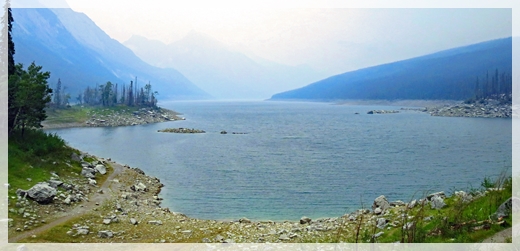
Medicine LakeJesus replied, “If you only knew the gift God has for you and who you are speaking to, you would ask me, and I would give you living water. … But those who drink the water I give will never be thirsty again. It becomes a fresh, bubbling spring within them, giving them eternal life.” [John 4:10,14 (NLT)]

When in Canada last summer, we came across a strange body of water called Medicine Lake; although it looks like a lake, it really isn’t. It’s where the Maligne River backs up before disappearing into several underground pipelines. The cave system draining this river is one of the most extensive in the world. Every spring, the runoff from melting glaciers and snow fills the river with water much faster than it can drain and, as the water backs up, the river becomes a lake. As the summer progresses, the inflow slows and the water level gradually lowers until, in autumn, it once again looks like a river. The disappearing water resurfaces far away in lakes and rivers throughout the Canadian Rockies and eventually ends up in the Pacific Ocean. Medicine Lake is like a bathtub without a stopper that is being filled faster than it can drain; once the faucet’s flow slows down, the tub’s water level lowers but it never quite empties.

On the other hand, the bogs near our northern home are more like bathtubs with drains so gunked up from hair, soap and other yucky stuff that the water can’t empty. Typically, rain and snow are the only source of a bog’s water. Formed when a lake fills with debris, a bog has little or no drainage and the water that enters it stays there. Without movement, the bog’s water becomes stagnant, gets a foul odor, and can become a breeding ground for insects, bacteria, parasites and disease. Thinking of these two bodies of water, I wondered if I’m like Medicine Lake or a bog. Like the lake, do I spread God’s blessings or, like the bog, do I keep them all to myself? The water that feeds both starts clear and fresh, but only water that flows (as it does in the lake) remains that way.

Jesus said He gives us living water, the Holy Spirit, so that we’ll never thirst again. For the water to remain fresh and sweet, however, we can’t allow it to become stagnant; it must flow in and through us and, like the water from Medicine Lake, spread far and wide. Like those underground streams, we must be His pipelines, not just of our blessings, but of the fruit of the Holy Spirit. Only when Jesus’ living water pours through us can we bring life to the world. Are we stagnant cisterns or flowing pipelines with rivers of living water flowing from our hearts?

Jesus stood and shouted to the crowds, “Anyone who is thirsty may come to me! Anyone who believes in me may come and drink! For the Scriptures declare, ‘Rivers of living water will flow from his heart.’” (When he said “living water,” he was speaking of the Spirit, who would be given to everyone believing in him. [John 7:37-39a (NLT)]

The Lord will guide you continually, giving you water when you are dry and restoring your strength. You will be like a well-watered garden, like an ever-flowing spring. [Isaiah 58:11 (NLT)]

Copyright ©2018 jsjdevotions. All rights reserved.

MEMORY WORK REDUX

Whenever you fast, don’t be sad-faced like the hypocrites. For they make their faces unattractive so their fasting is obvious to people. I assure you: They’ve got their reward! But when you fast, put oil on your head, and wash your face, so that you don’t show your fasting to people but to your Father who is in secret. [Matthew 6:16-18a (HCSB)]

sunflowerA young pastor friend admits to not being good at reciting Bible verses from memory. A product of the computer/Internet age, he just taps in a key word or topic and, almost instantly, the verses are right in front of him in whatever translation he wants. There’s no need to memorize verses when, with just a few keystrokes, the words appear. I may read the Bible every day and predate the age of computers but I’m no better at knowing verses by heart than he. If I  remember my passwords for both computer and Internet, I can find whatever verses I need. While that works when I’m researching or writing, my desk is not where most witnessing opportunities occur. I could plead age as an excuse but I didn’t memorize Bible verses even when my brain was younger and possessed far less useless trivia than it does now. My pastor friend and I both profess to love God’s word and yet we don’t seem to love it enough to learn it by heart.

For decades, I have given up some thing or things for Lent, often sweets and alcohol. I know those minor denials have nothing to do with my salvation or righteousness. They are just a way to remind me Christ’s difficult days in the wilderness and what God gave up when He sacrificed His only son for my sins. Although Jesus told his followers that fasting should be private, I often found myself needing to explain my refusal to partake in the host’s decadent dessert or the great bottle of wine he purchased in Napa. I also admit to occasionally feeling a sense of self-righteous pride when I denied myself chocolate chip cookies or a glass of pinot noir. Since self-denial should be private and never lead to self-righteousness, God and I decided to rethink my Lenten practices.

Last June, in a devotion called “Memory Work,” I wrote about four-year old Tanner Hemness who memorized a Bible verse for every letter of the alphabet. At that time, I downloaded the twenty-six verses he memorized with the intention of doing the same thing. Somehow, my good intention got side-tracked and I stopped after “Ask and it will be given to you; seek and you will find; knock and the door will be opened to you.” [Matthew 7:7]

Rather than a season of fasting, this Lent will be my season of growth. There will be no need to worry about looking sad or explaining why I won’t eat someone’s homemade pie. Rather than a period of self-denial, it will be one of self-discipline. If four-year old Tanner could memorize those twenty-six verses in seven months, even with my neuron-challenged brain, I should be able to do it in the forty-six days between Ash Wednesday and Easter. After all, I’ve already learned one! We are to put God’s word to work in our lives and the first place to start is by putting His word into our hearts. God’s word in my heart can only put a smile on my face and His promises on my lips.

Bible memorization is absolutely fundamental to spiritual formation. If I had to choose between all the disciplines of the spiritual life, I would choose Bible memorization, because it is a fundamental way of filling our minds with what it needs. This book of the law shall not depart out of your mouth. That’s where you need it! How does it get in your mouth? Memorization. [Dallas Willard]

This book of instruction must not depart from your mouth; you are to recite it day and night so that you may carefully observe everything written in it. For then you will prosper and succeed in whatever you do. [Joshua 1:8 (HCSB)]

I have your decrees as a heritage forever; indeed, they are the joy of my heart. [Psalm 119:111 (HCSB)]

Copyright ©2018 jsjdevotions. All rights reserved.

LEAVE THEM WANTING MORE 

And if someone asks about your hope as a believer, always be ready to explain it. But do this in a gentle and respectful way. [1 Peter 3: 15b-16a (NLT)]

dubble tulipHaving heard that I write Christian devotions, the man looked across the dinner table and asked, “Have you always been religious?” The unexpected question from a Jewish man I barely knew caught me off guard. While I knew he wasn’t asking for a long salvation story, I needed to answer his simple question. I faltered through a brief explanation that I couldn’t remember a time I didn’t consider myself a Christian but that my faith grew deeper as it carried me through some really rough spots in life. Having no idea where I’d go from there, I heaved a sigh of relief when the table’s conversation moved to another topic.

Describing our salvation experience was one of the topics this past week in our small group. There will be times, as there was at that dinner, when we’re given a brief opening to tell it and we’d best be prepared with a good but short answer. It was suggested that we keep our first answer to 100 words or less. In actuality, the shorter the answer, the more likely there will be a follow-up question later. As P.T. Barnum said: “Always leave them wanting more.”

When we ask someone, “How are you?” unless we’re a nurse or physician, we’re probably not interested in a detailed accounting of blood sugar, weight, bowel movements or blood pressure. When a non-believer asks about our faith, they’re not looking for a dissertation about the historical accuracy of the Bible, a sermon about salvation, or a blow by blow account of a faith journey that has probably taken years. They certainly don’t want to hear Christian buzz words like justification, conviction, propitiation, and sanctification or about the time God spoke to us in the grocery store.

When someone asks a simple and straightforward question about our faith, they expect a simple and straightforward answer. If someone is really interested in learning more, there will be additional opportunities to share the particulars. In actuality, for many of us, our salvation story is rather ordinary—we weren’t healed supernaturally, there were no burning bushes, the sky didn’t open, and a voice from heaven was not heard. Nevertheless, our lives changed. Unless we’ve thought about how to succinctly communicate that change, we may blow an amazing opportunity to share a little of God’s amazing grace. That time at the dinner party, I wasn’t well prepared; next time, I will be!

Jesus summarized the Ten Commandments into less than twenty-five words and Stephen managed to summarize the entire Old Testament into about 74 sentences for the High Council.  With a little effort, we should be able to put our faith story into 100 words. What’s your story? Can you tell it in 100 words or less?

So never be ashamed to tell others about our Lord. [2 Timothy 1:8a (NLT)]

Copyright ©2018 jsjdevotions. All rights reserved.

SEALING THE DEAL

A few days later Felix came back with his wife, Drusilla, who was Jewish. Sending for Paul, they listened as he told them about faith in Christ Jesus. As he reasoned with them about righteousness and self-control and the coming day of judgment, Felix became frightened. “Go away for now,” he replied. “When it is more convenient, I’ll call for you again.” [Acts 13:50-51 (NLT)]

Steamboat ski areaWhile under arrest in Caesarea, the Apostle Paul spent two years sharing Jesus with Felix, the governor. Nevertheless, after two years of testifying about salvation through Christ, Paul couldn’t seal the deal and Felix never came to believe. I’m reminded of a charming salesman who worked for a friend of ours. Although he diligently went out and made sales calls, no matter how many times he called on a potential client, he couldn’t close a deal! Eventually, as nice as he was, he had to be let go. After all, salesmen are expected to make the sale. Fortunately, God doesn’t work that way; if He did, the Apostle Paul might have been out of a job after failing to seal the deal with Felix!

Like Paul, we can repeatedly share our testimony with someone—we can teach Sunday school, invite people to church, talk about Jesus to everyone we meet, and even write Christian devotions. Nevertheless, we might never close the deal and hear someone say, “I’m accepting Jesus Christ as my Lord and Savior.” That, however, does not mean we have failed.

In my son’s first job out of college, he worked with a team of engineers selling cogeneration technology. Prior to his employment, the engineers from his company would meet with a potential customer to show them the benefits of their technology but they just couldn’t close a deal. It was not until my son joined the team that they made a sale. Rather than engineering, my son’s specialty was finance. The people making the final decision about purchase weren’t the engineers—they were the financial officers. Engineers talked combustion, turbines, power ratings and reciprocating engines which meant nothing to them but my son talked their language: percentages, return on investment and profits. Although my son closed the deal with his talk of financial advantages, he couldn’t have done it without the engineers who laid the groundwork by explaining the process.

Evangelism, like sales, is often a team effort; we may not be the ones who close the deal but we all must do our part to make the sale! While some may hear the message and respond immediately, committing to Jesus is a gradual process for many others. If we think we have to seal the deal every time we have a Jesus conversation, we’re going to be very disappointed Christians. That, however, doesn’t mean we stop having those conversations. Whether we’re just laying the ground work, explaining the process, or extolling the advantages, we may never know if our words have moved someone just a little closer to accepting Christ.  It may be someone else’s job to seal the deal; our job is just to keep sharing God’s Word!

For “Everyone who calls on the name of the Lord will be saved.” But how can they call on him to save them unless they believe in him? And how can they believe in him if they have never heard about him? And how can they hear about him unless someone tells them? [Romans 10:13-14 (NLT)]

Copyright ©2018 jsjdevotions. All rights reserved.

THY WILL BE DONE

Thy will be done, On earth as it is in heaven. [Matthew 6:10b (RSV)]

zinniaIn our house, we have an unwritten agreement to accept each other’s choices when it comes to giving. God had laid it on my heart to help a young family in our church through some difficult financial times. When I told my husband I’d written a generous check to them, he said I didn’t need to ask him. “I wasn’t asking,” I replied, adding that I hoped he was in agreement with me. Although that check was not dependent upon my husband’s authorization or approval, I still wanted him on board with my decision to write it.

I thought of our exchange while praying, “Thy will be done.” I’d mistakenly thought I was merely consenting to or accepting God’s will with those words. God, however, certainly doesn’t need my agreement for His will to be done any more than I needed my husband’s permission to write that check. God is all-powerful and whatever He wants to do, He easily can do without my prayers, input or approval. Why then then did Jesus tell us to pray those words?

“Thy will be done”—are they simply words of resignation and surrender? While that sentence is one of humble submission, I think there is much more to it. We’re asking God to reveal His will and praying for the obedience, wisdom, guidance, and means to accomplish it. We’re asking God to reassure us so that we can trust Him and go about achieving His purpose in eagerness and joy. We’re not offering a prayer to authorize or strengthen Him; we’re praying that He will strengthen and empower us. With those words, we’re thanking God for knowing what is best for each and every one of us.

In our daily walk, we have a choice. God can drag us along (much I had to drag the dog into the vet’s office) or we can eagerly follow Him. Either way, whether we’re kicking and screaming or moving enthusiastically, God’s will shall be done. Nevertheless, in praying, “Thy will be done,” we fully commit our hearts to that will. It’s saying, “Here I am, Lord. Put on my armor, send me into battle and keep me strong in the enemy’s attack!” Heavenly Father, thy will be done!

Prayer is not so much the means whereby God’s will is bent to man’s desires, as it is that whereby man’s will is bent to God’s desires. [Charles Bent]

And he said to all, “If any man would come after me, let him deny himself and take up his cross daily and follow me.” [Luke 9:23 (RSV)]

Copyright ©2018 jsjdevotions. All rights reserved.

GIVING THANKS

Make thankfulness your sacrifice to God, and keep the vows you made to the Most High. … But giving thanks is a sacrifice that truly honors me. If you keep to my path, I will reveal to you the salvation of God. [Psalm 50:14,23 (NLT)]

It’s one thing to be grateful. It’s another to give thanks. Gratitude is what you feel. Thanksgiving is what you do. [Tim Keller]

Black-crowned night heronYesterday I happened upon a wood stork enjoying a fish breakfast. I was astonished as the stork swallowed the whole wriggling fish in one big gulp. “I’ll have to put that in my gratitude journal,” I thought as I walked on. Later, I spotted two woodpeckers hammering away at a tree and got up close and personal with a pond snail laying eggs. Two more for the journal, I thought. Did I put those little blessings in my journal last night? Shamefully, I forgot to write in it at all; worse, I totally forgot about them in my nightly prayers!

When I look back at the rest of yesterday, all sorts of wonderful little things happened for which I was grateful and yet failed to thank God. Without having one red light, I got to an appointment with time enough to take a short walk on the beach. I’m not self-centered enough to think God turned all those lights green just for me; nevertheless, my day went better because of it and it deserved thanks. I met a delightful young couple at cooking class. Did God put them there just for me? I don’t know, but I was thankful to have them as cooking partners for the afternoon. There was a beautiful cooling breeze and the sunset was magnificent. Did God arrange the weather to my wishes? I doubt it, but I should have told Him how much I appreciated it! I was remiss in acknowledging God’s presence or thanking him for the day’s numerous small blessings.

Today, I set out again and spotted a black-crowned night heron hiding in the bushes. While getting a photo, I thought, “I’ll have to put that in my gratitude journal.” This time, however, that small voice reminded me how lackadaisical I’ve gotten with my journal and asked me why I was waiting to thank the creator of all those beautiful moments. That gave me pause. If I’d been walking with someone else, I would have shared those sightings. Although I wasn’t walking with another person, I was walking with God. Why wasn’t I talking to Him? Why wasn’t I sharing my joy with the one who gave it to me? God was right beside me and He shouldn’t have to wait until I get around to thanking him or writing in my journal, especially since I’m not good about remembering to do so. Thanks should be speedy and sincere.

We thank God through our prayer. We don’t need church, a table blessing or a gratitude journal to do so. We certainly don’t need to wait until our regular prayer time to offer thanks and, most especially, we shouldn’t wait until November for Thanksgiving Day! Our whole day, every day, should consist of a prayer of thanksgiving. God is with us as we take our daily walk; let us remember to thank him for the joy we find along with way.

We need to discover all over again that worship is natural to the Christian, as it was to the godly Israelites who wrote the psalms, and that the habit of celebrating the greatness and graciousness of God yields an endless flow of thankfulness, joy, and zeal. [J.I. Packer]

And give thanks for everything to God the Father in the name of our Lord Jesus Christ. [Ephesians 5:20 (NLT)]

 Give thanks to the Lord, for he is good! His faithful love endures forever. [1 Chronicles 16:34 (NLT)]

Copyright ©2018 jsjdevotions. All rights reserved.